Models
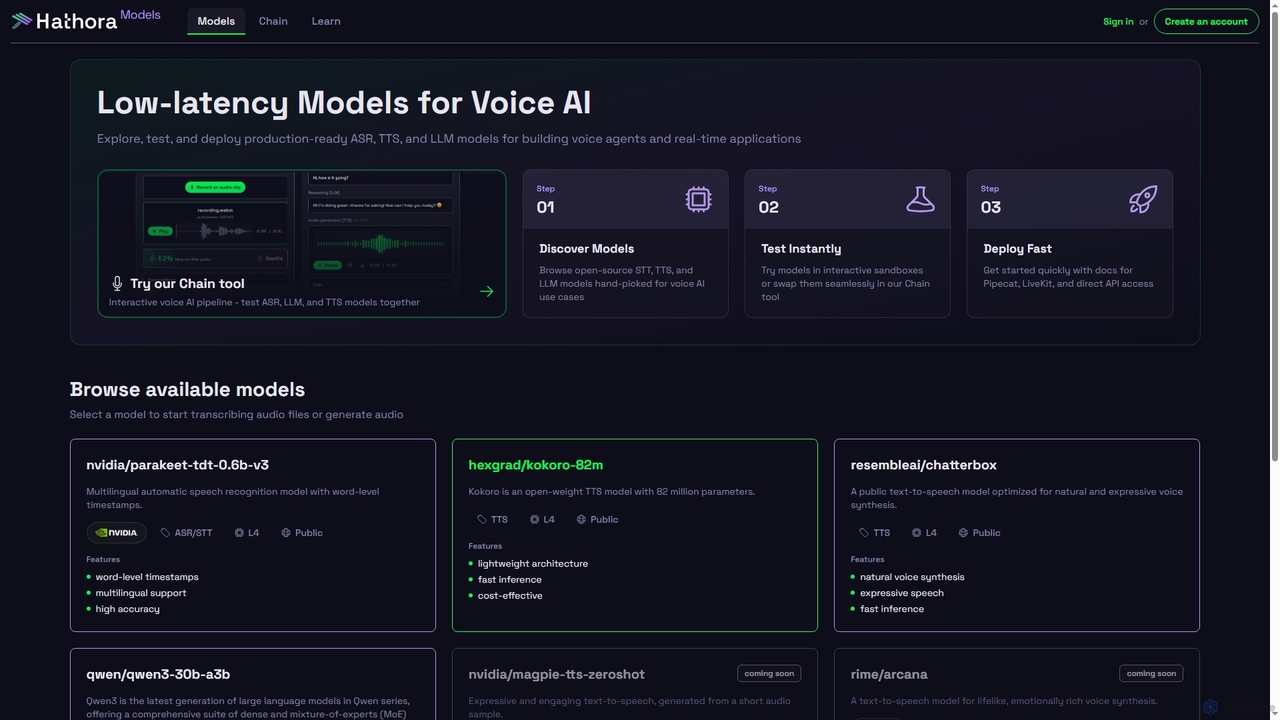
Models by Hathora offers a curated catalog of low-latency ASR, TTS, and LLM models optimized for voice AI …
Models by Hathora offers a curated catalog of low-latency ASR, TTS, and LLM models optimized for voice AI and real-time applications. Developers can explore, test, and deploy production-ready models quickly, featuring interactive sandboxes and direct API access for seamless integration into voice agents and other applications.
About Voice Ai
Voice AI tools are AI-powered applications that enable machines to understand, process, and generate human speech. Leveraging advanced natural language processing and machine learning, these tools transform spoken language into actionable data or synthesize realistic human voices. They enhance human-computer interaction, automate communication tasks, and create immersive audio experiences across various industries.
Core Features
- Speech Recognition (ASR): Converts spoken language into text, enabling voice commands and transcription.
- Text-to-Speech (TTS): Synthesizes written text into natural-sounding human speech in various voices and languages.
- Natural Language Understanding (NLU): Interprets the meaning and intent behind spoken words, facilitating intelligent responses.
- Voice Biometrics: Identifies or verifies individuals based on their unique voice characteristics for security and personalization.
- Voice Cloning/Synthesis: Creates highly realistic and personalized synthetic voices from minimal audio samples.
Use Cases
Voice AI finds extensive application in customer service for automated call routing and virtual assistants, in content creation for generating audiobooks and podcasts, and in accessibility tools for individuals with visual impairments. It also powers smart home devices, voice-controlled applications, and real-time translation services, making technology more intuitive and inclusive.
How to Choose
When selecting Voice AI tools, consider the accuracy of speech recognition, the naturalness and variety of text-to-speech voices, and the supported languages. Evaluate integration capabilities with existing systems, scalability for your needs, and data privacy measures. Additionally, assess the ease of use, customization options for voice parameters, and the pricing model based on usage or features.

Voice AiUse Cases
Automate Customer Service with AI Voicebots
Customer service departments can deploy Voice AI-powered chatbots to handle routine inquiries, provide instant answers, and route complex issues to human agents. This reduces call wait times, improves customer satisfaction, and frees up human agents to focus on more critical tasks, significantly enhancing operational efficiency.
Generate Audiobooks and Podcasts from Text
Content creators, publishers, and educators can leverage Text-to-Speech (TTS) Voice AI to convert written articles, e-books, or scripts into natural-sounding audio content. This expands content reach to auditory learners, creates accessible versions for visually impaired individuals, and enables efficient production of audiobooks, podcasts, and voiceovers without hiring voice actors.
Enable Voice Control for Smart Devices
Device manufacturers and smart home developers integrate Voice AI for intuitive, hands-free control of appliances, lighting, and entertainment systems. Users can issue voice commands to play music, adjust thermostats, or set alarms, enhancing convenience and accessibility for daily living. This creates a seamless and natural interaction experience within connected environments.
Facilitate Real-time Spoken Language Translation
Travelers, international business professionals, and conference organizers utilize Voice AI for instant, bidirectional translation of spoken conversations. This breaks down language barriers in real-time, enabling seamless communication across different linguistic backgrounds. It supports global collaboration and personal interactions by converting speech from one language to another almost instantaneously.
Enhance Security with Voice Biometric Authentication
Financial institutions, call centers, and secure access systems employ Voice AI for biometric authentication. Users can verify their identity simply by speaking, replacing traditional passwords or PINs. This adds a layer of security, reduces fraud, and streamlines the authentication process, offering a more convenient and robust security solution.
Develop Personalized AI Virtual Assistants
Businesses and individuals can create highly personalized virtual assistants that understand specific user preferences and contexts. These assistants can manage schedules, provide tailored information, and execute tasks based on individual voice commands and learned behaviors, offering a more intuitive and efficient personal or professional support system.