AIStoryBuilders
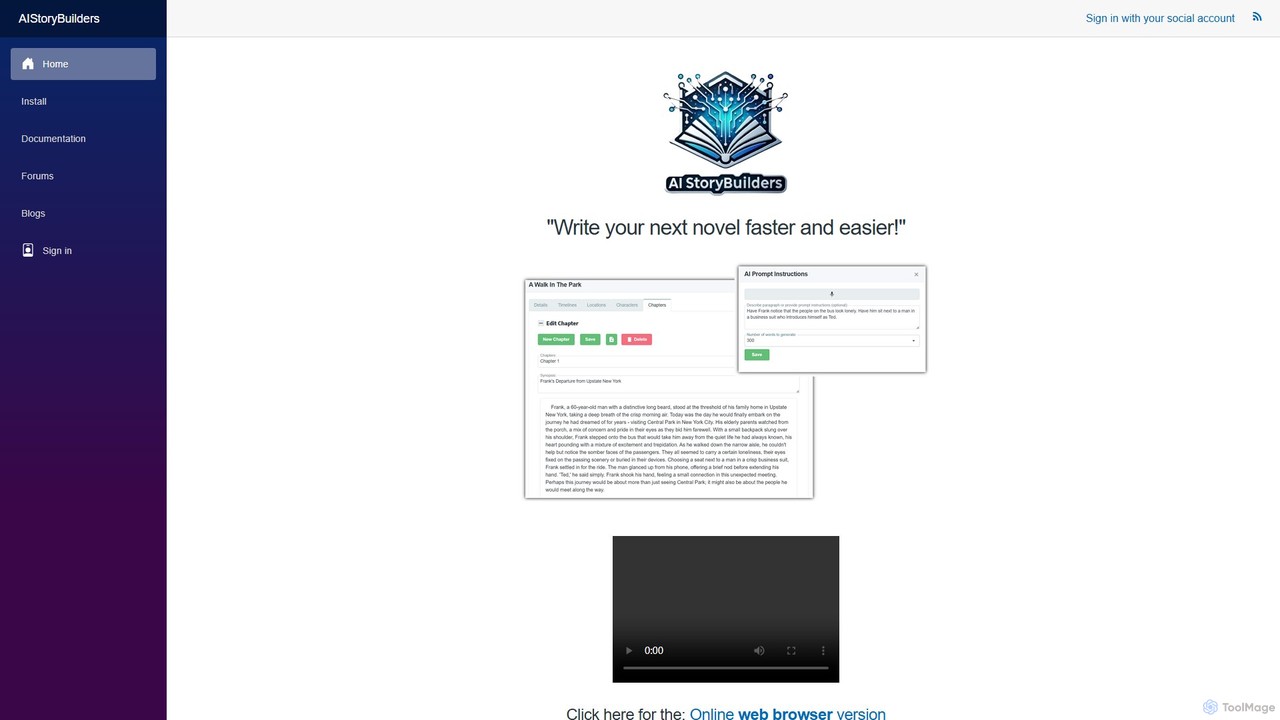
AIStoryBuilders is a specialized AI writing tool for novelists and storytellers. It uses a unique database system for …
AIStoryBuilders is a specialized AI writing tool for novelists and storytellers. It uses a unique database system for characters, locations, and timelines to ensure contextual consistency in long-form narratives. Available as a web app and a Windows program, it connects to your OpenAI or Azure API key, offering a cost-effective way to write novels faster, overcome writer's block, and manage complex story structures.

Talers
Talers is an elegant, modern, and collaborative writing application designed for novelists, screenwriters, and academics. It combines project-based …
Talers is an elegant, modern, and collaborative writing application designed for novelists, screenwriters, and academics. It combines project-based organization with powerful AI features like sentence rephrasing, document translation, and advanced grammar checking. With a focus on productivity, privacy, and a distraction-free experience, Talers synchronizes across all devices and works offline, making it a powerful alternative to Google Docs and Scrivener.
About Novel Writing
AI Novel Writing tools are specialized applications designed to assist authors throughout the entire creative process of long-form fiction. They leverage large language models trained on narrative structures to help generate plot outlines, develop complex characters, and build consistent fictional worlds. Unlike general writing assistants, these tools provide a structured environment for managing story elements, overcoming writer's block, and maintaining narrative cohesion from the first chapter to the last. This focused approach helps transform a simple idea into a fully-realized manuscript.
Core Features
- Plot & Outline Generation: Creates structured story arcs, chapter summaries, and key plot points based on genre conventions or custom inputs.
- Character Development: Generates detailed character profiles, including backstories, motivations, personality traits, and relationship maps.
- World-Building Assistance: Helps establish consistent settings, magic systems, timelines, and lore for fictional universes.
- Narrative Consistency Check: Analyzes the manuscript to track character arcs, plot threads, and details to avoid continuity errors.
- Dialogue & Scene Crafting: Suggests context-aware dialogue, scene descriptions, and narrative continuations to overcome creative hurdles.
Applicable Scenarios
These tools are primarily used by fiction authors, screenwriters, and narrative designers for games. They are valuable for brainstorming initial concepts, structuring a complex plot for a series, fleshing out a cast of characters, or simply generating new ideas when facing writer's block. They support both aspiring writers needing guidance and established authors looking to streamline their workflow.
Selection Criteria
When choosing an AI Novel Writing tool, consider its support for specific genres (e.g., fantasy, sci-fi, romance) and narrative frameworks like the Hero's Journey. Evaluate the depth of its character and world-building modules. Also, check its organizational capabilities for managing notes and timelines, and ensure it offers flexible export options (e.g., .docx, .epub) for easy integration with other writing software.
Novel WritingUse Cases
Developing a Complex Fantasy World
A fantasy author uses an AI novel writing tool to establish the foundations of a new world. They input core concepts like 'elemental magic' and 'fallen empire' to generate a detailed history, a map with key kingdoms, and a consistent set of magical rules. The tool helps create unique cultures for different races and tracks character lineages, ensuring the intricate lore remains coherent throughout the entire book series, saving weeks of manual organization.
Outlining a Multi-Chapter Thriller Novel
A thriller writer provides a core premise: 'a detective discovers a conspiracy within their own department'. The AI tool then generates a complete three-act structure outline. It suggests key plot points for each chapter, including inciting incidents, red herrings, a mid-point twist, and a climactic confrontation. This provides a solid narrative skeleton, allowing the writer to focus on prose, pacing, and character voice rather than getting lost in plot mechanics.
Overcoming Writer's Block for a Key Scene
An author is stuck writing a confrontation between a hero and a villain. They input the scene's context, the characters' motivations, and the desired outcome into the AI tool. The tool generates several alternative dialogue exchanges and action sequences. While not using the text verbatim, the author is inspired by a suggested line of dialogue that perfectly captures the villain's personality, breaking the creative block and allowing them to complete the chapter with renewed momentum.
Creating Dynamic Character Profiles
A screenwriter is developing a new TV series and needs a diverse cast. Using an AI tool, they input basic archetypes like 'the cynical mentor' or 'the ambitious rookie'. The AI expands these into full profiles, generating detailed backstories, internal conflicts, unique speech patterns, and potential character arcs. This process quickly populates the story's world with well-rounded characters, providing a rich foundation for writing compelling interpersonal drama and dialogue.
Maintaining Consistency in a Long Book Series
An author writing the fifth book in a science fiction saga uses an AI tool as a centralized 'story bible'. Whenever they mention a planet, character, or piece of technology from a previous book, the tool cross-references it with its database to ensure details like names, dates, and functions remain consistent. This prevents continuity errors that could alienate dedicated readers and eliminates the need to manually search through hundreds of pages of previous manuscripts for small details.
Adapting a Novel into a Screenplay
A novelist wants to adapt their book for the screen. They use an AI tool's screenplay module to help with the transition. The tool analyzes the novel's chapters and suggests how to break them down into scenes with appropriate formatting (e.g., INT./EXT., character names, dialogue). It can also help condense lengthy descriptive passages from the novel into concise, visual action lines suitable for a script, significantly speeding up the initial drafting phase of the adaptation.