
askmarvin
Code Assistant
AI TOOL COMPARISON
What is the difference, and which fits your workflow? Compare features, usage, pricing models and traffic side by side.
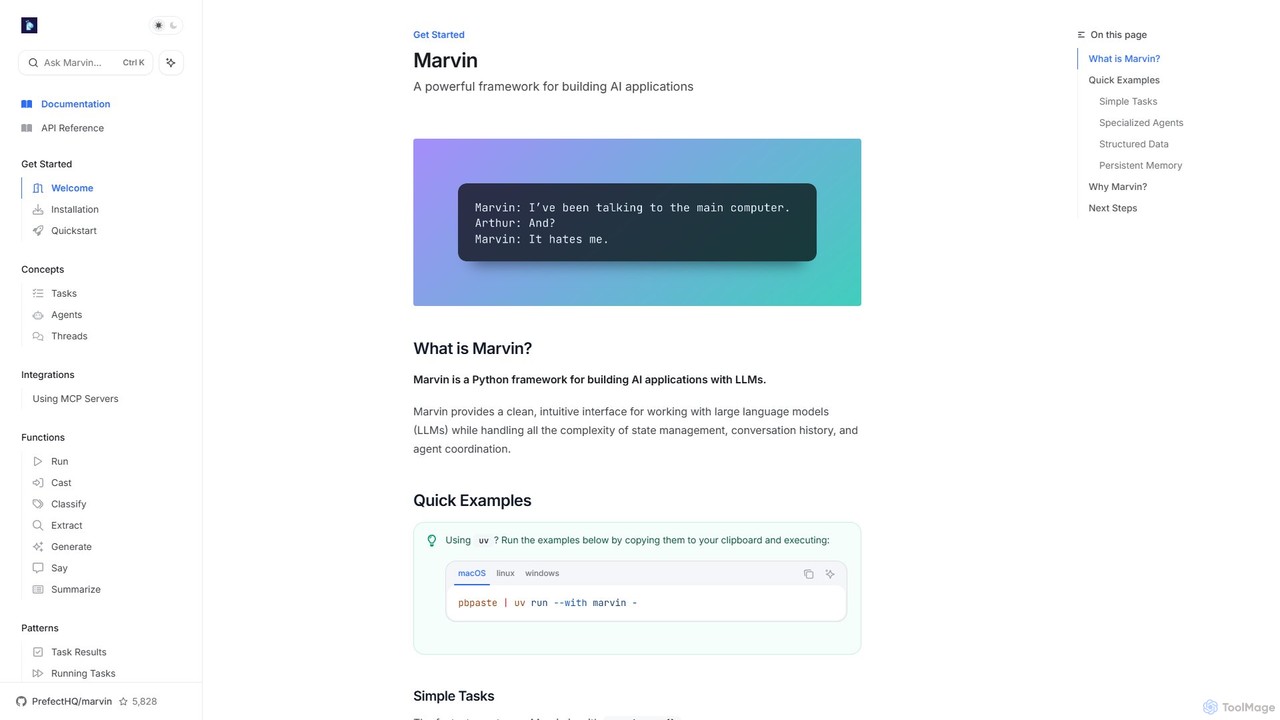
askmarvin is a powerful open-source Python framework for building AI applications. It simplifies interaction with LLMs, enabling developers to create specialized agents, manage conversation history, enforce structured data outputs, and integrate external tools with minimal code. Ideal for rapidly prototyping and scaling complex AI-powered workflows.
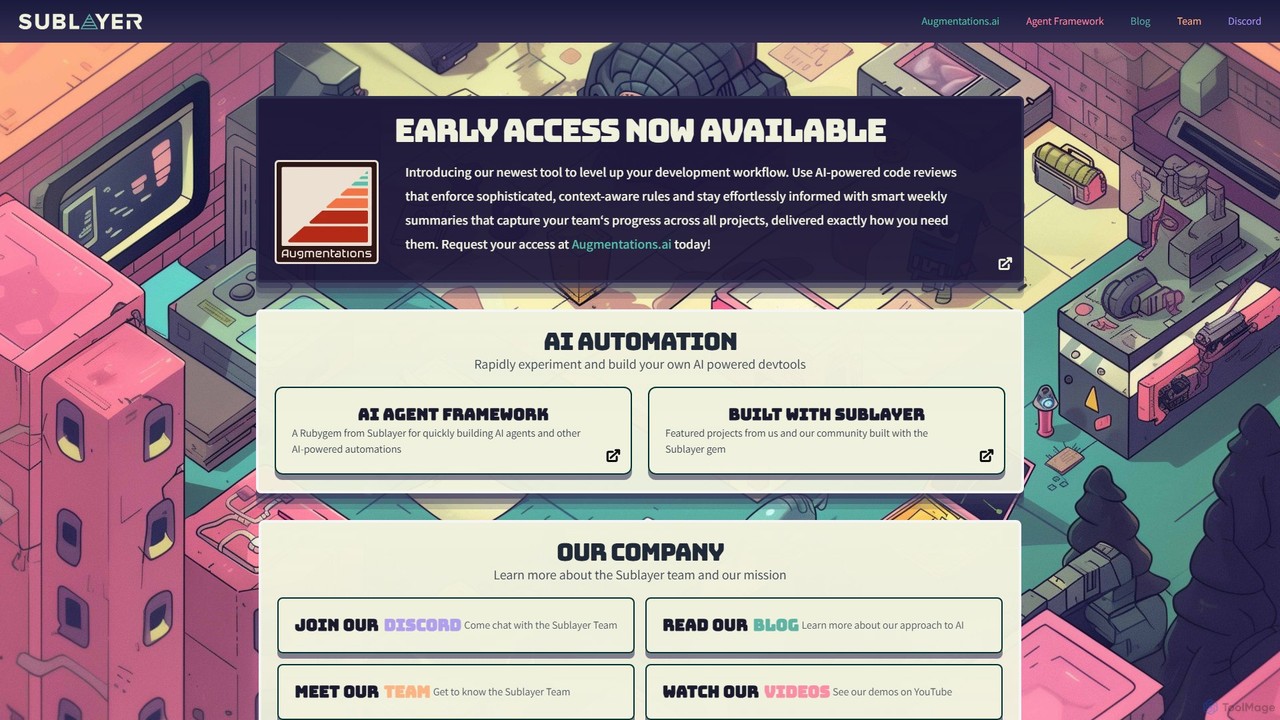
Sublayer is a model-agnostic AI agent framework for Ruby developers. It provides a powerful Rubygem to rapidly build, experiment with, and deploy AI agents and custom developer tools, enabling personalized and context-aware automation for software development workflows.
Compare product focus, pricing models and audiences. Highlighted rows indicate different listed information; unknown pricing does not mean free.
| Quick facts | askmarvin | Sublayer |
|---|---|---|
| Pricing model | Free | Freemium |
| Product type | Web | Web |
| Primary focus | Code Assistant | Code Assistant |
| Audience and roles | No data available | No data available |
| Categories | Code Assistant · Frameworks · Automation | Code Assistant · Frameworks · Automation |
| Added | Aug 15, 2025 | Aug 6, 2025 |
| Updated | Nov 19, 2026 | Nov 19, 2026 |
Explore the listed product descriptions, features and workflows. Taxonomy labels alone are not feature evaluations.
askmarvin, often referred to as Marvin, is a sophisticated, open-source Python framework designed to streamline the development of applications powered by Large Language Models (LLMs). Developed by the team at Prefect, Marvin provides a clean, intuitive interface that abstracts away the complexities of working with LLMs, such as state management, conversation history, and agent coordination. It's built with a 'batteries-included' philosophy, offering smart defaults that work out-of-the-box, while remaining highly customizable for advanced use cases.
The framework is designed to be both powerful and easy to use, allowing developers to scale from simple, single-line AI function calls to complex, multi-agent systems that can collaborate on tasks. Marvin's core strength lies in its ability to produce reliable and predictable results, particularly through its robust support for structured data outputs.
Using askmarvin involves integrating its Python library into your development projects. The process is straightforward for Python developers:
pip install marvin.marvin.run() function. This is the fastest way to get a response from an LLM. For example: marvin.run("Write a haiku about artificial intelligence").marvin.Agent(name="Poet", instructions="You are an expert poet...") and then use its .run() method.BaseModel and pass it as the result_type argument. Marvin will ensure the LLM's output conforms to your defined schema.marvin.Task to define instructions, tools, and context. This allows you to build complex, multi-step AI workflows.marvin.Thread to maintain conversation history and context, enabling multi-turn dialogues with agents.marvin.run() and scale to complex applications with dedicated classes for Agents, Tasks, and Threads.marvin.Memory and marvin.Thread.askmarvin is versatile and can be applied to a wide range of development scenarios:
askmarvin is a completely free and open-source framework, licensed under the Apache 2.0 License. There are no paid plans or hidden costs associated with using the library itself. As it is hosted on GitHub, developers can freely use, modify, and contribute to the project. Users are only responsible for the costs associated with the underlying LLM APIs (e.g., OpenAI, Anthropic) they choose to connect to.
Sublayer is a specialized AI framework designed to empower Ruby developers to build sophisticated AI-powered applications and automations. At its core, Sublayer is a model-agnostic Rubygem, meaning it provides the flexibility to integrate with various Large Language Models (LLMs) without being tied to a single provider. This allows developers to choose the best AI model for their specific needs, balancing cost, performance, and capabilities.
The primary goal of Sublayer is to simplify the process of creating AI agents and custom developer tools. It abstracts away the complexities of interacting with different AI APIs, providing a clean, Ruby-native interface for building powerful features. The framework is built on the philosophy of 'Promptable Architecture,' encouraging developers to design systems where AI can be seamlessly integrated to handle complex, dynamic tasks. This is particularly evident in their open-source 'Blueprints' initiative, which allows for AI-assisted coding that is personalized to a team's existing codebase and unique style, moving beyond generic code suggestions.
As a developer-focused framework, using Sublayer involves integrating its Rubygem into a Ruby or Ruby on Rails project.
Sublayer is ideal for development teams looking to build custom AI solutions that are deeply integrated with their existing processes.
The main advantage of Sublayer is its developer-centric and flexible approach. By being model-agnostic, it future-proofs applications against the rapidly changing AI landscape. Its focus on personalization through 'Blueprints' offers a significant advantage over one-size-fits-all AI coding assistants, leading to higher quality and more consistent code. For Ruby developers, it provides a familiar and powerful way to harness the power of AI without a steep learning curve.
The core Sublayer framework, including the 'Blueprints' feature, is open-source and available as a free Rubygem. This allows developers to start building and experimenting without any initial cost. The company's business model involves offering commercial products and services built on top of the framework. For example, their AI-powered code review and project summary tool, Augmentations.ai, is a paid service that requires requesting early access. This freemium model provides a powerful free tool for the community while monetizing specialized, enterprise-ready solutions.
Their taxonomy shows where the products overlap and where each one has a more distinct focus. Unknown fields are shown explicitly and are never filled with assumptions.
Traffic is shown on the same scale so differences in market visibility are not visually understated.
Both charts share the same months and vertical scale. Each tool identifies its latest reporting month; missing months are left blank, not counted as zero. Regional and source visit counts are estimates calculated from the reported shares.
| Country/region | Percentage | Estimated visits |
|---|---|---|
| 🇭🇺Hungary | 56.26% | 3.5K |
| 🇺🇸United States | 31.69% | 2K |
| 🇮🇳India | 12.05% | 744 |
| Source type | Percentage | Estimated visits |
|---|---|---|
| Direct | 98.76% | 6.1K |
| Referral | 1.24% | 77 |
| Country/region | Percentage | Estimated visits |
|---|---|---|
| 🇺🇸United States | 100% | 517 |
Ratings, comments, favorites, and likes are community signals—not a substitute for product fit.
This page is assembled from ToolMage product listings, taxonomy, traffic statistics and on-site user feedback. It is not a hands-on test or an independent review.