ToolMage
Sign in

AI TOOL COMPARISON

Augment Code vs CGFT

What is the difference, and which fits your workflow? Compare features, usage, pricing models and traffic side by side.

Jump to key differences

Product overview

Augment Code Product overview

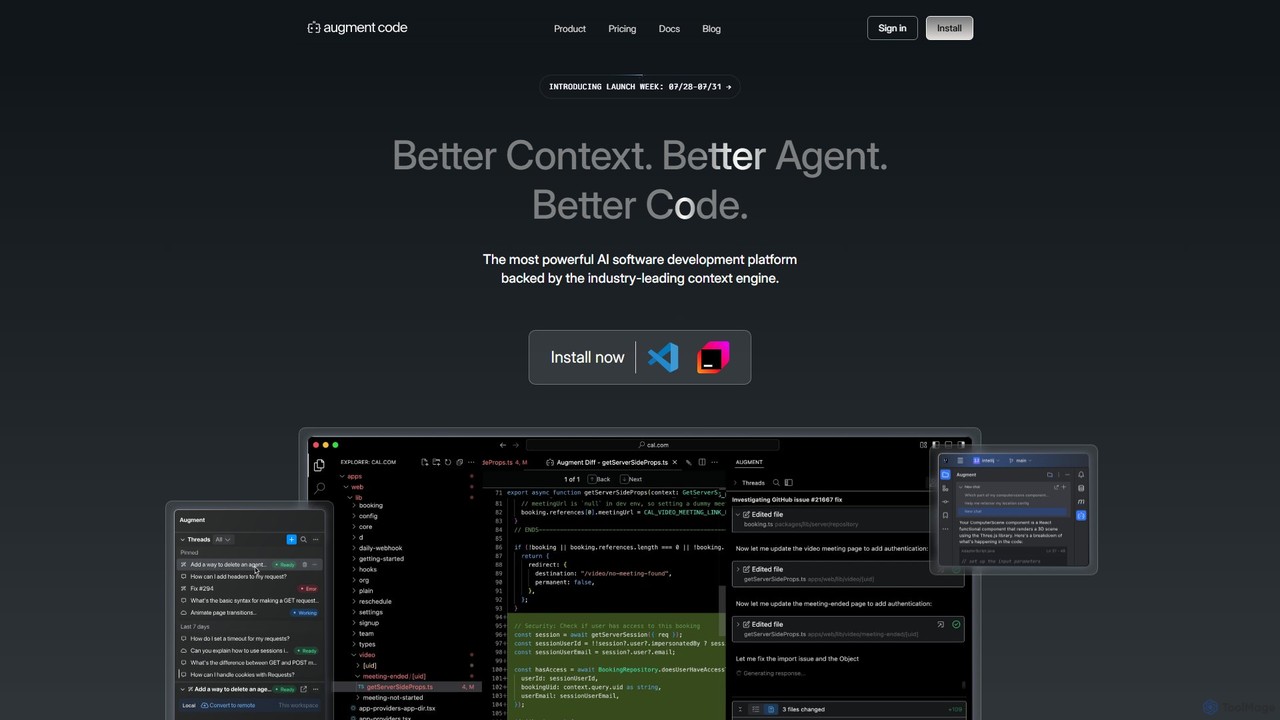
Augment Code is an advanced AI software development platform featuring autonomous agents and a powerful context engine. It integrates into your IDE to help you plan, build, and ship production-ready code faster, with a strong focus on enterprise-grade security and deep codebase understanding.

Preview

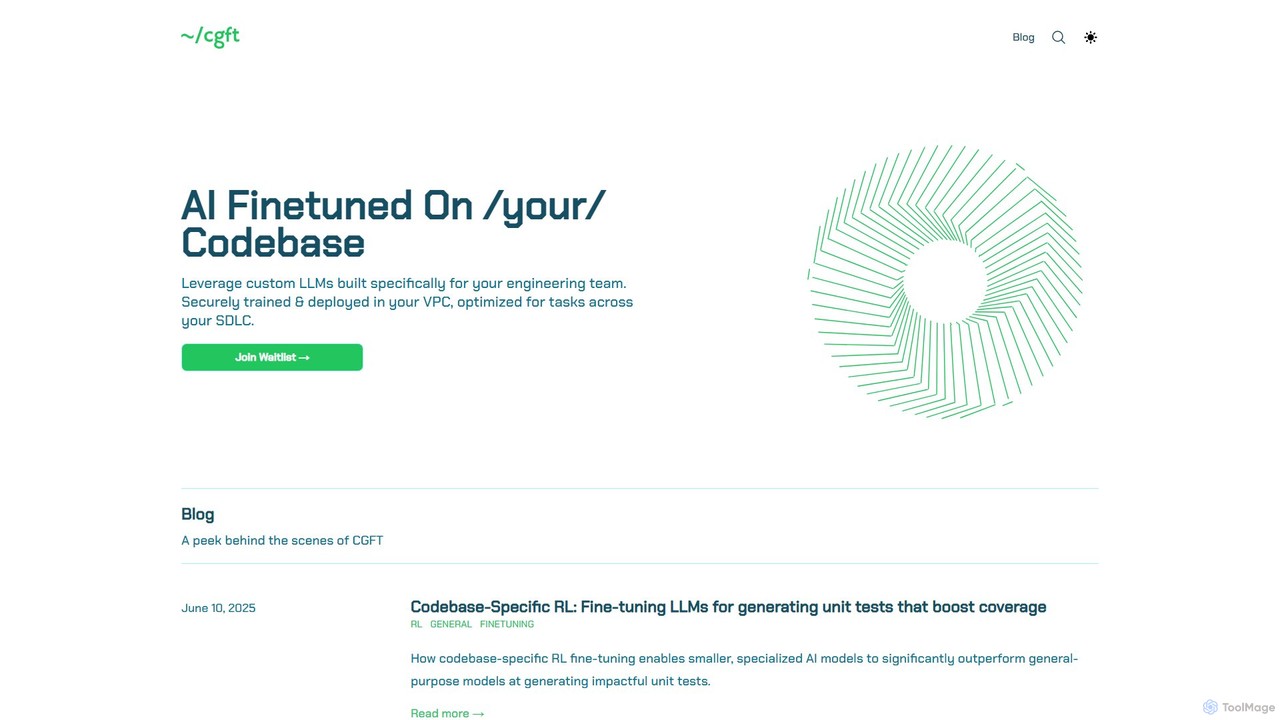
CGFT Product overview

CGFT provides custom AI models for engineering teams, fine-tuned on your specific codebase. It delivers secure, high-performance code generation, unit testing, and review automation by training models on your internal data and deploying them within your VPC.

Preview

Quick facts

Compare product focus, pricing models and audiences. Highlighted rows indicate different listed information; unknown pricing does not mean free.

Augment Code VS CGFT — Quick facts
Quick factsAugment CodeCGFT
Pricing modelFreemiumPaid
Product typeExtensionsWeb
Primary focusCode GenerationModel Fine Tuning
Audience and rolesNo data availableNo data available
CategoriesCode Generation · Code Assistant · Developer ToolsModel Fine Tuning · Code Assistant · Developer Tools
AddedAug 5, 2025Aug 2, 2025
UpdatedNov 19, 2026Nov 19, 2026

Features, usage and use cases

Explore the listed product descriptions, features and workflows. Taxonomy labels alone are not feature evaluations.

Augment Code

Augment Code is a cutting-edge AI software development platform designed for professional engineers and enterprise teams. It goes beyond simple code completion by offering autonomous AI agents that can handle complex software development tasks from end to end. Powered by an industry-leading context engine, Augment Code deeply understands your entire codebase, including its history and dependencies, to generate high-quality, production-ready code.

The platform is built to seamlessly integrate into a developer's existing workflow. It operates directly within popular IDEs and supports a wide range of tools and integrations, ensuring that developers can leverage its power without disrupting their processes. With a strong emphasis on security and privacy, Augment Code is SOC 2 Type II and ISO/IEC 42001 certified, making it a trusted choice for organizations that handle sensitive data.

How to use Augment Code

Getting started with Augment Code is straightforward. First, you install the extension for your preferred IDE, such as Visual Studio Code, JetBrains IDEs, Vim, or Neovim. Once installed, you can interact with the AI in several ways:

  • AI Chat: Use the chat interface to ask questions about your codebase, request code snippets, or get help with debugging. You can even provide context using screenshots or wireframes.
  • Codebase-Aware Autocomplete: As you type, Augment Code provides intelligent, context-aware suggestions that go far beyond standard autocompletion.
  • Autonomous Agents: For more complex tasks, you can delegate work to a local or remote AI agent. Simply provide a high-level prompt describing the feature or fix you need. The agent will then create a plan, write the code, run commands in the terminal (with your approval), and even open a pull request for you to review.

Core Features of Augment Code

  • Autonomous Software Agents: Deploy local or remote agents to perform end-to-end development tasks, from planning to creating pull requests.
  • Proprietary Context Engine: A real-time index of your entire codebase, including commit history, ensures that all AI suggestions and actions are highly relevant and accurate.
  • Seamless IDE Integration: Native support for Visual Studio Code, JetBrains IDEs, Vim, and Neovim.
  • Terminal Integration: Agents can execute commands in your terminal, with approval, to perform tasks like running tests or installing dependencies.
  • Multi-modal Input: Enhance prompts with screenshots and wireframes to provide clearer visual context to the AI.
  • Enterprise-Grade Security: SOC 2 Type II and ISO/IEC 42001 certified, with a commitment to data privacy. Your code is never used for training on paid plans.
  • Customization and Memory: Tailor the AI to your team's best practices, coding style, and preferences through memories and rules.
  • Smart Apply & Next Edit: Intelligently applies suggestions from chat and understands the ripple effects of code changes across the codebase.

Use Cases for Augment Code

Augment Code is versatile and can be applied to numerous software development scenarios:

  • Complex Feature Development: Delegate the implementation of new features to an agent, freeing up developers to focus on architecture and planning.
  • Legacy Code Refactoring: Analyze and modernize large, complex, or outdated codebases with AI assistance.
  • Automated Bug Fixing: Describe a bug, and let the agent identify the root cause and generate a fix.
  • Automated Code Documentation: Generate comprehensive and accurate documentation for your codebase automatically.
  • Accelerated Testing: Create unit tests, integration tests, and end-to-end tests for new and existing code.
  • Developer Onboarding: Help new team members get up to speed on a large codebase quickly by using the AI to answer questions and explain complex parts of the code.

Advantages of Augment Code

Augment Code stands out from other AI coding tools due to its focus on real-world, complex software development. Its primary advantages include its deep contextual understanding, which leads to higher quality code, and its autonomous agents, which significantly boost developer productivity by automating entire tasks, not just single lines of code. The platform's unwavering commitment to enterprise-grade security and privacy makes it a reliable partner for businesses of all sizes.

Pricing and Plans

Augment Code offers a tiered pricing structure to suit different needs, from individual developers to large enterprises.

  • Community Plan: Free. Perfect for getting started with essential features, includes up to 50 user messages per month. AI training may be performed on data from this plan.
  • Developer Plan: $50/month. For individuals and small teams, includes up to 600 user messages, team management, and SOC 2 Type II compliance. No AI training on your data.
  • Pro Plan: $100/month. Increased message limits (1500/month) for more active users.
  • Max Plan: $250/month. For power users, with up to 4500 user messages per month.
  • Enterprise Plan: Custom pricing. For large teams with high volume, security, or support needs. Offers bespoke message limits, Slack integration, SSO, dedicated support, and volume discounts. No AI training on your data.

A 7-day free trial is available for the Developer plan.

CGFT

CGFT (Finetuned Code AI) is a specialized service designed to create custom Large Language Models (LLMs) tailored specifically for enterprise engineering teams. It addresses a core limitation of general-purpose AI coding assistants: their lack of understanding of a company's unique internal frameworks, coding patterns, and business logic. By fine-tuning models directly on an organization's private codebase, documentation, commit histories, and code reviews, CGFT builds a hyper-contextual AI partner that dramatically improves developer productivity and code quality across the entire Software Development Lifecycle (SDLC).

The core philosophy of CGFT is that for an AI to be a truly effective collaborator, it needs the same deep onboarding as a new senior engineer. This is achieved through a meticulous fine-tuning process that leverages a wealth of internal data. The resulting models are not only more accurate but are also deployed securely within the client's own Virtual Private Cloud (VPC), ensuring that sensitive code and intellectual property never leave their trusted environment. This approach contrasts with relying on public, multi-tenant APIs, offering superior security and privacy.

How to use CGFT

CGFT operates as a managed service, providing a bespoke solution for each client. The process typically involves the following steps:

  1. Initial Consultation: Teams interested in a custom AI model reach out to the CGFT team (via their waitlist or email) to discuss their specific needs, codebase complexity, and desired outcomes (e.g., improving code completion, automating tests).
  2. Secure Data Integration: CGFT works with the client to establish a secure pipeline for accessing internal engineering data. This includes code repositories, internal documentation, code review histories, commit logs, and even relevant technical discussions from platforms like Slack. Security is paramount, and this process is designed to work within the client's security protocols.
  3. Model Fine-Tuning: The CGFT team uses its proprietary fine-tuning pipeline to train a base model (often a powerful open-weight model like DeepSeek-Coder or Starcoder) on the provided data. This process imbues the model with a deep understanding of the client's specific architectural patterns, libraries, and coding standards.
  4. Deployment and Integration: Once trained and validated, the custom model is packaged and deployed directly into the client's VPC. Developers can then access the model's capabilities through integrations with their existing tools, such as IDE extensions, providing a seamless experience similar to tools like GitHub Copilot but with far greater contextual accuracy.

Core Features of CGFT

  • Repo-Specific Fine-Tuning: The model is trained on your specific codebase, not on generic open-source data, enabling it to understand and generate code that aligns with your internal patterns and abstractions.
  • Secure VPC Deployment: All training and deployment occur within your own secure cloud environment, guaranteeing data privacy and control over your intellectual property.
  • Hyper-Accurate Code Completion: Delivers code suggestions that are significantly more relevant and accurate than general-purpose models, with reported performance gains of around 50%.
  • Intelligent Unit Test Generation: Leverages Reinforcement Learning (RL) to generate meaningful unit tests that not only compile but also increase test coverage by understanding the underlying business logic.
  • Automated Code Review: The model can be used to automate parts of the code review process, flagging deviations from internal coding standards, suggesting improvements, and identifying potential anti-patterns.
  • Support for Complex & Legacy Codebases: Particularly effective for large, complex, or older codebases (including iOS/Android, legacy systems, and modern languages like Rust) that are poorly represented in public training data.

Use Cases for CGFT

CGFT can be applied across the entire software development lifecycle to enhance efficiency and quality:

  • Accelerating Feature Development: Developers can write code faster and with fewer errors, as the AI provides highly relevant, context-aware suggestions that adhere to existing frameworks.
  • Improving Code Quality and Consistency: By automating reviews and providing pattern-compliant suggestions, CGFT helps maintain a high standard of code quality and consistency across large teams.
  • Onboarding New Engineers: New hires can become productive more quickly by using the AI as a guide to navigate and understand a complex, unfamiliar codebase.
  • Modernizing Legacy Systems: Assists engineers in refactoring, documenting, and adding tests to legacy code, reducing the risk and effort involved in modernization projects.

Advantages of CGFT

The primary advantage of CGFT is its ability to transform a general AI into a specialized, expert team member.

  • Deep Contextual Understanding: Unlike generic tools, CGFT understands your code's unique 'dialect'—its specific frameworks, APIs, and business logic.
  • Unmatched Accuracy: By training on relevant data, it achieves a level of precision in code generation and analysis that general models cannot match.
  • Enterprise-Grade Security: The single-tenant, VPC-deployed model ensures that your proprietary code remains confidential and secure.
  • Full SDLC Impact: Its benefits extend beyond simple code completion to encompass testing, debugging, and code review, providing holistic value.

Pricing and Plans

CGFT's pricing information is not publicly available on their website. Given the bespoke nature of the service, which involves custom fine-tuning and dedicated deployment, they operate on an enterprise pricing model. Interested organizations are encouraged to join the waitlist or contact the CGFT team directly at [email protected] to receive a custom quote based on their specific requirements, such as the size of the codebase, the number of developers, and the scope of the implementation.

Positioning

Their taxonomy shows where the products overlap and where each one has a more distinct focus. Unknown fields are shown explicitly and are never filled with assumptions.

Categories

Shared
Code AssistantDeveloper Tools
Only Augment Code
Code Generation
Only CGFT
Model Fine Tuning

Tags

Shared
code assistantcode generationdeveloper tools
Only Augment Code
ai pair programmerautonomous agententerprise securityide extensionjetbrainsrefactoringSOC 2software developmentVS Code
Only CGFT
code reviewenterprise AIfine-tuninglegacy codesecure AIunit testingVPC

Audience and roles

Shared
No listed items
Only Augment Code
No listed items
Only CGFT
No listed items

Traffic comparison

Traffic is shown on the same scale so differences in market visibility are not visually understated.

How to interpret the traffic data

Both charts share the same months and vertical scale. Each tool identifies its latest reporting month; missing months are left blank, not counted as zero. Regional and source visit counts are estimates calculated from the reported shares.

Augment Code monthly traffic:

Latest traffic · 2026-05

Monthly visits
543.5K
Avg. visit duration
1:51
Pages per visit
2.55
Bounce rate
46.27%
Data updated 2026-06-15

Monthly traffic trend

  • 2025-09: 1M
  • 2026-01: 614.9K
  • 2026-02: 524.3K
  • 2026-03: 676.2K
  • 2026-04: 507.2K
  • 2026-05: 543.5K

Top regions

Top 5 countries/regions
Country/regionPercentageEstimated visits
🇺🇸United States56.75%308.4K
🇮🇳India17.56%95.4K
🇨🇳China10.67%58K
🇬🇧United Kingdom8.34%45.3K
🇩🇪Germany6.68%36.3K

Traffic sources

Source typePercentageEstimated visits
Direct76.45%415.5K
Referral19.36%105.2K
Email4.19%22.8K

Search keywords

augmentaugment aiaugment codebest ai for codingeverything claude code

CGFT monthly traffic:

Latest traffic · 2026-05

Monthly visits
1.7K
Avg. visit duration
0:00
Pages per visit
1.12
Bounce rate
37.9%
Data updated 2026-06-15

Monthly traffic trend

  • 2025-09: 662
  • 2026-01: 310
  • 2026-02: 1.6K
  • 2026-03: 4.3K
  • 2026-04: 445
  • 2026-05: 1.7K

Top regions

Top 5 countries/regions
Country/regionPercentageEstimated visits
🇺🇸United States100%1.7K

Search keywords

cgft aifastest reasoning model than qwen3.5 9bglm 4.7 flash vs qwen 3.6 35bgrpo definitiongrpo explained

Community signals

Ratings, comments, favorites, and likes are community signals—not a substitute for product fit.

Augment Code

Rating
No data available
Comments
0
Favorites
186
Likes
159

CGFT

Rating
No data available
Comments
0
Favorites
159
Likes
166

Augment Code vs CGFT · Comparison FAQ

What do Augment Code and CGFT have in common?
Both tools are listed under Code Assistant、Developer Tools. These categories indicate overlapping use cases; compare their detailed descriptions for workflows, capabilities and limitations.
Are Augment Code and CGFT free?
Listed pricing models: Augment Code — Freemium; CGFT — Paid. Missing pricing is not proof of a free plan, and freemium does not mean every feature is free. Check official sites for current plans, limits and trials.
How should I choose between Augment Code and CGFT?
The primary listed category is Code Generation for Augment Code, and Model Fine Tuning for CGFT. Compare features, steps and use cases, then verify pricing, data permissions and deployment needs. This page does not include hands-on testing and does not declare a winner from traffic or tags.

Sources and comparison methodology

This page is assembled from ToolMage product listings, taxonomy, traffic statistics and on-site user feedback. It is not a hands-on test or an independent review.

  • Feature and plan descriptions reflect information in the listings, not real-time guarantees. Verify pricing, quotas, availability and privacy terms on the official sites.
  • Traffic uses the reporting months shown. Missing statistics do not mean zero visits, and different periods do not establish growth or superiority. Regional and source visit counts are estimates based on shares.
  • Different tags indicate differences in the listings, not proof that the other product lacks a capability. Ratings, favorites and visits are not used to declare a winner.

Related comparisons