ToolMage
Sign in

AI TOOL COMPARISON

Browserless vs FetchFox

What is the difference, and which fits your workflow? Compare features, usage, pricing models and traffic side by side.

Jump to key differences

Product overview

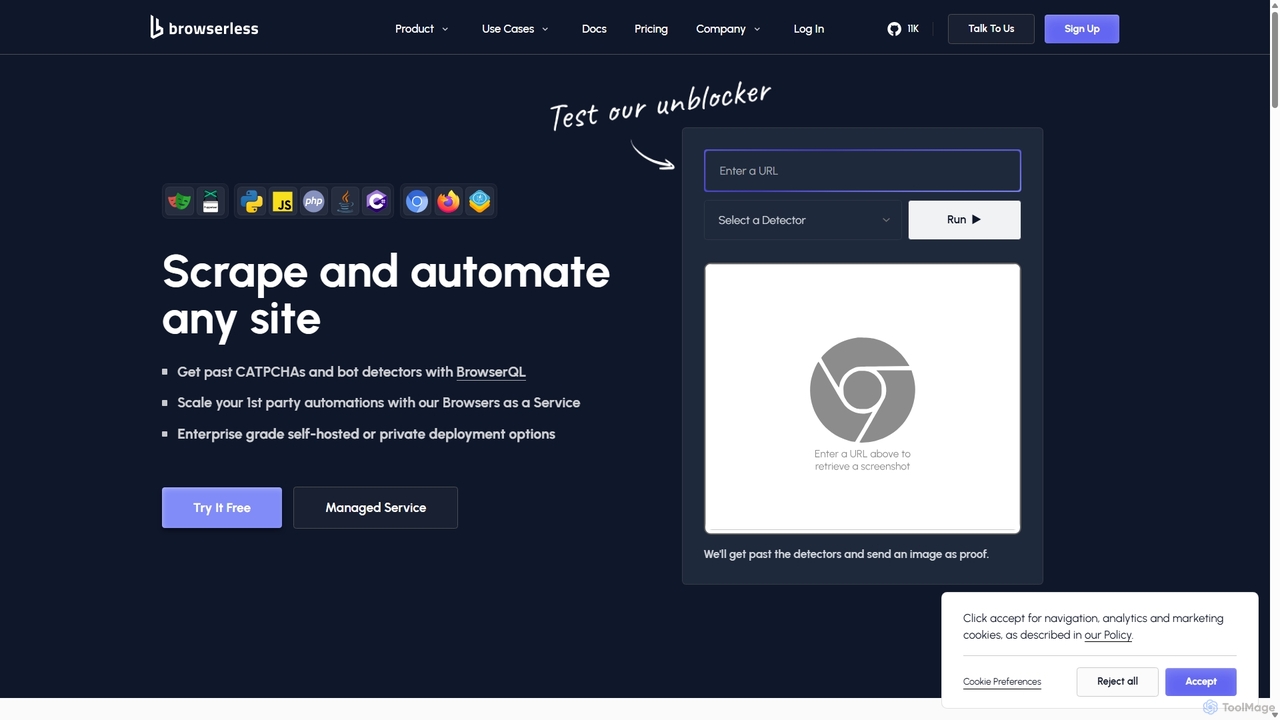
Browserless Product overview

Browserless is a powerful Browser-as-a-Service (BaaS) platform designed for scalable web scraping and browser automation. It helps developers bypass CAPTCHAs and bot detectors effortlessly using Puppeteer, Playwright, or its proprietary BrowserQL language. The service manages browser infrastructure, allowing users to focus on building automation scripts without worrying about updates, memory leaks, or scaling.

Preview

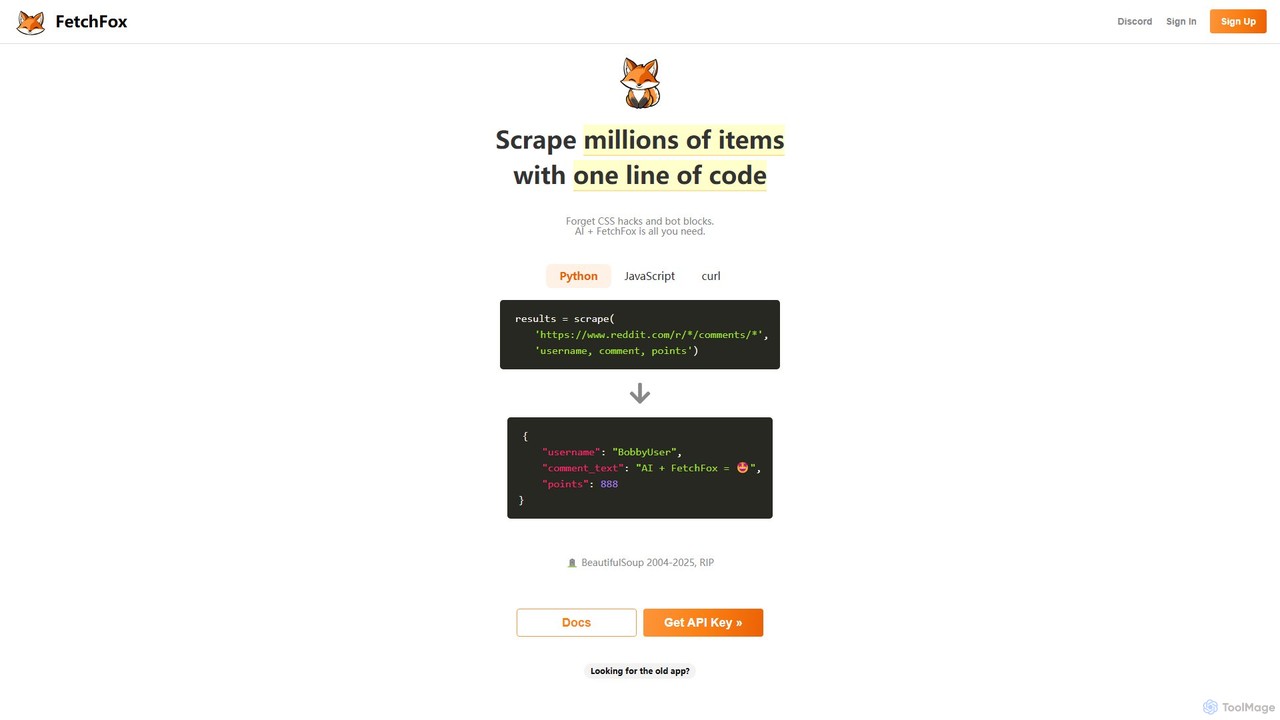
FetchFox Product overview

FetchFox is an AI-powered web scraping tool that allows users to extract data from any website using simple text prompts. It eliminates the need for complex coding or CSS selectors, automatically handling anti-bot measures. Available as an API, JavaScript library, and Chrome extension, it's designed for both developers and non-technical users to automate data collection effortlessly.

Preview

Quick facts

Compare product focus, pricing models and audiences. Highlighted rows indicate different listed information; unknown pricing does not mean free.

Browserless VS FetchFox — Quick facts
Quick factsBrowserlessFetchFox
Pricing modelFreemiumFreemium
Product typeWebWeb
Primary focusData ExtractionData Extraction
Audience and rolesData Analyst · Data Scientist · DevOps Engineer · Marketing Manager · Product Manager · QA Engineer · Software DeveloperNo data available
CategoriesData Extraction · Web Scraping · AutomationData Extraction · Web Scraping · Lead Generation · Automation
AddedSep 15, 2025Aug 13, 2025
UpdatedNov 19, 2026Nov 19, 2026

Features, usage and use cases

Explore the listed product descriptions, features and workflows. Taxonomy labels alone are not feature evaluations.

Browserless

Browserless is a comprehensive cloud-based platform that provides headless browser instances for a wide range of web automation and data extraction tasks. It's built to solve the common challenges developers face when working with headless browsers at scale, such as infrastructure management, performance issues, and evading sophisticated bot detection systems. By offering a robust pool of managed browsers, Browserless allows developers and businesses to focus on their core logic rather than the complexities of deploying and maintaining browser automation systems.

The service is trusted by thousands of companies, from startups to large enterprises, for its reliability, scalability, and advanced features. It offers both managed cloud services and self-hosted enterprise solutions, providing flexibility for different security and compliance needs, including SOC 2 Type II compliance.

How to use Browserless

Browserless offers multiple ways to integrate its services into your workflow, making it accessible for various skill levels and project requirements:

  1. Connect with Puppeteer or Playwright: The easiest way to get started is by connecting your existing Puppeteer or Playwright scripts. Instead of launching a local browser instance, you simply change the connection method to point to a Browserless WebSocket endpoint. This requires minimal code changes and instantly scales your existing automations.
  2. Use REST APIs: For common tasks like generating PDFs, taking screenshots, or extracting HTML content, Browserless provides simple REST APIs. You can make a cURL request or use any HTTP client to perform these actions without writing complex browser automation scripts.
  3. Leverage BrowserQL: For advanced use cases, especially those involving bypassing tough bot detectors (like Cloudflare), Browserless offers BrowserQL. This is a next-generation automation language and IDE designed to leave minimal fingerprints. You can write concise queries to perform complex actions like clicking buttons, solving CAPTCHAs, and extracting structured data, all while appearing more human to detection systems.
  4. Hybrid Automations: Browserless supports hybrid workflows where you can stream a browser session to an iframe. This is useful for tasks that require manual intervention, such as solving a complex CAPTCHA, entering 2FA codes, or handling OAuth logins within an automated script.

Core Features of Browserless

  • BrowserQL: A proprietary query language and IDE built from the ground up to bypass the most advanced bot detectors by minimizing browser fingerprints.
  • Browser as a Service (BaaS): A scalable, managed pool of thousands of browsers, handling all infrastructure aspects like version updates, load balancing, and resource management.
  • Bot Detection & CAPTCHA Evasion: Specialized technology to automatically solve CAPTCHAs (reCAPTCHA, hCaptcha) and get past bot-blocking services like Cloudflare.
  • Puppeteer & Playwright Integration: Seamless compatibility with the two most popular browser automation libraries.
  • REST APIs: Simple endpoints for common tasks such as PDF generation, screenshots, and content scraping.
  • Session Management & Reconnects: The ability to keep browser sessions alive and reconnect to them, which significantly reduces proxy usage and avoids repetitive bot checks.
  • Enterprise-Grade Solutions: Options for self-hosting, private cloud deployments, custom machine setups (including GPUs), SSO, dedicated support, and SOC 2 Type II compliance.
  • Monitoring & Debugging: A user-friendly dashboard provides metrics on requests, worker health (CPU/memory), and a debugger to watch scripts run in real-time.

Use Cases for Browserless

Browserless is versatile and can be applied to numerous scenarios:

  • Web Scraping & Data Extraction: Gathering data from dynamic, JavaScript-heavy websites, e-commerce platforms (e.g., Walmart, eBay), real estate listings (Zillow), and job boards (Indeed).
  • Automated Software Testing: Running end-to-end tests for web applications at scale, integrating with frameworks like Laravel Dusk without the need to manage a complex Selenium Grid.
  • AI & LLM Data Ingestion: Powering AI agents (e.g., using LangChain or CrewAI) with real-time web access to gather fresh data for training large language models or performing automated research.
  • Report Generation: Automatically generating PDFs and screenshots of dashboards, analytics reports, or invoices from web applications.
  • Price & Competitor Monitoring: Tracking product prices, inventory levels, and competitor strategies across various online retailers.

Advantages of Browserless

Using Browserless provides several key advantages:

  • Reduced Operational Overhead: Eliminates the need for a dedicated team to build, deploy, and maintain a complex browser automation infrastructure.
  • Enhanced Success Rates: Its advanced bot evasion techniques, particularly with BrowserQL, lead to higher success rates in scraping protected websites.
  • Scalability on Demand: Effortlessly scales from a few concurrent sessions to thousands, handling traffic spikes without performance degradation.
  • Cost Efficiency: Features like session reconnects can reduce proxy costs by up to 90%. The unit-based pricing model is predictable and cost-effective.
  • Developer-Focused: Designed by developers for developers, with excellent documentation, SDKs, and responsive technical support.

Pricing and Plans

Browserless offers a flexible, unit-based pricing model to suit different needs:

  • Free Plan: Includes 1,000 units per month, 1 max concurrent browser, and access to the BrowserQL editor. No credit card required.
  • Prototyping Plan: Starts at $25/month (billed annually) for 20,000 units and 3 concurrent browsers. Ideal for small projects and testing.
  • Starter Plan: Starts at $140/month (billed annually) for 180,000 units and 20 concurrent browsers, suitable for growing applications.
  • Scale Plan: Starts at $350/month (billed annually) for 500,000 units and 50 concurrent browsers, designed for high-volume operations.
  • Enterprise Plan: Custom pricing for users needing millions of units, private deployments, self-hosting, advanced features like GPU infrastructure, SSO, and a dedicated technical account manager.

A "Unit" corresponds to up to 30 seconds of browser time. Longer sessions consume additional units. Units are also used for residential proxies and successful CAPTCHA solves.

FetchFox

FetchFox is a revolutionary AI-powered web scraping platform designed to simplify and automate the process of data extraction from the web. It fundamentally changes how users approach web scraping by replacing complex coding, CSS selectors, and maintenance of fragile scripts with simple, natural language prompts. Whether you're a developer needing to integrate data into an application or a business user looking to gather market intelligence, FetchFox provides a robust and accessible solution.

The core principle of FetchFox is its AI engine, which intelligently understands the structure and content of a webpage. Users simply describe the data they want to extract, and the AI handles the rest. This includes navigating through pages, identifying the relevant data points, and structuring the output into a clean, usable format like JSON. The platform is engineered to be resilient, automatically adapting to website layout changes and bypassing common anti-scraping technologies such as CAPTCHAs and IP blocks, which are major hurdles for traditional scraping methods.

How to use FetchFox

FetchFox offers flexible ways to use its service, catering to different user needs:

1. For Developers (API and Libraries):

  • Get an API Key: Sign up on the FetchFox website to receive your unique API key.
  • Integrate with your code: Use the official Python or JavaScript (npm install fetchfox) libraries for seamless integration, or make direct cURL requests to the API endpoint.
  • Define your scrape job: In your request, specify the target website(s) using `start_urls` and a URL `pattern` for crawling multiple pages.
  • Write a natural language prompt: The most crucial part is the `template` parameter. Here, you describe the data fields you need, for example: "Extract the product name, price, customer rating, and the text of the first three reviews."
  • Execute and receive data: Run your script to start the scraping job. FetchFox will process the request and return the extracted data in a structured JSON format.

2. For Non-Technical Users (Chrome Extension):

  • Install the Extension: Add the FetchFox extension to your Chrome browser from the Chrome Web Store.
  • Navigate and Activate: Go to the webpage you want to scrape data from. Open the extension and input your API key.
  • Enter a Prompt: In the extension's interface, type a simple command describing what you want to collect, such as "list all job titles and company names on this page."
  • Start Scraping: Press the 'Go' button. FetchFox will analyze the page, extract the requested information, and allow you to download the results, typically as a CSV file.

Core Features of FetchFox

  • AI-Powered Natural Language Scraping: No need for XPath or CSS selectors. Just tell the AI what data you need in plain English.
  • Advanced Anti-Bot Bypass: Intelligently navigates through anti-scraping measures, including dynamic content, CAPTCHAs, and proxy management.
  • Multi-Platform Access: Use the powerful API, convenient Python/JavaScript libraries, or the user-friendly no-code Chrome extension.
  • Structured Data Output: Automatically delivers clean, well-structured JSON data, saving you time on data cleaning and parsing.
  • Scalable Crawling: Effortlessly scrape millions of items across entire websites by defining URL patterns for the crawler to follow.
  • Bring Your Own Key (BYOK): An option to use your personal OpenAI API key, which can reduce costs and provides a more generous free item allowance.

Use Cases for FetchFox

FetchFox is versatile and can be applied across various industries and roles:

  • Sales and Lead Generation: Scrape business directories, LinkedIn Sales Navigator, or professional networks to build targeted lead lists with names, job titles, companies, and contact details.
  • Market and Competitor Research: Aggregate product information, pricing, and customer reviews from e-commerce sites like Amazon or eBay to analyze market trends and competitor strategies.
  • Financial Data Aggregation: Collect data from financial news sites, stock market platforms, or DeFi protocols for investment analysis and model training.
  • Academic and Scientific Research: Assemble large datasets from various online sources, publications, or public records for academic studies.
  • Real Estate Analysis: Gather property listings, prices, and agent details from real estate websites to monitor market conditions.

Advantages of FetchFox

The primary advantage of FetchFox is its radical simplicity and power. It democratizes web scraping, making it accessible to users without a technical background. For developers, it significantly speeds up the development process by abstracting away the most tedious and challenging aspects of scraping. Its resilience to website changes means less time spent on maintaining broken scripts and more time focused on utilizing the data. The combination of a powerful AI engine and robust infrastructure makes it a highly efficient and reliable tool for any data extraction task.

Pricing and Plans

FetchFox employs a straightforward, transparent, pay-as-you-go pricing model.

  • Free Tier: New users get their first 1,000 extracted items for free. An 'item' corresponds to one row of data (e.g., one product's details).
  • Standard Pricing: After the free tier, the cost is a flat rate of $1 per 1,000 items.
  • Bring Your Own Key (BYOK) Bonus: If you choose to use your own OpenAI API key, you receive an additional 10,000 items for free. This can be a more cost-effective option for users with existing OpenAI accounts.
  • Custom Plans: For users with large-scale scraping needs or complex requirements, FetchFox offers custom enterprise plans. Interested parties can contact their sales team for a consultation.

Positioning

Their taxonomy shows where the products overlap and where each one has a more distinct focus. Unknown fields are shown explicitly and are never filled with assumptions.

Categories

Shared
Data ExtractionWeb ScrapingAutomation
Only Browserless
No listed items
Only FetchFox
Lead Generation

Tags

Shared
APIdata extractiondata miningweb scraping
Only Browserless
bot detectionbrowser automationcaptcha solvingheadless browserPlaywrightpuppeteer
Only FetchFox
AI scraperautomationdeveloper toolslead generationmarket researchno-code

Audience and roles

Shared
No listed items
Only Browserless
Data AnalystData ScientistDevOps EngineerMarketing ManagerProduct ManagerQA EngineerSoftware Developer
Only FetchFox
No listed items

Traffic comparison

Traffic is shown on the same scale so differences in market visibility are not visually understated.

How to interpret the traffic data

Both charts share the same months and vertical scale. Each tool identifies its latest reporting month; missing months are left blank, not counted as zero. Regional and source visit counts are estimates calculated from the reported shares.

Browserless monthly traffic:

Latest traffic · 2026-05

Monthly visits
242.1K
Avg. visit duration
1:17
Pages per visit
2.45
Bounce rate
56.01%
Data updated 2026-06-15

Monthly traffic trend

  • 2025-09: 126.9K
  • 2026-01: 150.9K
  • 2026-02: 150.8K
  • 2026-03: 157.8K
  • 2026-04: 148.9K
  • 2026-05: 242.1K

Top regions

Top 5 countries/regions
Country/regionPercentageEstimated visits
🇧🇷Brazil28.09%68K
🇺🇸United States26.55%64.3K
🇨🇭Switzerland23.8%57.6K
🇨🇦Canada11.55%28K
🇪🇸Spain10.01%24.2K

Traffic sources

Source typePercentageEstimated visits
Direct81.79%198K
Referral13.74%33.3K
Email4.47%10.8K

Search keywords

browserlessbrowserless apibrowserless iomemory leak fixplaywright vs selenium

FetchFox monthly traffic:

Latest traffic · 2026-05

Monthly visits
40.3K
Avg. visit duration
5:28
Pages per visit
4.08
Bounce rate
57.8%
Data updated 2026-06-15

Monthly traffic trend

  • 2025-09: 2.7K
  • 2026-01: 1.9K
  • 2026-02: 771
  • 2026-03: 1K
  • 2026-04: 14.8K
  • 2026-05: 40.3K

Top regions

Top 5 countries/regions
Country/regionPercentageEstimated visits
🇮🇳India45.78%18.5K
🇺🇸United States44.91%18.1K
🇪🇸Spain9.31%3.8K

Search keywords

fetch foxfetchfox aifetchfoxaifetchfox.iafounding engineer equity

Community signals

Ratings, comments, favorites, and likes are community signals—not a substitute for product fit.

Browserless

Rating
No data available
Comments
0
Favorites
178
Likes
165

FetchFox

Rating
No data available
Comments
0
Favorites
149
Likes
149

Browserless vs FetchFox · Comparison FAQ

What do Browserless and FetchFox have in common?
Both tools are listed under Data Extraction、Web Scraping、Automation. These categories indicate overlapping use cases; compare their detailed descriptions for workflows, capabilities and limitations.
Are Browserless and FetchFox free?
Listed pricing models: Browserless — Freemium; FetchFox — Freemium. Missing pricing is not proof of a free plan, and freemium does not mean every feature is free. Check official sites for current plans, limits and trials.
How should I choose between Browserless and FetchFox?
The primary listed category is Data Extraction for Browserless, and Data Extraction for FetchFox. Compare features, steps and use cases, then verify pricing, data permissions and deployment needs. This page does not include hands-on testing and does not declare a winner from traffic or tags.

Sources and comparison methodology

This page is assembled from ToolMage product listings, taxonomy, traffic statistics and on-site user feedback. It is not a hands-on test or an independent review.

  • Feature and plan descriptions reflect information in the listings, not real-time guarantees. Verify pricing, quotas, availability and privacy terms on the official sites.
  • Traffic uses the reporting months shown. Missing statistics do not mean zero visits, and different periods do not establish growth or superiority. Regional and source visit counts are estimates based on shares.
  • Different tags indicate differences in the listings, not proof that the other product lacks a capability. Ratings, favorites and visits are not used to declare a winner.

Related comparisons