Browserless
Data Extraction
AI TOOL COMPARISON
What is the difference, and which fits your workflow? Compare features, usage, pricing models and traffic side by side.
Data Extraction
Data Extraction
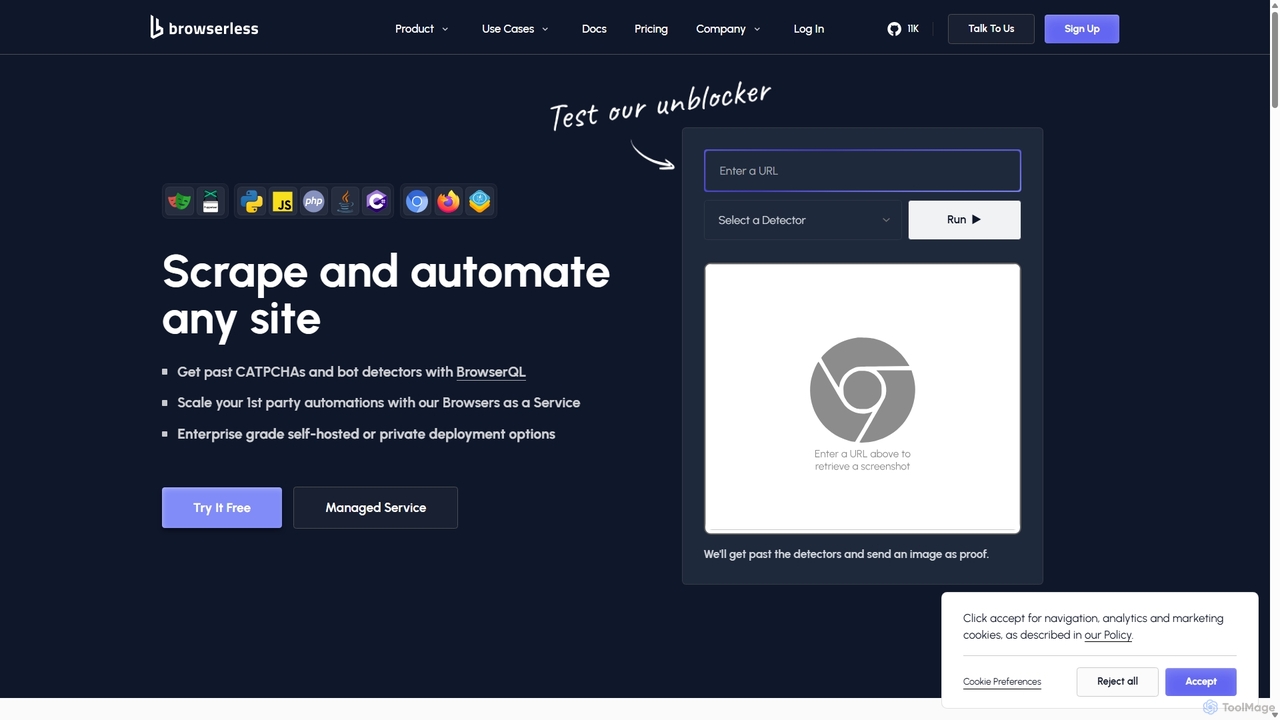
Browserless is a powerful Browser-as-a-Service (BaaS) platform designed for scalable web scraping and browser automation. It helps developers bypass CAPTCHAs and bot detectors effortlessly using Puppeteer, Playwright, or its proprietary BrowserQL language. The service manages browser infrastructure, allowing users to focus on building automation scripts without worrying about updates, memory leaks, or scaling.
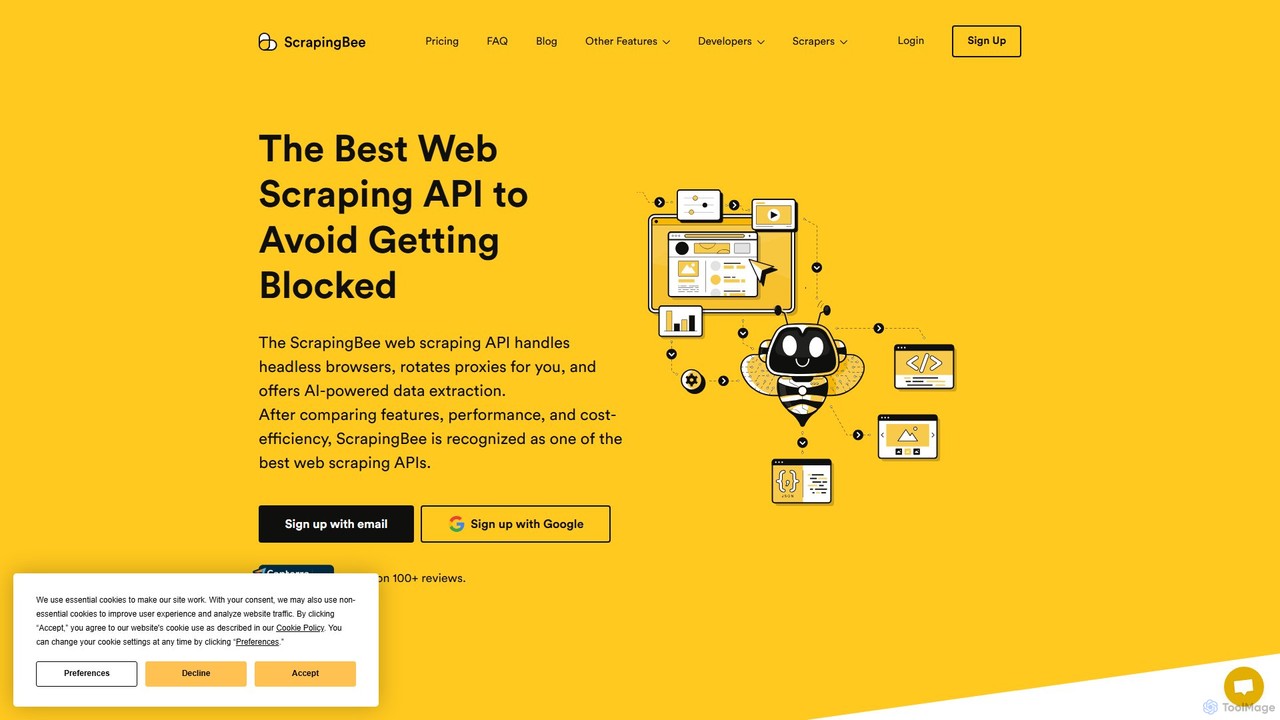
ScrapingBee is a powerful web scraping API that handles headless browsers and proxy rotation to prevent getting blocked. It features an innovative AI-powered extractor that lets you describe the data you need in plain English, eliminating the need for complex CSS selectors. Ideal for developers, marketers, and data analysts for tasks like price monitoring, lead generation, and SERP analysis.
Compare product focus, pricing models and audiences. Highlighted rows indicate different listed information; unknown pricing does not mean free.
| Quick facts | Browserless | ScrapingBee |
|---|---|---|
| Pricing model | Freemium | Freemium |
| Product type | Web | Web |
| Primary focus | Data Extraction | Data Extraction |
| Audience and roles | Data Analyst · Data Scientist · DevOps Engineer · Marketing Manager · Product Manager · QA Engineer · Software Developer | No data available |
| Categories | Data Extraction · Web Scraping · Automation | Data Extraction · Web Scraping · Seo |
| Added | Sep 15, 2025 | Aug 7, 2025 |
| Updated | Nov 19, 2026 | Nov 19, 2026 |
Explore the listed product descriptions, features and workflows. Taxonomy labels alone are not feature evaluations.
Browserless is a comprehensive cloud-based platform that provides headless browser instances for a wide range of web automation and data extraction tasks. It's built to solve the common challenges developers face when working with headless browsers at scale, such as infrastructure management, performance issues, and evading sophisticated bot detection systems. By offering a robust pool of managed browsers, Browserless allows developers and businesses to focus on their core logic rather than the complexities of deploying and maintaining browser automation systems.
The service is trusted by thousands of companies, from startups to large enterprises, for its reliability, scalability, and advanced features. It offers both managed cloud services and self-hosted enterprise solutions, providing flexibility for different security and compliance needs, including SOC 2 Type II compliance.
Browserless offers multiple ways to integrate its services into your workflow, making it accessible for various skill levels and project requirements:
Browserless is versatile and can be applied to numerous scenarios:
Using Browserless provides several key advantages:
Browserless offers a flexible, unit-based pricing model to suit different needs:
A "Unit" corresponds to up to 30 seconds of browser time. Longer sessions consume additional units. Units are also used for residential proxies and successful CAPTCHA solves.
ScrapingBee is a comprehensive web scraping API designed to simplify the complex process of data extraction from the web. It effectively tackles the most common challenges in web scraping, such as IP blocks, rate limiting, and handling dynamic, JavaScript-heavy websites. By managing a fleet of headless Chrome browsers and a vast pool of rotating proxies, ScrapingBee allows developers and businesses to focus on data analysis rather than the intricacies of scraper maintenance. Its standout feature is an AI-powered data extractor, which enables users to specify their data requirements in natural language, making the process more intuitive and resilient to website layout changes.
Using ScrapingBee is straightforward and designed for developer efficiency. The process begins with a simple sign-up to obtain an API key. Once you have your key, you can make API requests to the ScrapingBee endpoint.
1. Choose your endpoint: For general scraping, you send a GET request to the API with the target URL as a parameter.
2. Enable JavaScript Rendering: To scrape single-page applications (SPAs) built with React, Vue.js, or Angular, simply add the `render_js=True` parameter to your request. This tells ScrapingBee to render the page in a real Chrome browser before returning the HTML.
3. Use AI Extraction: For the simplest data extraction, use the AI extraction feature. You describe the data fields you want in plain English (e.g., "extract the product title, price, and customer reviews"). The AI will parse the page and return structured JSON data without you needing to write any CSS selectors.
4. Execute Custom Scripts: For complex interactions like clicking buttons, scrolling, or waiting for elements to load, you can use the `js_scenario` parameter to pass a custom JavaScript snippet.
5. Take Screenshots: Add the `screenshot=True` parameter to capture a full-page or partial screenshot of the target website.
6. Scrape Google: Use the dedicated Google Search API endpoint to easily scrape search engine results pages (SERPs) without facing rate limits.
ScrapingBee is versatile and trusted by over 2,500 customers for a wide range of applications:
- E-commerce & Price Monitoring: Retailers and market analysts use ScrapingBee to track competitor pricing, monitor stock levels, and gather product details from thousands of e-commerce sites.
- Lead Generation: Sales and marketing teams scrape professional networks, online directories, and company websites to build targeted lead lists.
- SEO & SERP Analysis: SEO professionals use the Google Search API to track keyword rankings, analyze SERP features, and monitor competitors' online presence.
- Real Estate Data Aggregation: Agencies and investors scrape real estate listings to gather data on property prices, availability, and features across different platforms.
- Academic & Market Research: Researchers and journalists extract data from various web sources for studies, reports, and content creation, as demonstrated by users gathering data for dissertations or blog posts.
The primary advantage of ScrapingBee is its ability to abstract away the most difficult parts of web scraping. Users no longer need to manage their own proxy infrastructure or headless browser fleets, saving significant time, resources, and maintenance overhead. The AI extraction feature is a major differentiator, making scrapers easier to build and more robust against website updates. The API is well-documented, easy to integrate, and offers a high success rate even on heavily protected sites. Furthermore, the "pay for success" model, where failed requests are not charged, and excellent customer support make it a reliable and cost-effective solution.
ScrapingBee offers a transparent, tiered pricing structure suitable for various needs, with the option to cancel anytime. All plans come with a free trial of 1,000 API calls (no credit card required).
- Freelance Plan: Starting at $49/month, this plan includes 250,000 API credits and 10 concurrent requests, ideal for individual developers and small projects.
- Startup Plan: At $99/month, it provides 1,000,000 API credits and 50 concurrent requests, suitable for growing businesses.
- Business Plan: For $249/month, users get 3,000,000 API credits and 100 concurrent requests, designed for established companies with higher scraping demands.
- Business+ Plan: At $599/month, this plan offers 8,000,000 API credits and 200 concurrent requests.
All paid plans include JavaScript rendering, rotating & premium proxies, and geotargeting. Higher-tier plans offer priority email support and dedicated account management. Custom enterprise plans are available for users needing more credits and concurrency.
Their taxonomy shows where the products overlap and where each one has a more distinct focus. Unknown fields are shown explicitly and are never filled with assumptions.
Traffic is shown on the same scale so differences in market visibility are not visually understated.
Both charts share the same months and vertical scale. Each tool identifies its latest reporting month; missing months are left blank, not counted as zero. Regional and source visit counts are estimates calculated from the reported shares.
| Country/region | Percentage | Estimated visits |
|---|---|---|
| 🇧🇷Brazil | 28.09% | 68K |
| 🇺🇸United States | 26.55% | 64.3K |
| 🇨🇭Switzerland | 23.8% | 57.6K |
| 🇨🇦Canada | 11.55% | 28K |
| 🇪🇸Spain | 10.01% | 24.2K |
| Source type | Percentage | Estimated visits |
|---|---|---|
| Direct | 81.79% | 198K |
| Referral | 13.74% | 33.3K |
| 4.47% | 10.8K |
| Country/region | Percentage | Estimated visits |
|---|---|---|
| 🇺🇸United States | 56.95% | 147.1K |
| 🇮🇳India | 16.81% | 43.4K |
| 🇲🇦Morocco | 9.66% | 24.9K |
| 🇷🇺Russia | 8.62% | 22.3K |
| 🇫🇷France | 7.96% | 20.6K |
| Source type | Percentage | Estimated visits |
|---|---|---|
| Direct | 83.54% | 215.7K |
| Referral | 11.93% | 30.8K |
| 4.53% | 11.7K |
Ratings, comments, favorites, and likes are community signals—not a substitute for product fit.
This page is assembled from ToolMage product listings, taxonomy, traffic statistics and on-site user feedback. It is not a hands-on test or an independent review.