ToolMage
Sign in

AI TOOL COMPARISON

Bunnyshell vs Devtron

What is the difference, and which fits your workflow? Compare features, usage, pricing models and traffic side by side.

Jump to key differences

Product overview

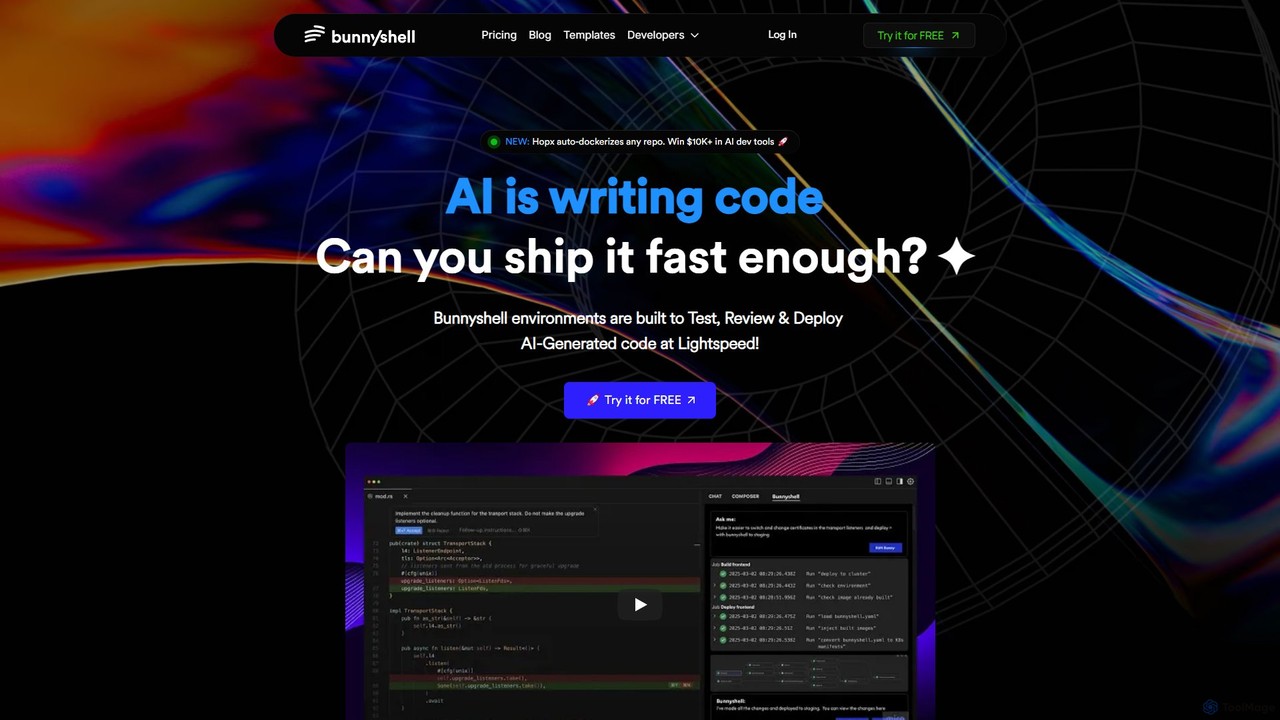
Bunnyshell Product overview

Bunnyshell is an AI-orchestrated Environments as a Service (EaaS) platform that automates the creation of ephemeral, production-like environments. It's designed to accelerate the testing, review, and deployment of code, especially AI-generated code, enabling teams to ship software up to 100x faster while reducing cloud costs by up to 70%.

Preview

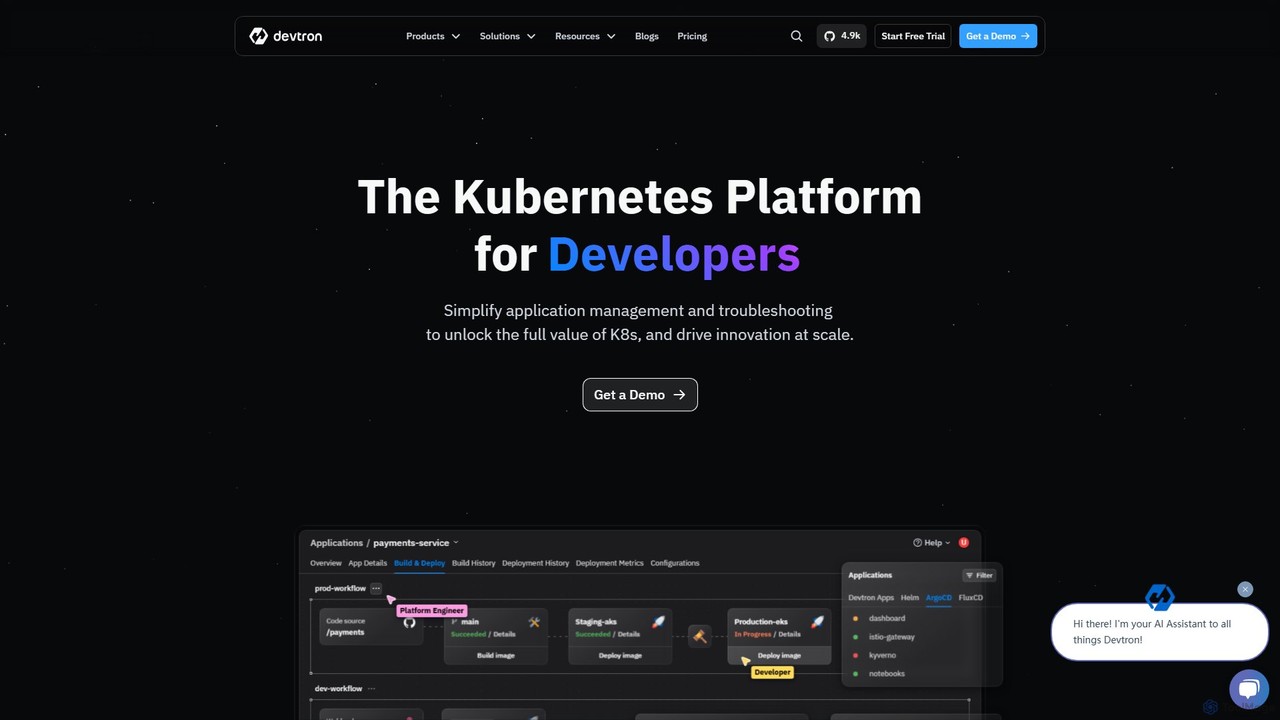
Devtron Product overview

Devtron is an open-source, Kubernetes-native software delivery platform that simplifies application management. It integrates CI/CD, GitOps, security, and observability into a unified dashboard, empowering developers and DevOps teams to manage complex Kubernetes environments with ease, accelerate release cycles, and improve productivity without a steep learning curve.

Preview

Quick facts

Compare product focus, pricing models and audiences. Highlighted rows indicate different listed information; unknown pricing does not mean free.

Bunnyshell VS Devtron — Quick facts
Quick factsBunnyshellDevtron
Pricing modelFreemiumFreemium
Product typeWebWeb
Primary focusInfrastructureCloud Computing
Audience and rolesNo data availableNo data available
CategoriesInfrastructure · Devops · Testing · Project ManagementCloud Computing · Deployment Automation · Devops · Project Management
AddedAug 6, 2025Aug 4, 2025
UpdatedNov 19, 2026Nov 19, 2026

Features, usage and use cases

Explore the listed product descriptions, features and workflows. Taxonomy labels alone are not feature evaluations.

Bunnyshell

Bunnyshell is a powerful Environments as a Service (EaaS) platform designed to revolutionize the software development lifecycle. In an era where AI is increasingly writing code, Bunnyshell provides the critical infrastructure to test, review, and deploy this code at unprecedented speeds. It addresses the common bottlenecks in development pipelines by offering AI-orchestrated, ephemeral, and production-like environments for every pull request. This ensures that developers can work in isolated, secure, and consistent settings, eliminating configuration drift and hidden bugs before they reach production.

The platform's core mission is to empower development teams to move from weekly deployments to multiple deployments per day. By automating environment provisioning and management, Bunnyshell frees developers from complex DevOps tasks, allowing them to focus on writing quality code. It seamlessly integrates with existing workflows and toolchains, including GitHub, GitLab, Bitbucket, Kubernetes, and all major cloud providers, ensuring a smooth and rapid adoption process without requiring changes to the current stack.

How to use Bunnyshell

Getting started with Bunnyshell is designed to be straightforward and fast, requiring no deep DevOps expertise. The typical workflow is as follows:

  1. Connect Your Repository: Integrate Bunnyshell with your Git provider (GitHub, GitLab, Bitbucket).
  2. Define Your Environment: Use a simple `bunnyshell.yml` file in your repository to define your application stack, or leverage Bunnyshell's AI-assisted setup and templates. The new Hopx feature can even auto-dockerize any repository, simplifying this step further.
  3. Automated Environment Creation: Bunnyshell automatically spins up a new, isolated, and fully-functional preview environment for every pull request. This environment is a perfect replica of production.
  4. Test and Review: Use the unique URL for each ephemeral environment to conduct thorough testing, UI/UX reviews, and stakeholder feedback sessions in a live setting.
  5. Merge and Deploy: Once the pull request is approved and merged, Bunnyshell automatically tears down the ephemeral environment and can be configured to trigger a deployment to your staging or production environments.
  6. Manage via CLI/API: For advanced users and automation, Bunnyshell provides a full-featured Command Line Interface (CLI) and API to manage environments programmatically.

Core Features of Bunnyshell

  • AI-Orchestrated Environments: Automates the creation, management, and teardown of development environments.
  • Ephemeral & Preview Environments: Instantly creates isolated, shareable environments for every pull request, enabling parallel development and faster review cycles.
  • Production-Like Replicas: Ensures environments are identical to production, minimizing the "it works on my machine" problem and catching bugs early.
  • Cloud Cost Optimization: Automatically detects and shuts down idle environments, leading to cloud infrastructure cost savings of up to 70%.
  • Seamless Integrations: Works out-of-the-box with popular tools like GitHub, GitLab, Kubernetes, Docker, and major cloud providers (AWS, Azure, DigitalOcean).
  • Enterprise-Grade Security: Features SOC 2 compliance, Single Sign-On (SSO), on-premise deployment options, and data anonymization to meet enterprise security standards.
  • Developer Productivity Tools: Includes a full API & CLI, DORA metrics for performance tracking, and fast build systems to enhance the developer experience.
  • Hopx Auto-Dockerizer: A new feature that automatically containerizes any repository, lowering the barrier to entry for container-based development.

Use Cases for Bunnyshell

Bunnyshell is ideal for a wide range of teams and scenarios:

  • AI-Powered Teams: Rapidly test and deploy AI-generated code, ensuring that the high velocity of code creation is matched by deployment speed.
  • High-Velocity Development: Enables teams practicing CI/CD to move from weekly or bi-weekly releases to multiple deployments per day, stress-free.
  • Quality Assurance & Code Review: Provides QA engineers and product managers with live, testable environments for every feature, improving feedback quality and speed.
  • Complex Microservices Architectures: Simplifies the management of complex applications by allowing developers to spin up the entire stack for testing a single service change.
  • DevOps Automation: Reduces the burden on DevOps teams by empowering developers to self-serve their own environments, cutting down setup time from days to minutes.

Advantages of Bunnyshell

The primary advantages of adopting Bunnyshell are speed, efficiency, and reliability. Teams report a 100x increase in deployment velocity, moving from slow, risky releases to a continuous flow of updates. The platform significantly reduces cloud waste through its auto-shutdown feature. By providing secure, isolated, and consistent environments, it enhances code quality and system stability. Ultimately, Bunnyshell simplifies the entire development-to-deployment process, allowing companies to innovate faster and stay ahead of the competition.

Pricing and Plans

Bunnyshell offers a flexible pricing model with a 14-day free trial to get started.

  • Personal Plan: Starting at $20/month. Includes 2 CPUs, 4 GB RAM, 25 GB Storage. Perfect for small projects and individual developers.
  • Pro Plan: Starting at $40/month. Includes 4 CPUs, 8 GB RAM, 50 GB Storage. Ideal for more complex applications and daily use.
  • Turbo Plan: Starting at $80/month. Includes 6 CPUs, 12 GB RAM, 100 GB Storage. Designed for AI engineers and complex deployment pipelines.
  • Business/Enterprise Plan: Custom pricing is available for larger teams with specific needs like on-premise deployment, SSO, and dedicated support. A demo can be booked to discuss these requirements.

All paid plans include key features like Preview Environments, Sandbox AI Environments, and Modern CI/CD capabilities.

Devtron

Devtron is a comprehensive, open-source software platform designed for Kubernetes application management. It aims to democratize Kubernetes by providing an intuitive, unified interface that abstracts away the underlying complexities. Born in the cloud, Devtron is tailored for modern teams, integrating Continuous Integration/Continuous Deployment (CI/CD), GitOps, security, and observability into a single, seamless platform. This allows development and operations teams to build, deploy, and run applications on Kubernetes with confidence, efficiency, and scale, regardless of their size or industry.

The platform directly addresses common challenges in the DevOps lifecycle, such as the steep learning curve of Kubernetes, deployment bottlenecks caused by microservice dependencies, fragmented tooling, and the inefficiencies of manual processes. By offering a centralized dashboard, Devtron empowers developers to become self-sufficient, reducing their dependency on dedicated DevOps personnel for routine tasks like deployments, log checking, and troubleshooting.

How to use Devtron

Using Devtron involves a streamlined workflow that simplifies the entire software delivery process on Kubernetes:

  1. Integration: Connect your code repositories (like Git) and container registries. Devtron seamlessly integrates with your existing tool ecosystem.
  2. Application Setup: Use the intuitive UI to create and configure your applications. You can use ready-made Helm charts or define your own configurations without writing complex YAML files from scratch.
  3. Build & Deploy Pipelines: Configure CI/CD pipelines through the dashboard. Define build stages, testing integrations, and deployment strategies (e.g., Blue-Green, Canary). The platform supports multi-language and multi-architecture builds.
  4. GitOps-based Deployment: Leverage GitOps for automated, auditable, and reliable deployments. Devtron synchronizes your cluster state with your Git repository, enabling features like drift detection and automated rollbacks.
  5. Management & Observability: Use the Kubernetes Dashboard to manage all your applications across multiple clusters. View logs, monitor resource utilization and DORA metrics, debug with ephemeral containers, and manage user access with fine-grained RBAC.
  6. Security & Governance: Implement DevSecOps practices with built-in security scanning for container images and Kubernetes manifests. Enforce policies for deployments, access control, and compliance.

Core Features of Devtron

  • Kubernetes Dashboard: A single pane of glass for managing applications, clusters, permissions, logs, and metrics across multiple Kubernetes environments.
  • Release Orchestration: Advanced pipeline management with approval workflows, environment-specific controls, and detailed tracking for releases.
  • Continuous Deployment with GitOps: Fully automated, Helm-based deployments with drift detection, SLO-based rollbacks, and support for multi-cluster and air-gapped environments.
  • Integrated DevSecOps: Built-in container image and code manifest security scanning using tools like Trivy and Clair, with policy-based controls.
  • Fine-Grained RBAC & Governance: Centralized user management with SSO integration, custom roles, API tokens, and compliance-ready audit logging.
  • Multi-Cluster Management: Unified visibility and management of workloads deployed across multiple clouds and clusters.
  • Automated CI Pipelines: Support for multi-language, multi-architecture builds, buildpacks, Dockerfiles, and comprehensive testing integrations.
  • Auto Remediation: Self-healing capabilities for Kubernetes, with the ability to create and run custom runbooks based on event triggers.

Use Cases for Devtron

Devtron is versatile and has been adopted by businesses of all sizes to solve real-world challenges:

  • Increasing Developer Productivity: Companies like TravClan and Indiamart have used Devtron to boost developer productivity by 40-70% by abstracting K8s complexity and enabling developer self-service.
  • Cost Optimization & Migration: India's largest used-car platform, Spinny, leveraged Devtron's CI capabilities to migrate from AMD to ARM architecture, resulting in a 30% reduction in infrastructure costs and a 25% performance enhancement.
  • Accelerating Time-to-Market: Apica, a global data management company, revolutionized its customer deployment process with Devtron, reducing time-to-market by an incredible 90%.
  • Automating Software Distribution: Fintech company 73 Strings uses Devtron to automate software distribution into their customers' secure, air-gapped environments, ensuring reliability and security.
  • Simplifying Microservices Management: SaaS companies with a growing number of microservices use Devtron to move from scattered scripts to a unified dashboard, improving collaboration and eliminating DevOps bottlenecks.

Advantages of Devtron

Devtron offers a significant competitive edge for teams adopting Kubernetes:

  • Simplified K8s Adoption: Drastically reduces the learning curve, allowing developers to deploy and manage applications without deep Kubernetes expertise.
  • Enhanced Productivity: Empowers developers with self-service capabilities, freeing up DevOps teams to focus on strategic initiatives.
  • Faster Release Cycles: Automates the entire CI/CD pipeline, from build to deployment, leading to up to 60% faster time-to-market.
  • Improved Security & Compliance: Integrates security scanning and governance policies directly into the development lifecycle.
  • Cost Reduction: Optimizes operations and infrastructure usage, as demonstrated by real-world case studies showing up to 30% cost savings.
  • Unified & Open Platform: Provides a single, cohesive platform for all Kubernetes-related tasks, built on an open-source foundation that fosters community and transparency.

Pricing and Plans

Devtron offers flexible pricing plans designed to scale with your team's needs:

  • Free (Open Source): Ideal for individual developers and small teams. This plan includes core features like CI/CD, GitOps, Helm UI, pre-defined RBAC roles, and community support.
  • Startup: A custom-priced plan for growing teams. It includes all features from the Free plan, plus advanced deployment strategies, policy enforcement, centralized audit logs, built-in security, and email/chat support for up to 10 users.
  • Enterprise: A custom-priced plan built for scale and security. It encompasses all Startup features and adds support for unlimited clusters and workloads, compliance-ready audit logging, multi-tenant dashboards, premium support with SLAs, and options for deployment in hybrid or air-gapped environments.

Positioning

Their taxonomy shows where the products overlap and where each one has a more distinct focus. Unknown fields are shown explicitly and are never filled with assumptions.

Categories

Shared
DevopsProject Management
Only Bunnyshell
InfrastructureTesting
Only Devtron
Cloud ComputingDeployment Automation

Tags

Shared
CI/CDdevopskubernetes
Only Bunnyshell
AI developmentCloud Cost ManagementdockerEaaSEnvironment as a ServiceEphemeral EnvironmentsPreview EnvironmentsSoftware DeploymentTesting Environment
Only Devtron
cloud nativeDeployment AutomationDevSecOpsGitOpsmicroservicesopen sourceplatform engineering

Audience and roles

Shared
No listed items
Only Bunnyshell
No listed items
Only Devtron
No listed items

Traffic comparison

Traffic is shown on the same scale so differences in market visibility are not visually understated.

How to interpret the traffic data

Both charts share the same months and vertical scale. Each tool identifies its latest reporting month; missing months are left blank, not counted as zero. Regional and source visit counts are estimates calculated from the reported shares.

Bunnyshell monthly traffic:

Latest traffic · 2026-05

Monthly visits
31.3K
Avg. visit duration
0:17
Pages per visit
1.73
Bounce rate
39.76%
Data updated 2026-06-15

Monthly traffic trend

  • 2025-09: 24.6K
  • 2026-01: 19.2K
  • 2026-02: 15.1K
  • 2026-03: 16.8K
  • 2026-04: 22.3K
  • 2026-05: 31.3K

Top regions

Top 5 countries/regions
Country/regionPercentageEstimated visits
🇺🇸United States32.09%10K
🇮🇳India29.56%9.3K
🇻🇳Vietnam17.11%5.4K
🇫🇷France10.94%3.4K
🇧🇷Brazil10.3%3.2K

Search keywords

alternative to vercelbunnyshellcoolify alternativesokteto alternativessite like vercel

Devtron monthly traffic:

Latest traffic · 2026-05

Monthly visits
49.8K
Avg. visit duration
0:36
Pages per visit
1.88
Bounce rate
39.7%
Data updated 2026-06-15

Monthly traffic trend

  • 2025-09: 77.4K
  • 2026-01: 68.9K
  • 2026-02: 54K
  • 2026-03: 55.9K
  • 2026-04: 51.7K
  • 2026-05: 49.8K

Top regions

Top 5 countries/regions
Country/regionPercentageEstimated visits
🇮🇳India33.05%16.5K
🇺🇸United States20.25%10.1K
🇳🇬Nigeria18.01%9K
🇻🇳Vietnam14.62%7.3K
🇰🇭Cambodia14.07%7K

Traffic sources

Source typePercentageEstimated visits
Direct84.81%42.3K
Referral15.19%7.6K

Search keywords

ai harness frameworkdevtrondevtron secret grafanaharnessk8s cluster alertmanager config

Community signals

Ratings, comments, favorites, and likes are community signals—not a substitute for product fit.

Bunnyshell

Rating
No data available
Comments
0
Favorites
160
Likes
170

Devtron

Rating
No data available
Comments
0
Favorites
136
Likes
159

Bunnyshell vs Devtron · Comparison FAQ

What do Bunnyshell and Devtron have in common?
Both tools are listed under Devops、Project Management. These categories indicate overlapping use cases; compare their detailed descriptions for workflows, capabilities and limitations.
Are Bunnyshell and Devtron free?
Listed pricing models: Bunnyshell — Freemium; Devtron — Freemium. Missing pricing is not proof of a free plan, and freemium does not mean every feature is free. Check official sites for current plans, limits and trials.
How should I choose between Bunnyshell and Devtron?
The primary listed category is Infrastructure for Bunnyshell, and Cloud Computing for Devtron. Compare features, steps and use cases, then verify pricing, data permissions and deployment needs. This page does not include hands-on testing and does not declare a winner from traffic or tags.

Sources and comparison methodology

This page is assembled from ToolMage product listings, taxonomy, traffic statistics and on-site user feedback. It is not a hands-on test or an independent review.

  • Feature and plan descriptions reflect information in the listings, not real-time guarantees. Verify pricing, quotas, availability and privacy terms on the official sites.
  • Traffic uses the reporting months shown. Missing statistics do not mean zero visits, and different periods do not establish growth or superiority. Regional and source visit counts are estimates based on shares.
  • Different tags indicate differences in the listings, not proof that the other product lacks a capability. Ratings, favorites and visits are not used to declare a winner.

Related comparisons