
ToolMage
Sign in

AI TOOL COMPARISON

Codebuff vs Jolt AI

What is the difference, and which fits your workflow? Compare features, usage, pricing models and traffic side by side.

Jump to key differences

Product overview

Codebuff Product overview

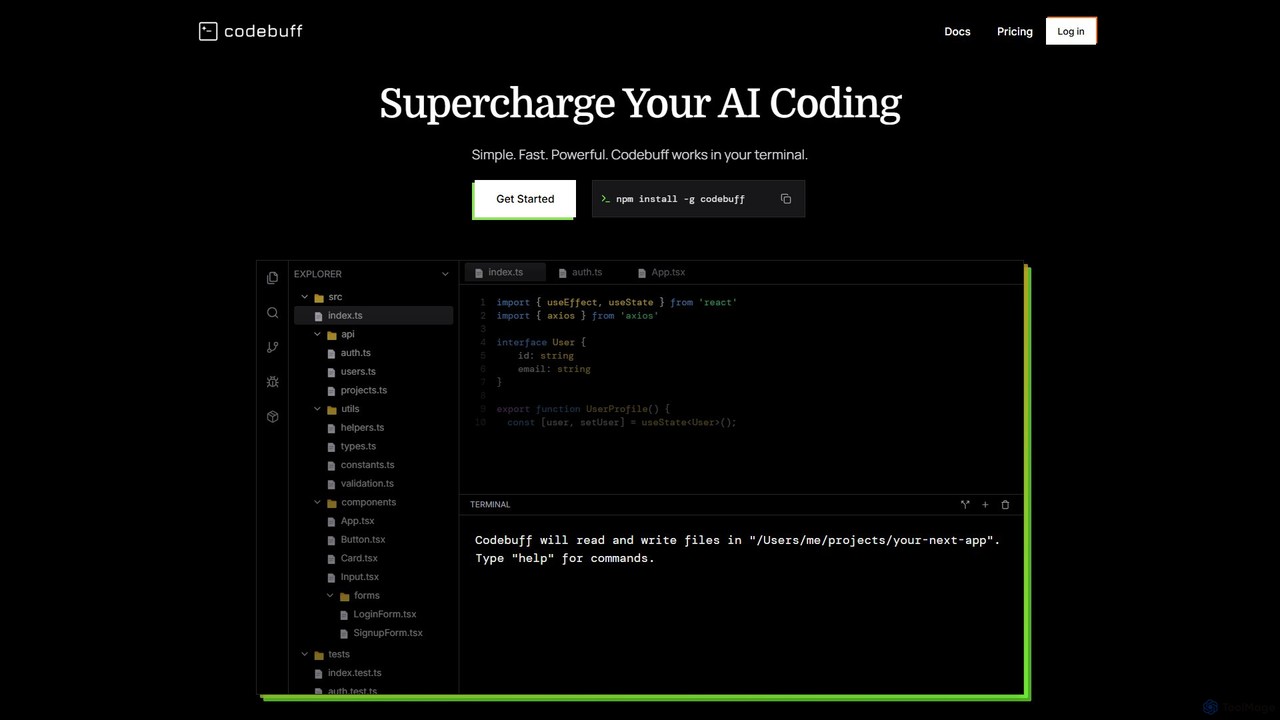
Codebuff is a powerful AI coding assistant that operates directly in your terminal. It deeply understands your entire codebase, enabling it to perform complex tasks like surgical code edits, feature implementation, and large-scale refactoring with unparalleled speed and accuracy. It learns from your project context and integrates seamlessly into any tech stack.

Preview

Jolt AI Product overview

Jolt AI is a specialized AI coding assistant designed for large and complex codebases. Its proprietary HyperContext engine automatically understands your entire project, enabling it to generate accurate, multi-file code changes, answer complex questions, and significantly accelerate development velocity for teams.

Preview

Quick facts

Compare product focus, pricing models and audiences. Highlighted rows indicate different listed information; unknown pricing does not mean free.

Codebuff VS Jolt AI — Quick facts
Quick factsCodebuffJolt AI
Pricing modelFreemiumFreemium
Product typeAppWeb
Primary focusCode GenerationCode Generation
Audience and rolesNo data availableNo data available
CategoriesCode Generation · Code Assistant · Developer ToolsCode Generation · Code Assistant · Developer Tools
AddedAug 4, 2025Aug 12, 2025
UpdatedNov 19, 2026Nov 19, 2026

Features, usage and use cases

Explore the listed product descriptions, features and workflows. Taxonomy labels alone are not feature evaluations.

Codebuff

Codebuff is a next-generation AI coding agent designed to supercharge your development workflow directly from the terminal. Unlike other AI tools that operate in a separate window or have limited context, Codebuff indexes and deeply understands your entire codebase in seconds. This total codebase awareness allows it to generate highly accurate and context-aware code, perform precise edits, and execute complex refactoring tasks that other tools struggle with. It's built for professional developers who demand speed, precision, and seamless integration into their existing environment.

By building a complete map of your project, including hidden dependencies and structural patterns, Codebuff delivers solutions that respect your project's architecture and coding style. It continuously learns from your interactions, storing project-specific knowledge in human-readable Markdown files (`knowledge.md`). This persistent memory means you don't have to repeat yourself, and the assistant becomes more effective and tailored to your needs over time.

How to use Codebuff

Getting started with Codebuff is straightforward and designed for a hassle-free setup. It works with any tech stack and doesn't require special environments.

  1. Installation: Install Codebuff globally using npm with a single command: npm install -g codebuff. You'll need Node.js version 18 or higher.
  2. Initialization: Navigate to your project's root directory in the terminal and simply run the command: codebuff. The tool will automatically index your codebase.
  3. Interaction: Once running, you can interact with Codebuff using natural language prompts. Ask it to add features, write tests, refactor code, or even run terminal commands. For example, you can ask it to "implement a dark/light mode toggle" or "refactor the user authentication service to use a new database schema."
  4. Configuration (Advanced): For more control, you can create a .codebuffignore file to exclude specific files/folders from its context, similar to .gitignore. You can also create a codebuff.json file to configure startup processes, file change hooks, and agent behavior, turning Codebuff into a central hub for your development environment.

Core Features of Codebuff

  • Total Codebase Awareness: Indexes your entire project in seconds to build a deep understanding of its structure, dependencies, and patterns.
  • Surgical Code Edits: Makes precise, pinpoint changes to your files while respecting existing code style and architecture, rather than rewriting entire files.
  • Terminal-Native Interface: Works directly in your command line, integrating seamlessly into your existing workflow without needing a separate IDE or editor.
  • Continuous Learning: Persists project knowledge and conversation context in knowledge.md files, allowing it to learn and improve with every session.
  • Multi-Model Architecture: Intelligently uses a combination of top-tier AI models (including Claude Sonnet, Gemini Pro, and Gemini Flash) to select the best one for each specific task, optimizing for speed, cost, and quality.
  • Zero-Setup & Tech-Stack Agnostic: Requires only an npm install and works with any programming language or framework.
  • Advanced Configuration: Supports custom configurations for ignoring files (.codebuffignore) and managing development processes (codebuff.json).
  • Performance Modes: Offers different modes like --lite for cost savings, --max for complex problems, and --experimental for cutting-edge features.

Use Cases for Codebuff

Codebuff is versatile and can be used for a wide range of development tasks:

  • Feature Development: Quickly implement new features, from frontend components in React to backend API endpoints. For example, converting an entire application from dark mode to a new light mode design.
  • Large-Scale Refactoring: Perform complex structural changes across multiple files and directories with a single prompt, a task that could take a human developer hours or days.
  • Test Generation: Autonomously write unit tests, integration tests, and end-to-end tests based on your existing code and requirements.
  • Codebase Q&A: Ask questions about your project, such as "Where is the API key configured?" or "Explain how the user authentication flow works."
  • Build & CLI Automation: Execute terminal commands, configure build scripts, and manage your development environment directly through the AI agent.
  • Onboarding & Exploration: Help new developers get up to speed on a large, unfamiliar codebase by explaining its structure and functionality.

Advantages of Codebuff

Codebuff stands out from competitors like GitHub Copilot and Cursor by offering a fundamentally different and more powerful approach:

  • Superior Speed and Efficiency: It's significantly faster than alternatives like Claude Code, performing tasks in a fraction of the time with fewer steps.
  • Unmatched Contextual Understanding: Its ability to analyze the entire codebase leads to far fewer hallucinations and more accurate, relevant suggestions.
  • Seamless Workflow Integration: By living in the terminal, it eliminates context switching and integrates with any developer's preferred tools.
  • Cost-Effective: The pay-as-you-go model with a generous free tier, combined with optimized model usage, makes it more affordable than many competitors for equivalent tasks.
  • Precise and Non-Intrusive: It makes targeted edits instead of wholesale file replacements, giving the developer more control and confidence in the changes.

Pricing and Plans

Codebuff uses a simple, usage-based pricing model that is flexible and transparent.

  • Pay As You Go: Users receive 500 free credits monthly. After the free credits are used, the rate is just $0.01 per credit. Credits are consumed based on the complexity of the task, and they never expire. This plan is ideal for individual developers.
  • Team Plan: For $19 per user/month, this plan includes a team management dashboard, pooled credit usage for the entire team, and the same pay-as-you-go rate of $0.01 per credit for usage beyond the pooled amount.
  • Enterprise Plan: Offers custom pricing for larger organizations. It includes all features of the Team plan, plus dedicated support and custom integration options. Interested parties can contact the founders directly.

Jolt AI

Jolt AI is an advanced AI-powered developer tool, purpose-built to function as an instant expert on large and complex codebases, ranging from 100,000 to millions of lines of code. Unlike general-purpose AI coding assistants, Jolt AI excels at understanding the full context of a project automatically. Its core is the proprietary "HyperContext" engine, a sophisticated search system that identifies all relevant files and dependencies for any given task, eliminating the tedious and error-prone process of manual context selection.

This deep contextual understanding allows Jolt AI to perform complex operations with remarkable accuracy. It can generate coherent, multi-file code changes that seamlessly integrate with your existing patterns and conventions, making the output feel like it was written by a seasoned team member. Development teams using Jolt report significant productivity boosts, with some seeing a 25% to 75% increase in shipping velocity and task completion times reduced by as much as 80-90%.

How to use Jolt AI

Getting started with Jolt AI is designed to be straightforward and integrate into existing developer workflows. First, you connect your Git provider (like GitHub or GitLab), which allows Jolt's HyperContext engine to index and understand your codebase. Once connected, you can interact with Jolt AI through multiple platforms:

  • IDE Extensions: Jolt offers dedicated extensions for popular IDEs like Visual Studio Code (and its forks like Cursor) and the entire JetBrains suite (IntelliJ, Android Studio, etc.).
  • Desktop App: For developers using other editors such as Xcode, Neovim, or Zed, a dedicated desktop app provides full access to Jolt's capabilities.
  • Web App: A powerful web interface is available for access from any device, allowing for code exploration, chat, and generation without local installation.

Within these interfaces, you can use Jolt Chat to ask questions in natural language about the codebase, request new features, describe a bug, or brainstorm architectural changes. Jolt will analyze the request, leverage HyperContext to gather the necessary information, and then generate code, explanations, or documentation.

Core Features of Jolt AI

  • HyperContext Engine: Automatically identifies and utilizes the relevant context across your entire codebase for any prompt, ensuring highly accurate and relevant AI responses.
  • Multi-File & Multi-Repo Code Generation: Capable of making coordinated changes across multiple files and even multiple repositories, essential for modern microservice architectures.
  • Code Style Matching: The generated code adheres to the existing patterns, conventions, and style of your codebase, ensuring consistency.
  • Jolt Chat: An interactive chat interface to instantly understand any part of the codebase, generate documentation, create diagrams, and brainstorm new features.
  • Broad IDE Integration: Seamlessly integrates with a wide range of IDEs and code editors, ensuring developers don't have to change their preferred tools.
  • Jolt API: An API that allows teams to automate workflows, such as generating pull requests directly from Jira tickets, Linear issues, or Sentry error reports.
  • Enterprise-Ready Security: Jolt AI is SOC 2 Type II certified and guarantees that your code is never used for training its models, ensuring data privacy and security.

Use Cases for Jolt AI

Jolt AI is versatile and addresses many challenges in the software development lifecycle:

  • Accelerated Feature Development: Drastically reduce the time to build new features and MVPs. For example, one team reduced the time for an MVP from 5 hours to just 30 minutes.
  • Legacy Codebase Navigation & Modernization: Instantly get up to speed on old, complex, or poorly documented codebases. Use Jolt to refactor and modernize code, such as upgrading to a new framework.
  • Rapid Developer Onboarding: New hires can become productive within hours instead of weeks, as Jolt acts as a knowledgeable guide to the codebase.
  • Efficient Bug Fixing: Provide a bug description or crash log, and Jolt will trace the root cause and suggest a precise fix.
  • Automated Documentation: Generate clear and comprehensive documentation, code comments, and even architectural diagrams based on its deep understanding of the code.

Advantages of Jolt AI

Jolt AI offers a distinct edge over other AI coding tools:

  • Superior Context for Large Projects: Its primary advantage is the ability to handle massive codebases where other tools fail to grasp the full picture.
  • Significant Time Savings: By automating context gathering and generating high-quality, multi-file changes, it frees up developers to focus on high-level problem-solving.
  • Increased Team Velocity: Teams consistently ship features faster and can operate as if they were twice their size.
  • All-Inclusive, Transparent Pricing: The subscription fee covers all costs, including LLM usage, with no surprise fees or throttling.
  • Security and Trust: With SOC 2 Type II certification and a strict no-training policy on user data, it's a tool that enterprises can trust.

Pricing and Plans

Jolt AI offers a tiered pricing structure to suit different needs:

  • Trial Plan: $0. Includes 500 credits, support for repositories up to 120K lines, HyperContext, team member invites, and Jolt API access. It is SOC 2 Type II compliant.
  • Team Plan: $200 per seat/month (minimum 5 seats). Includes everything in the Trial plan plus unlimited usage, unlimited repository size, multi-repo context, and priority support with a shared Slack channel.
  • Enterprise Plan: Custom pricing. Includes all Team plan features plus usage reporting, training workshops, SSO, optional granular RBAC, and an on-premise deployment option.

Positioning

Their taxonomy shows where the products overlap and where each one has a more distinct focus. Unknown fields are shown explicitly and are never filled with assumptions.

Categories

Shared
Code GenerationCode AssistantDeveloper Tools
Only Codebuff
No listed items
Only Jolt AI
No listed items

Tags

Shared
code assistantcode generationdeveloper toolsrefactoring
Only Codebuff
ai pair programmerclicodebase analysisjavascriptpythonterminaltypescript
Only Jolt AI
AI programmingbug fixingenterprise AIIDE pluginlarge codebaseSOC 2

Audience and roles

Shared
No listed items
Only Codebuff
No listed items
Only Jolt AI
No listed items

Traffic comparison

Traffic is shown on the same scale so differences in market visibility are not visually understated.

How to interpret the traffic data

Both charts share the same months and vertical scale. Each tool identifies its latest reporting month; missing months are left blank, not counted as zero. Regional and source visit counts are estimates calculated from the reported shares.

Codebuff monthly traffic:

Latest traffic · 2026-05

Monthly visits
56.5K
Avg. visit duration
0:46
Pages per visit
2.48
Bounce rate
40.88%
Data updated 2026-06-15

Monthly traffic trend

  • 2025-09: 44K
  • 2026-01: 8.6K
  • 2026-02: 49.9K
  • 2026-03: 50.5K
  • 2026-04: 22.5K
  • 2026-05: 56.5K

Top regions

Top 5 countries/regions
Country/regionPercentageEstimated visits
🇮🇳India43.22%24.4K
🇻🇳Vietnam23.15%13.1K
🇨🇳China13.41%7.6K
🇺🇸United States10.8%6.1K
🇧🇷Brazil9.42%5.3K

Traffic sources

Source typePercentageEstimated visits
Direct89.04%50.3K
Referral10.96%6.2K

Search keywords

code buffcodebuffcodebuff custom urlfreebuffreebuff

Jolt AI

No data available

Community signals

Ratings, comments, favorites, and likes are community signals—not a substitute for product fit.

Codebuff

Rating
No data available
Comments
0
Favorites
174
Likes
153

Jolt AI

Rating
No data available
Comments
0
Favorites
172
Likes
174

Codebuff vs Jolt AI · Comparison FAQ

What do Codebuff and Jolt AI have in common?
Both tools are listed under Code Generation、Code Assistant、Developer Tools. These categories indicate overlapping use cases; compare their detailed descriptions for workflows, capabilities and limitations.
Are Codebuff and Jolt AI free?
Listed pricing models: Codebuff — Freemium; Jolt AI — Freemium. Missing pricing is not proof of a free plan, and freemium does not mean every feature is free. Check official sites for current plans, limits and trials.
How should I choose between Codebuff and Jolt AI?
The primary listed category is Code Generation for Codebuff, and Code Generation for Jolt AI. Compare features, steps and use cases, then verify pricing, data permissions and deployment needs. This page does not include hands-on testing and does not declare a winner from traffic or tags.

Sources and comparison methodology

This page is assembled from ToolMage product listings, taxonomy, traffic statistics and on-site user feedback. It is not a hands-on test or an independent review.

  • Feature and plan descriptions reflect information in the listings, not real-time guarantees. Verify pricing, quotas, availability and privacy terms on the official sites.
  • Traffic uses the reporting months shown. Missing statistics do not mean zero visits, and different periods do not establish growth or superiority. Regional and source visit counts are estimates based on shares.
  • Different tags indicate differences in the listings, not proof that the other product lacks a capability. Ratings, favorites and visits are not used to declare a winner.

Related comparisons