heycli
Command Line
AI TOOL COMPARISON
What is the difference, and which fits your workflow? Compare features, usage, pricing models and traffic side by side.
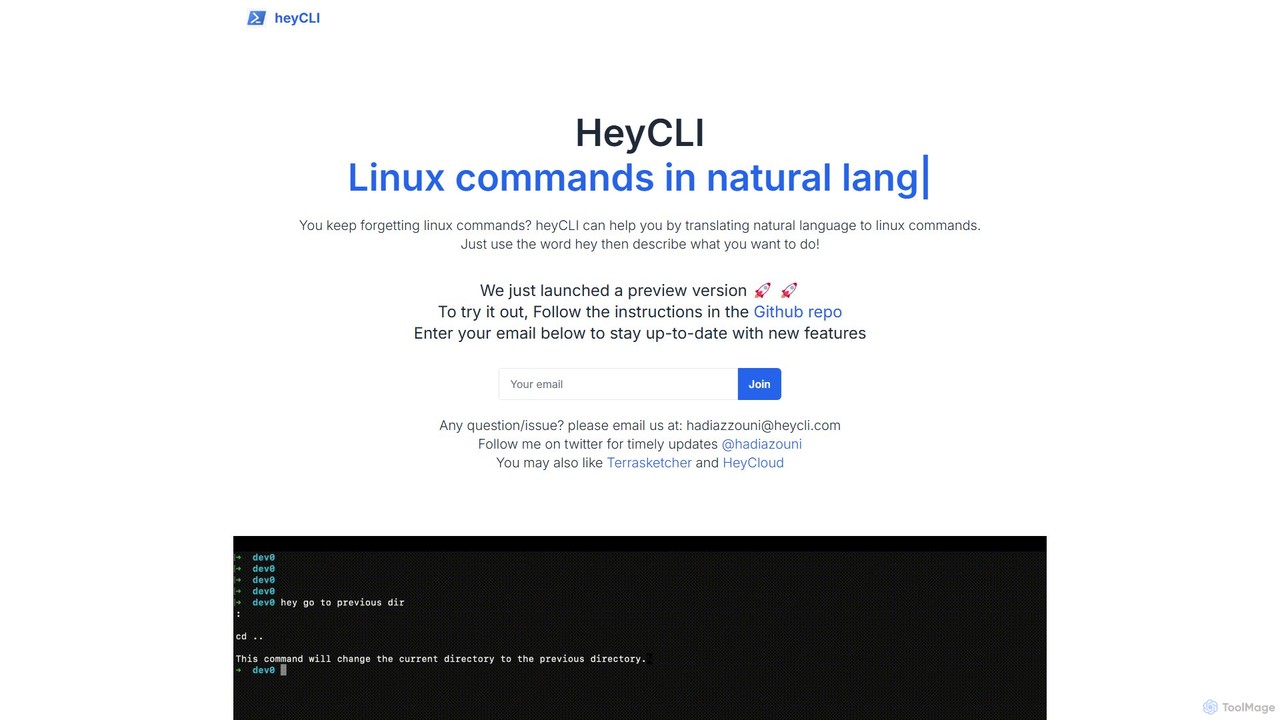
heycli is an AI-powered copilot for the command line that translates natural language into Linux commands. Simply describe the task you want to perform, and heycli generates the correct command, boosting productivity and reducing the learning curve for developers and sysadmins.
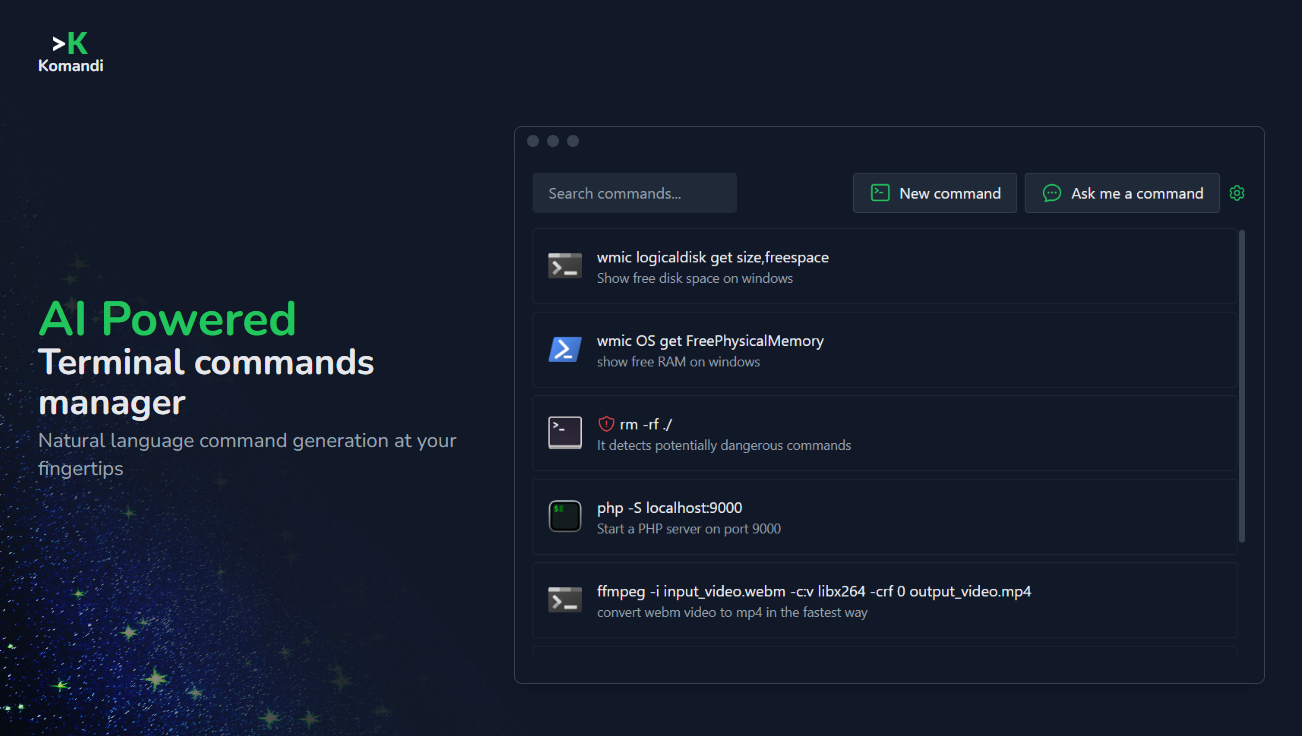
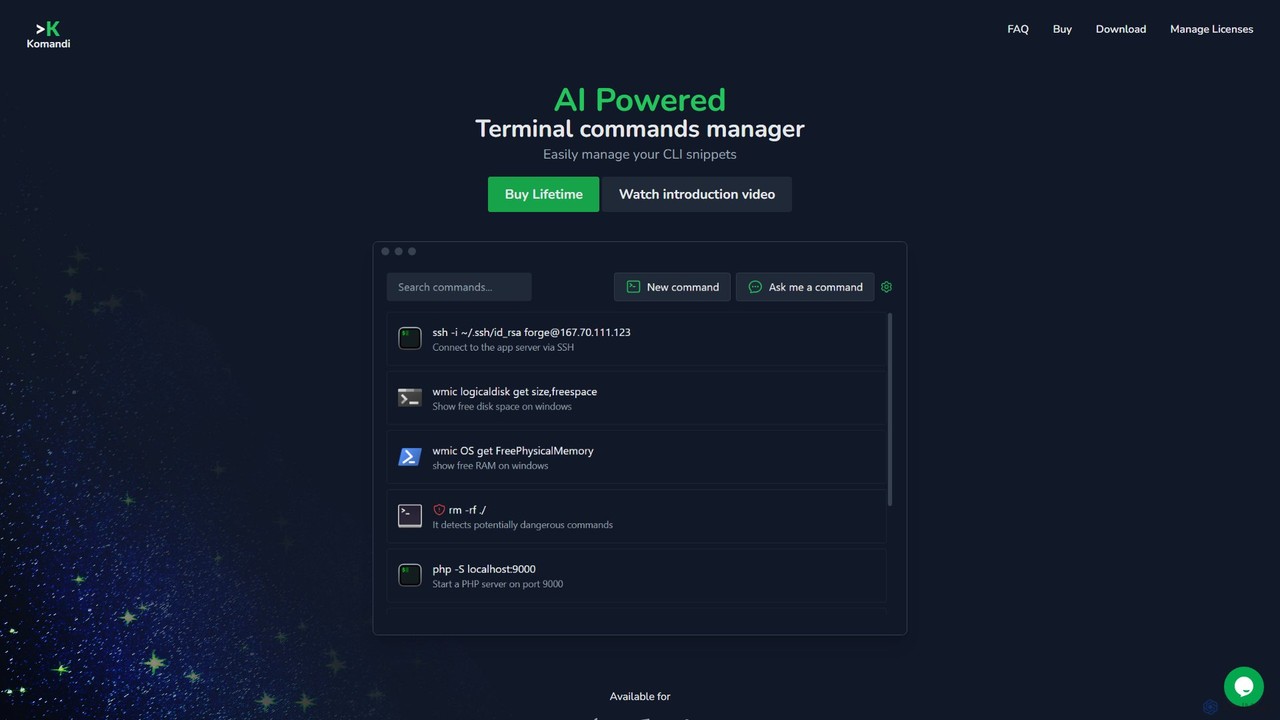
Komandi is an AI-powered CLI/terminal command manager for developers and sysadmins. It simplifies command-line operations by allowing you to manage snippets, generate complex commands from natural language, and execute them safely. It supports macOS, Windows, and Linux, streamlining your workflow by organizing frequently used commands and detecting potentially dangerous ones before execution.
Compare product focus, pricing models and audiences. Highlighted rows indicate different listed information; unknown pricing does not mean free.
| Quick facts | heycli | Komandi |
|---|---|---|
| Pricing model | Free | Paid |
| Product type | App | App |
| Primary focus | Command Line | Code Assistant |
| Audience and roles | No data available | No data available |
| Categories | Command Line · Learning · Automation | Code Assistant · Command Line · Automation |
| Added | Aug 17, 2025 | Aug 7, 2025 |
| Updated | Nov 19, 2026 | Nov 19, 2026 |
Explore the listed product descriptions, features and workflows. Taxonomy labels alone are not feature evaluations.
heycli is a revolutionary AI tool designed to act as your personal copilot for the Linux command line. It addresses a common pain point for developers, system administrators, and even seasoned tech professionals: remembering the specific syntax and options for countless Linux commands. With heycli, you no longer need to interrupt your workflow to search Google or sift through `man` pages. Instead, you can describe what you want to do in plain English, and heycli will instantly translate your request into an accurate, ready-to-use shell command.
The tool is built for seamless integration into your terminal environment. By simply prefixing your natural language query with the keyword 'hey', you activate the AI's power to interpret your intent and provide the corresponding command. This intuitive interaction model makes the command line more accessible to beginners and significantly faster for experts, transforming a potentially frustrating experience into a fluid and productive one.
Using heycli is designed to be straightforward and integrated directly into your command-line workflow. Here’s a typical process:
heycli is versatile and valuable for a wide range of users and scenarios:
The primary advantage of heycli is its ability to make the command line more human-centric. It boosts efficiency by removing the bottleneck of command recall. It lowers the barrier to entry for new users, making powerful system tools more accessible. For experts, it acts as a quick and reliable assistant for less-frequently used commands, preventing errors and saving time that would otherwise be spent on verification. This leads to a smoother, faster, and less error-prone workflow for anyone interacting with a Linux shell.
Based on the information from its launch, heycli is currently available as a free preview version. The distribution via a GitHub repository suggests an open-source or free-to-use model. Users are encouraged to sign up with their email on the official website to stay informed about new features and future developments, which may include potential premium plans or additional services in the future.
Komandi is a sophisticated desktop application designed to revolutionize how developers and system administrators interact with the command line. It acts as a centralized, intelligent manager for all your CLI/terminal commands, effectively replacing scattered notes and the endless search for complex command syntax. By leveraging the power of AI, Komandi allows users to generate necessary terminal commands simply by describing what they want to do in natural language. This significantly lowers the barrier to entry for complex tasks and boosts the productivity of even seasoned professionals.
The application is built with efficiency and safety in mind. It not only stores and organizes your most-used command snippets but also includes a crucial safety feature that detects and flags potentially dangerous commands (like `rm -rf /`) to prevent accidental, catastrophic execution. Komandi is a cross-platform tool, available for macOS, Windows, and Linux, ensuring a consistent workflow across different operating systems.
Getting started with Komandi is straightforward. First, download and install the application on your preferred operating system (macOS, Windows, or Linux). You can start with a 7-day free trial to explore the core features, though AI command generation requires a license. To unlock the full potential, purchase a lifetime license. Once activated, you can immediately start managing your commands. You can manually add, edit, and categorize your existing command snippets for quick access. To use the AI feature, simply type a prompt in plain English (or any other language) describing the task, for example, "find all files larger than 100MB in the current directory and its subdirectories." Komandi will generate the corresponding command, which you can then copy, save as a favorite, or execute directly in your chosen terminal environment, such as iTerm2, PowerShell, or Gnome Terminal. The application also allows you to manage your license and deactivate it on one device to activate it on another.
Komandi is invaluable for a wide range of professionals who regularly use the command line. For a software developer, it can instantly generate complex `git` commands for rebasing, `docker` commands for managing containers, or `npm` scripts. A system administrator or DevOps engineer can use it to quickly formulate `awk`, `sed`, or `grep` commands for log parsing, manage user permissions with `chmod`/`chown`, or configure network settings with `iptables`. For data scientists, it can help construct commands for managing virtual environments or running data processing scripts. Even users less familiar with the CLI can leverage Komandi to perform tasks that would otherwise require extensive searching and learning, making the terminal more accessible to everyone.
The primary advantage of Komandi is the massive boost in productivity and efficiency. It drastically reduces the time spent searching for command syntax on Google or Stack Overflow. The AI generation feature minimizes cognitive load and allows users to stay focused on their primary task. The dangerous command detection adds a critical layer of safety, providing peace of mind. Its cross-platform nature ensures a consistent and reliable experience regardless of your work environment. Finally, the lifetime license model offers exceptional value, providing permanent access and updates for a single, affordable price, a stark contrast to the subscription-based models of many modern tools.
Komandi offers a simple and highly attractive pricing model:
Lifetime License: For a one-time payment of $19, you get lifetime access to the application and all future updates. This plan includes:
Their taxonomy shows where the products overlap and where each one has a more distinct focus. Unknown fields are shown explicitly and are never filled with assumptions.
Traffic is shown on the same scale so differences in market visibility are not visually understated.
Both charts share the same months and vertical scale. Each tool identifies its latest reporting month; missing months are left blank, not counted as zero. Regional and source visit counts are estimates calculated from the reported shares.
| Country/region | Percentage | Estimated visits |
|---|---|---|
| 🇮🇳India | 100% | 222 |
| Country/region | Percentage | Estimated visits |
|---|---|---|
| 🇹🇷Turkey | 100% | 482 |
Ratings, comments, favorites, and likes are community signals—not a substitute for product fit.
This page is assembled from ToolMage product listings, taxonomy, traffic statistics and on-site user feedback. It is not a hands-on test or an independent review.