ToolMage
Sign in

AI TOOL COMPARISON

Magic Loops vs Toolbuilder

What is the difference, and which fits your workflow? Compare features, usage, pricing models and traffic side by side.

Jump to key differences

Product overview

Magic Loops Product overview

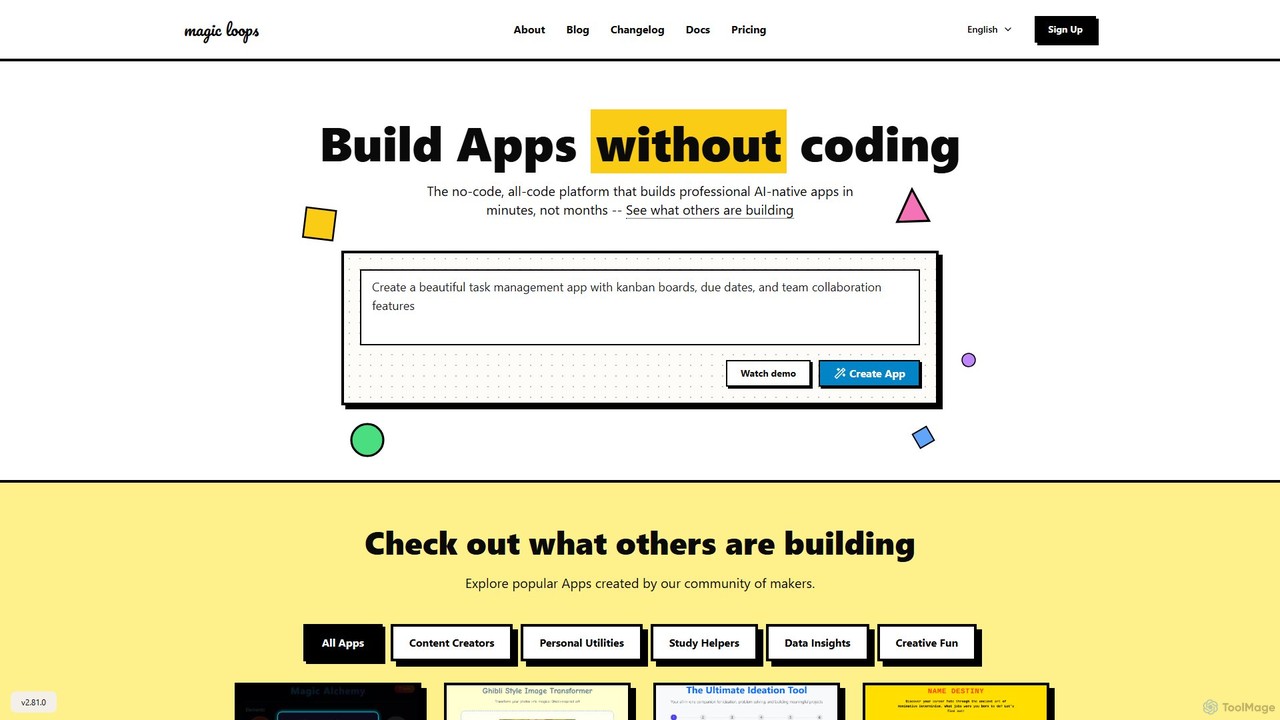
Magic Loops is a no-code/low-code platform that empowers you to build professional, AI-native applications in minutes. Simply describe your idea in plain English, and Magic Loops generates the underlying workflow and user interface. It's perfect for creators, developers, and businesses looking to rapidly prototype and deploy AI-powered tools, automations, and utilities without extensive coding.

Preview

Toolbuilder Product overview

Toolbuilder is a no-code platform that empowers users to create and deploy custom AI applications, chatbots, and automated workflows without writing a single line of code. Connect to top AI models, integrate your own data, and build specialized tools for your business needs in minutes.

Preview

Quick facts

Compare product focus, pricing models and audiences. Highlighted rows indicate different listed information; unknown pricing does not mean free.

Magic Loops VS Toolbuilder — Quick facts
Quick factsMagic LoopsToolbuilder
Pricing modelFreemiumFreemium
Product typeWebWeb
Primary focusBuildersWorkflow Management
Audience and rolesNo data availableNo data available
CategoriesBuilders · No Code · AutomationWorkflow Management · No Code · Content Generation · Automation
AddedAug 11, 2025Aug 6, 2025
UpdatedNov 19, 2026Nov 19, 2026

Features, usage and use cases

Explore the listed product descriptions, features and workflows. Taxonomy labels alone are not feature evaluations.

Magic Loops

Magic Loops is a revolutionary platform that bridges the gap between idea and execution, allowing anyone to build sophisticated AI-native applications without writing a single line of code. It operates on a unique "no-code, all-code" philosophy, making it accessible for beginners while providing the depth and flexibility required by professional developers. By simply describing your desired application in natural language, you can watch Magic Loops construct a complete, functional app in minutes, a process that would traditionally take months of development.

The platform is built around the concept of "Loops," which are visual workflows composed of interconnected blocks. Each block represents a specific action, such as calling an AI model, scraping a website, sending an email, or processing data. This modular approach makes it incredibly intuitive to design complex logic and automations. The community aspect is also a significant part of the experience, with a gallery of popular apps and loops that users can explore, clone, and customize for their own needs.

How to use Magic Loops

Getting started with Magic Loops is a straightforward, conversational process:

  1. Describe Your Idea: Begin by typing a description of the app you want to create. For example, "Build an app that takes a URL, summarizes the content, and emails me the summary."
  2. AI-Powered Generation: Magic Loops' AI analyzes your request and automatically generates a "Loop"—a visual workflow of the necessary steps (e.g., an API trigger block, a web scraper block, an LLM block for summarization, and an email block).
  3. Customize and Refine: Review the generated Loop. You can easily add, remove, or reconfigure blocks in the visual editor. You can also customize the app's front-end UI to match your vision. For developers, there's an option to inject custom Python or TypeScript code for more advanced logic.
  4. Test and Deploy: Run test executions of your Loop to ensure everything works as expected. Once you're satisfied, you can publish your app.
  5. Integrate and Share: Published apps can be triggered via a unique API endpoint, a webhook, or on a set schedule. You can integrate them into your existing workflows, share them with others, or even showcase them in the Magic Loops community marketplace.

Core Features of Magic Loops

  • AI-Powered App Builder: Generate entire applications from a simple text description.
  • Visual Workflow Editor (Loops): Intuitively build and manage complex automations by connecting functional blocks.
  • Extensive Block Library: Access a wide range of pre-built blocks, including integrations with AI models (GPT-4, Claude, DALL-E, Perplexity), web scrapers, API requests, Google Sheets, and notification services (Email, SMS).
  • Custom Code Integration: The "all-code" philosophy allows developers to write and insert custom Python and TypeScript code directly into their workflows for maximum control.
  • Community Marketplace: Discover, use, and learn from a vast collection of apps and loops created by other users.
  • API & Webhook Triggers: Seamlessly integrate your created apps into any external service or workflow.
  • Customizable UI: Tailor the look and feel of your application's user interface.
  • Transparent Credit System: A clear, usage-based pricing model for both app generation and execution.

Use Cases for Magic Loops

The versatility of Magic Loops makes it suitable for a wide array of applications:

  • Productivity & Automation: Create tools to summarize articles (TL;DR Anything), track expenses, automate reporting, or manage tasks.
  • Content Creation: Build idea generators, content repurposing tools, social media post schedulers, or AI-powered writing assistants.
  • Creative & Entertainment: Develop fun games (Magic Alchemy), AI art generators (Ghibli Transformer), or personalized story creators.
  • Business & Finance: Design internal tools for data analysis, lead qualification bots, customer support automations, or financial trackers.
  • Education: Generate personalized project ideas for students or create study helper tools.

Advantages of Magic Loops

Magic Loops offers significant advantages over traditional development methods:

  • Unmatched Speed: Go from concept to a deployed application in minutes, drastically reducing development time.
  • Extreme Accessibility: Empowers non-technical users, marketers, and entrepreneurs to build their own software solutions.
  • High Flexibility: Caters to both no-code creators and professional developers, offering the best of both worlds.
  • Cost-Effective: The freemium model and transparent credit system make it affordable to start and scale.
  • Community-Powered Innovation: Leverage the collective creativity of the community to find inspiration and ready-to-use templates.

Pricing and Plans

Magic Loops uses a fair and transparent credit-based system. Paid plans are based on a rate of $1 USD per 1000 credits.

  • Free: Perfect for getting started. Includes 8,000 initial credits, 250 daily generation credits, 500 monthly run credits, and access to public loops.
  • Hobby: $9/month for 9,000 credits and dedicated support.
  • Professional: $20/month for 20,000 credits. Includes private loops, dynamic credits, and dedicated support.
  • Developer: $50/month for 50,000 credits.
  • Startup: $300/month for 300,000 credits and 1:1 support.
  • Enterprise: Custom pricing for large organizations. Offers unlimited credits, on-premise hosting options, SOC 2 compliance, custom models, and premium 1:1 support.

Toolbuilder

Toolbuilder is a revolutionary no-code platform designed to democratize AI development. It provides an intuitive, visual interface that allows anyone, from entrepreneurs and marketers to developers and business analysts, to build powerful, custom AI-powered tools. Instead of relying on generic AI solutions, Toolbuilder enables you to create applications tailored specifically to your unique data, workflows, and business objectives. The platform serves as a bridge between complex AI models and practical business applications, removing the technical barriers traditionally associated with AI development.

With Toolbuilder, you can transform your ideas into functional AI applications rapidly. Whether you need a customer support chatbot trained on your company's knowledge base, a content generator that matches your brand's voice, or an internal tool to automate data analysis, the platform provides all the necessary components to bring your vision to life. It's built for speed, flexibility, and scalability, allowing you to prototype, test, and deploy AI solutions in a fraction of the time and cost it would take with traditional methods.

How to use Toolbuilder

Using Toolbuilder is a straightforward, step-by-step process designed for clarity and efficiency:

  1. Define Your Goal: Start by clearly defining what you want your AI tool to accomplish. For example, 'Summarize customer reviews' or 'Generate social media posts from a blog article'.
  2. Select an AI Model: Choose from a variety of leading AI models (like GPT-4, Claude, etc.) that best suit your task's complexity and creative needs.
  3. Provide Context with Data: Upload your own data to give the AI context. This can be in the form of documents (PDFs, TXT), website content, or direct text input. This step is crucial for creating a tool that understands your specific domain.
  4. Design the Workflow: Use the visual, drag-and-drop editor to build your tool's logic. You can chain multiple steps together, such as 'Extract keywords from text', then 'Use keywords to search a database', and finally 'Generate a report based on the findings'.
  5. Create the User Interface: Customize the input and output fields for your tool. Create a simple, user-friendly interface for anyone to use your new application.
  6. Test and Deploy: Test your tool within the platform to ensure it works as expected. Once you're satisfied, you can deploy it and share it with others via a unique link, embed it on your website, or integrate it into other systems using an API.

Core Features of Toolbuilder

  • No-Code Visual Builder: An intuitive drag-and-drop interface for building complex AI workflows without any programming.
  • Multi-Model Integration: Access to a wide range of state-of-the-art Large Language Models (LLMs) to power your applications.
  • Custom Data Sources: Train your AI tools on your own data by uploading documents, scraping websites, or connecting to databases for highly relevant and accurate outputs.
  • Workflow Automation: Chain multiple AI prompts and actions together to create sophisticated, multi-step automations.
  • Instant Deployment & Sharing: Generate a shareable web app for your tool with a single click, or embed it directly into your existing websites and platforms.
  • API Access: For advanced users, Toolbuilder provides API access to integrate your custom-built tools into other software and services.
  • Team Collaboration: Work with your team to build, manage, and improve AI tools in a shared workspace.

Use Cases for Toolbuilder

Toolbuilder is versatile and can be applied across various industries and functions:

  • Marketing: Create tools for generating ad copy, writing SEO-optimized blog posts, creating social media calendars, or personalizing email campaigns.
  • Customer Support: Build custom chatbots trained on your product documentation and FAQs to provide instant, accurate answers to customer queries 24/7.
  • Human Resources: Develop tools to screen resumes, generate job descriptions, or create onboarding materials for new hires.
  • Operations: Automate the process of summarizing reports, extracting key information from contracts and legal documents, or analyzing customer feedback.
  • Sales: Build a tool to generate personalized sales pitches, research potential leads, or summarize call transcripts.

Advantages of Toolbuilder

The primary advantage of Toolbuilder is its ability to empower non-technical users to build sophisticated AI. This leads to several key benefits:

  • Speed to Market: Go from idea to a functional AI application in hours, not months.
  • Cost-Effective: Drastically reduces the development costs associated with hiring specialized AI engineers and developers.
  • Hyper-Customization: Create tools that are perfectly aligned with your specific workflows, data, and brand voice, which off-the-shelf solutions cannot offer.
  • Democratization of AI: Enables teams across your organization to leverage AI, fostering innovation and improving efficiency without needing a centralized development team.
  • Scalability: Start with a simple tool and easily scale its complexity and usage as your business needs grow.

Pricing and Plans

Toolbuilder offers a flexible pricing structure to suit different needs, from individual creators to large enterprises.

  • Free Plan: Perfect for exploring the platform. Includes a limited number of tool runs per month, access to basic AI models, and the ability to build and test a few tools.
  • Pro Plan (approx. $29/month): Ideal for professionals and small businesses. Offers a significantly higher number of tool runs, access to premium AI models, the ability to build more tools, and standard support.
  • Business Plan (Custom Pricing): Designed for teams and enterprises. Includes unlimited tool creation, high-volume usage, advanced features like API access, team collaboration, dedicated support, and enhanced security.

Positioning

Their taxonomy shows where the products overlap and where each one has a more distinct focus. Unknown fields are shown explicitly and are never filled with assumptions.

Categories

Shared
No CodeAutomation
Only Magic Loops
Builders
Only Toolbuilder
Workflow ManagementContent Generation

Tags

Shared
automationdeveloper toolsgptno-codeworkflow automation
Only Magic Loops
AI applicationAI-nativeapp builderlow-codevisual programming
Only Toolbuilder
AI agentAI app builderchatbot buildercustom AIllm

Audience and roles

Shared
No listed items
Only Magic Loops
No listed items
Only Toolbuilder
No listed items

Traffic comparison

Traffic is shown on the same scale so differences in market visibility are not visually understated.

How to interpret the traffic data

Both charts share the same months and vertical scale. Each tool identifies its latest reporting month; missing months are left blank, not counted as zero. Regional and source visit counts are estimates calculated from the reported shares.

Magic Loops monthly traffic:

Latest traffic · 2026-05

Monthly visits
5.5K
Avg. visit duration
0:18
Pages per visit
2.3
Bounce rate
42.54%
Data updated 2026-06-15

Monthly traffic trend

  • 2025-09: 94K
  • 2026-01: 26K
  • 2026-02: 13.2K
  • 2026-03: 11.3K
  • 2026-04: 9K
  • 2026-05: 5.5K

Top regions

Top 5 countries/regions
Country/regionPercentageEstimated visits
🇲🇽Mexico33.06%1.8K
🇦🇷Argentina24.41%1.4K
🇺🇸United States21.17%1.2K
🇮🇩Indonesia12.61%698
🇺🇾Uruguay8.75%484

Traffic sources

Source typePercentageEstimated visits
Direct73.33%4.1K
Referral26.67%1.5K

Search keywords

app magicloops iamagic loopsmagicloopsmagit loops

Toolbuilder

No data available

Community signals

Ratings, comments, favorites, and likes are community signals—not a substitute for product fit.

Magic Loops

Rating
No data available
Comments
0
Favorites
188
Likes
176

Toolbuilder

Rating
No data available
Comments
0
Favorites
188
Likes
203

Magic Loops vs Toolbuilder · Comparison FAQ

What do Magic Loops and Toolbuilder have in common?
Both tools are listed under No Code、Automation. These categories indicate overlapping use cases; compare their detailed descriptions for workflows, capabilities and limitations.
Are Magic Loops and Toolbuilder free?
Listed pricing models: Magic Loops — Freemium; Toolbuilder — Freemium. Missing pricing is not proof of a free plan, and freemium does not mean every feature is free. Check official sites for current plans, limits and trials.
How should I choose between Magic Loops and Toolbuilder?
The primary listed category is Builders for Magic Loops, and Workflow Management for Toolbuilder. Compare features, steps and use cases, then verify pricing, data permissions and deployment needs. This page does not include hands-on testing and does not declare a winner from traffic or tags.

Sources and comparison methodology

This page is assembled from ToolMage product listings, taxonomy, traffic statistics and on-site user feedback. It is not a hands-on test or an independent review.

  • Feature and plan descriptions reflect information in the listings, not real-time guarantees. Verify pricing, quotas, availability and privacy terms on the official sites.
  • Traffic uses the reporting months shown. Missing statistics do not mean zero visits, and different periods do not establish growth or superiority. Regional and source visit counts are estimates based on shares.
  • Different tags indicate differences in the listings, not proof that the other product lacks a capability. Ratings, favorites and visits are not used to declare a winner.

Related comparisons