ToolMage
Sign in

AI TOOL COMPARISON

Magic Patterns vs Miro

What is the difference, and which fits your workflow? Compare features, usage, pricing models and traffic side by side.

Jump to key differences

Product overview

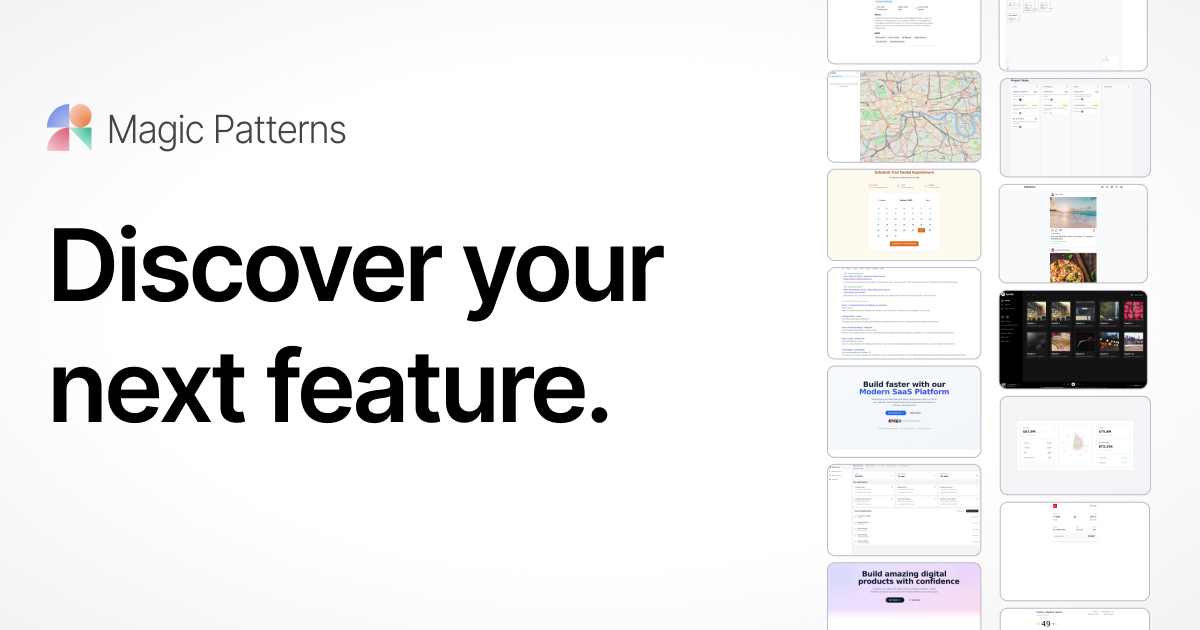
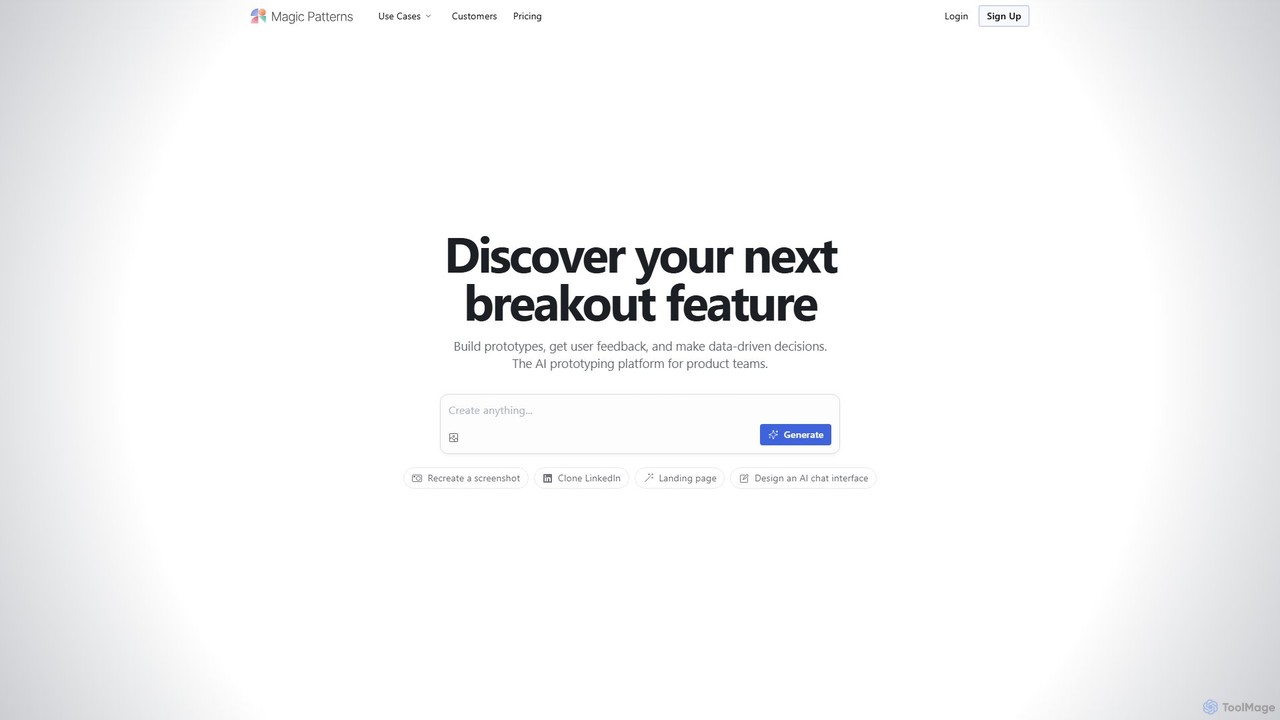
Magic Patterns Product overview

Magic Patterns is an AI-powered prototyping platform for product teams, designers, and developers. It accelerates UI creation by generating interactive prototypes and production-ready code (React, Tailwind CSS) from text prompts, screenshots, or existing websites. It helps teams iterate faster, gather user feedback, and make data-driven decisions.

Preview

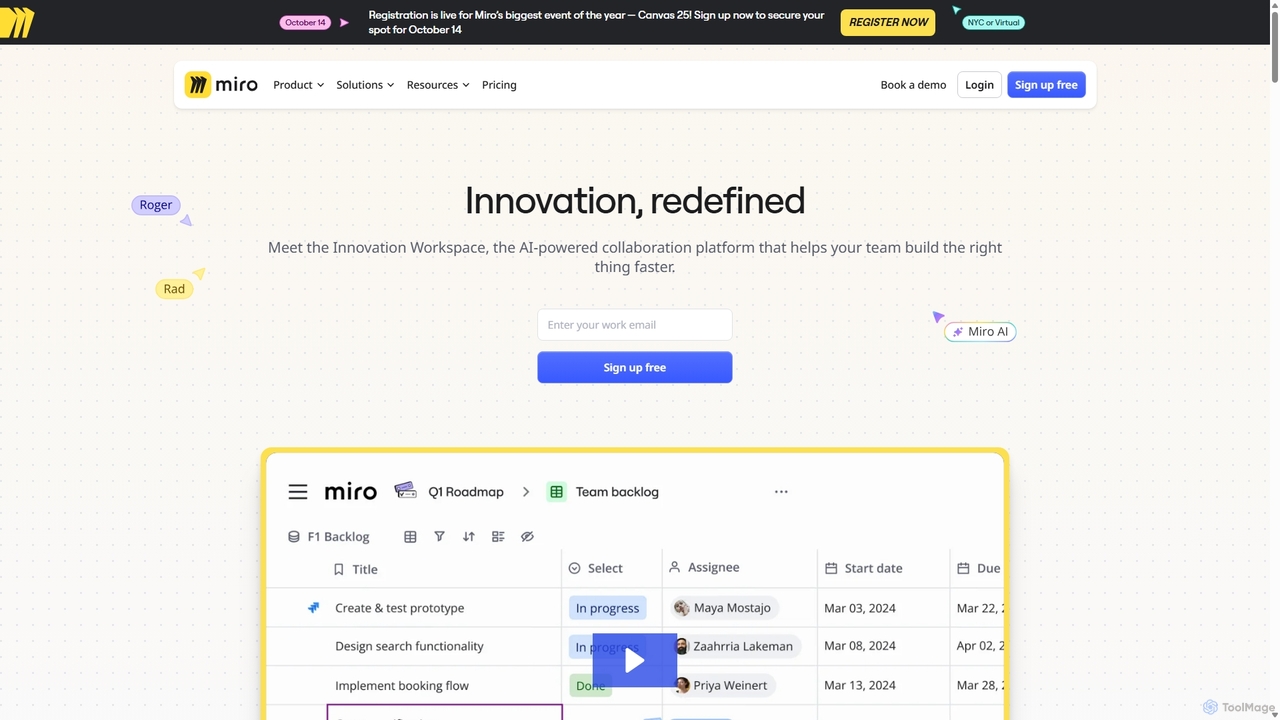
Miro Product overview

Miro is an AI-powered online collaborative whiteboard platform designed for modern teams. It provides an infinite canvas for brainstorming, planning, designing, and managing projects in real-time. With a vast template library, powerful integrations, and AI-driven features, Miro helps teams centralize communication and accelerate innovation from idea to execution.

Preview

Quick facts

Compare product focus, pricing models and audiences. Highlighted rows indicate different listed information; unknown pricing does not mean free.

Magic Patterns VS Miro — Quick facts
Quick factsMagic PatternsMiro
Pricing modelFreemiumFreemium
Product typeWebWeb
Primary focusPrototypingBrainstorming
Audience and rolesNo data availableAgile Coach · Consultant · Facilitator · IT Manager · Marketing Manager · Product Manager · Project Manager · Researcher · Software Developer · Strategist · Team Lead · UX/UI Designer
CategoriesPrototyping · Low Code No Code · CollaborationBrainstorming · Prototyping · Collaboration · Visual Management
AddedAug 8, 2025Sep 8, 2025
UpdatedNov 19, 2026Nov 19, 2026

Features, usage and use cases

Explore the listed product descriptions, features and workflows. Taxonomy labels alone are not feature evaluations.

Magic Patterns

Magic Patterns is a revolutionary AI prototyping platform designed to streamline the workflow for product teams, designers, and frontend engineers. It empowers users to transform ideas into high-fidelity, interactive prototypes and production-ready code in minutes. By leveraging advanced AI, the platform can generate complex user interfaces from simple text descriptions, screenshots of existing applications, or by cloning a website's URL. This dramatically reduces the time and effort required for initial design and development, fostering a culture of rapid experimentation and iteration.

Trusted by professionals at leading companies like Figma and Doordash, Magic Patterns is built for speed and collaboration. It allows teams to quickly build out new feature ideas, test them directly with customers, and gather valuable feedback to make informed, data-driven product decisions. The platform is not just about creating static images; it generates functional components that can be edited and refined in real-time through a conversational chat interface.

How to use Magic Patterns

Using Magic Patterns is an intuitive process designed to be accessible to both technical and non-technical users:

  1. Provide Input: Start by giving the AI a prompt. This can be a text description (e.g., "Create a Kanban board with draggable cards"), a screenshot of a design you like, or the URL of a website you wish to replicate or take inspiration from.
  2. AI Generation: The AI processes your input and generates a fully responsive UI component or page. The underlying technology stack includes modern frameworks like React and Tailwind CSS, ensuring the output is clean and maintainable.
  3. Iterate and Refine: Use the simple chat interface to make live edits. You can request changes like "Make the primary button indigo," "Add a search bar to the header," or "Change the layout to three columns." The AI will apply these changes instantly.
  4. Collaborate with Your Team: Share a link to your live prototype with colleagues. Designers, engineers, and product managers can all view, comment, and even make edits, ensuring everyone is aligned.
  5. Export for Production: Once the design is finalized, you can export it in multiple formats. Export to Figma for further design refinement or grab the production-ready React, HTML, and Tailwind CSS code to hand off to your development team, significantly speeding up the implementation phase.

Core Features of Magic Patterns

  • AI-Powered UI Generation: Create UI components and full pages from text, screenshots, or URLs.
  • Design System Matching: Automatically detects and matches your existing product's styling, colors, and fonts to ensure brand consistency.
  • Rapid Prototyping: Build and test interactive prototypes in minutes to validate ideas with real users.
  • Real-time Team Collaboration: Edit, share, and iterate on designs live with your entire team, breaking down silos between design and engineering.
  • Production-Ready Code Export: Generates clean, maintainable code in React, Tailwind CSS, and HTML.
  • Figma Integration: Seamlessly export designs to Figma for a smooth design-to-development handoff.
  • Enterprise-Ready Security: Offers robust security and compliance features to keep your business data safe.
  • Community Component Library: Explore and use over a million designs created by the community for inspiration or as a starting point.

Use Cases for Magic Patterns

Magic Patterns is versatile and can be used by various roles within an organization:

  • Product Managers: Quickly create high-fidelity mockups for new feature proposals, stakeholder presentations, and sales demos.
  • UI/UX Designers: Accelerate the wireframing and design process by generating multiple layout options and component variations instantly.
  • Frontend Developers: Eliminate boilerplate work by starting with AI-generated, production-quality code, allowing them to focus on complex logic.
  • Startups and Founders: Build and launch MVPs (Minimum Viable Products) and landing pages at a fraction of the traditional time and cost.
  • Marketing Teams: Create realistic product mockups for marketing campaigns and client presentations without needing engineering resources.

Advantages of Magic Patterns

The primary advantage of Magic Patterns is the massive boost in speed and efficiency. It bridges the gap between idea and execution, allowing teams to ship products faster. By enabling rapid experimentation, it helps teams build better products based on direct user feedback. The platform also promotes consistency by adhering to existing design systems and empowers non-technical team members to contribute to the design process, fostering a more collaborative and agile environment.

Pricing and Plans

Magic Patterns offers a freemium model to suit different needs:

  • Free Plan: Ideal for exploring and trialing the platform. It includes limited AI message credits, export to Figma, and custom domains.
  • Hobby Plan ($19/seat/month, billed annually): Designed for hobbyists and individuals with light usage. It offers higher message limits, a faster AI model, private generations, and removes the watermark on previews.
  • Pro Plan ($75/seat/month, billed annually): The best option for professional software builders who need to ship fast. It includes significantly higher message limits, shared team presets, centralized billing, Slack Connect, and priority support.
  • Enterprise Plan (Custom Pricing): Tailored for large organizations, offering custom contracts, advanced security, personalized onboarding, and dedicated support.

Paid plans allow for the commercial use of all generated designs and code.

Miro

Miro is a comprehensive visual collaboration platform, branded as The Innovation Workspace, designed to empower remote, in-office, and hybrid teams to communicate and collaborate effectively. It offers a flexible and intuitive online whiteboard that serves as a single source of truth for team projects, from initial brainstorming sessions to final project delivery. With over 90 million users, Miro has established itself as a leading solution for teams looking to streamline workflows, foster creativity, and accelerate outcomes.

The platform's core is its infinite canvas, which allows teams to visualize complex ideas, systems, and strategies without limitations. This is enhanced by Miro AI, a suite of intelligent features that automate tedious tasks, generate new ideas, create diagrams from text, and summarize complex information, freeing up teams to focus on high-impact work. Miro is built for all types of teams, including product, UX & design, engineering, marketing, and project management, providing specialized tools and templates for each.

How to use Miro

Getting started with Miro is straightforward. First, sign up for a free account using your work email. You can then create a new board from scratch or choose from over 5,000 pre-built templates in the Miroverse community library to kickstart your project. Invite your teammates to the board to collaborate in real-time, where everyone can add sticky notes, draw concepts, upload files, and leave comments. For asynchronous collaboration, use the Talktrack feature to record a video walkthrough of your board. Leverage Miro AI by simply typing a prompt to generate mind maps, sequence diagrams, or summarize existing content. To integrate Miro into your existing ecosystem, connect it with over 160 apps like Jira, Asana, Slack, Google Drive, and Microsoft Teams to create a seamless workflow.

Core Features of Miro

  • Miro AI: An AI-powered assistant to generate ideas, summarize content, create diagrams, and automate repetitive tasks.
  • Infinite Canvas: A limitless digital whiteboard for brainstorming, diagramming, and visualizing workflows.
  • Real-time Collaboration: Work simultaneously with teammates, see their cursors, and communicate via comments, mentions, and built-in video chat.
  • Extensive Template Library: Access thousands of templates for various use cases, including agile workflows, design thinking, strategy planning, and more.
  • Advanced Diagramming: Create professional diagrams, flowcharts, mind maps, and system architecture visuals with a vast library of shape packs (UML, AWS, Azure).
  • Workshop & Facilitation Tools: Engage participants with features like a timer, voting, private mode, and interactive presentation tools.
  • Powerful Integrations: Connect with over 160 popular tools, including Atlassian (Jira), Microsoft 365, Google Workspace, Slack, and Zoom.
  • Enterprise-Grade Security: Features like Single Sign-On (SSO), data residency options (EU/US), and advanced governance controls ensure your data is secure.

Use Cases for Miro

Miro is versatile and supports a wide range of professional activities:

  • Product Management: Building product roadmaps, conducting sprint planning, and creating user story maps.
  • UX & Design Research: Creating customer journey maps, wireframing, building interactive prototypes, and synthesizing user research.
  • Engineering: Visualizing cloud architecture, mapping out complex systems, and facilitating agile ceremonies like retrospectives.
  • Program & Project Management: Centralizing project plans, tracking progress, managing dependencies, and aligning stakeholders.
  • Marketing: Planning campaigns, developing content strategies, and brainstorming creative concepts.
  • Strategy & Planning: Facilitating strategic planning sessions, conducting SWOT analysis, and creating business model canvases.

Advantages of Miro

Miro's primary advantage is its ability to serve as a centralized hub for all team collaboration, reducing the need to switch between multiple tools. Its AI capabilities significantly boost productivity by automating routine tasks and sparking creativity. The platform is highly flexible, catering to diverse team needs with customizable templates and a robust developer platform. For organizations, Miro offers scalability and enterprise-level security, ensuring that it can grow with the company while protecting sensitive information. The intuitive, visual interface makes it easy for anyone to contribute, fostering a more inclusive and engaging collaborative environment.

Pricing and Plans

Miro offers a freemium model with several tiers to suit different needs:

  • Free Plan: $0. Includes unlimited team members, 3 editable boards, and access to core templates and integrations. Miro AI is available with 10 credits/month per team.
  • Starter Plan: Starts at $8 per member/month (billed annually). Includes everything in Free, plus unlimited editable boards, private boards, high-resolution exports, and version history. Miro AI credits increase to 25/month per member.
  • Business Plan: Starts at $16 per member/month (billed annually). Best for teams and companies, it adds unlimited guests, Single Sign-On (SSO), advanced diagramming, and two-way sync with Jira/Azure. Miro AI credits increase to 50/month per member.
  • Enterprise Plan: Custom pricing. Designed for large organizations, this plan offers advanced security, centralized management, flexible licensing, dedicated support, and 100 Miro AI credits/month per member.

Add-ons like Miro Prototyping and Enterprise Guard are also available for specific plans.

Positioning

Their taxonomy shows where the products overlap and where each one has a more distinct focus. Unknown fields are shown explicitly and are never filled with assumptions.

Categories

Shared
PrototypingCollaboration
Only Magic Patterns
Low Code No Code
Only Miro
BrainstormingVisual Management

Tags

Shared
collaborationprototypingux design
Only Magic Patterns
code generationdesign systemfigmafrontend developmentlow-codeno-codeproduct developmentreactTailwind CSSui design
Only Miro
agileAI-poweredbrainstormingdiagramminginnovationmind mappingproject managementremote workvisual workspacewhiteboard

Audience and roles

Shared
No listed items
Only Magic Patterns
No listed items
Only Miro
Agile CoachConsultantFacilitatorIT ManagerMarketing ManagerProduct ManagerProject ManagerResearcherSoftware DeveloperStrategistTeam LeadUX/UI Designer

Traffic comparison

Traffic is shown on the same scale so differences in market visibility are not visually understated.

How to interpret the traffic data

Both charts share the same months and vertical scale. Each tool identifies its latest reporting month; missing months are left blank, not counted as zero. Regional and source visit counts are estimates calculated from the reported shares.

Magic Patterns monthly traffic:

Latest traffic · 2026-05

Monthly visits
241.9K
Avg. visit duration
1:59
Pages per visit
2.46
Bounce rate
45.8%
Data updated 2026-06-15

Monthly traffic trend

  • 2025-09: 278.8K
  • 2026-01: 319.2K
  • 2026-02: 337.8K
  • 2026-03: 304.6K
  • 2026-04: 321.7K
  • 2026-05: 241.9K

Top regions

Top 5 countries/regions
Country/regionPercentageEstimated visits
🇺🇸United States67.21%162.6K
🇮🇳India13.45%32.5K
🇮🇩Indonesia7.21%17.4K
🇵🇭Philippines6.2%15K
🇪🇬Egypt5.93%14.3K

Traffic sources

Source typePercentageEstimated visits
Direct84.88%205.3K
Referral11.86%28.7K
Email3.26%7.9K

Search keywords

claude designmagic patternmagic patternsmagicpatternsmagic patterns ai

Miro monthly traffic:

Latest traffic · 2026-05

Monthly visits
31M
Avg. visit duration
3:23
Pages per visit
2.98
Bounce rate
50.32%
Data updated 2026-06-11

Monthly traffic trend

  • 2025-09: 31.9M
  • 2026-01: 29.8M
  • 2026-02: 30M
  • 2026-03: 34.4M
  • 2026-04: 32.7M
  • 2026-05: 31M

Top regions

Top 5 countries/regions
Country/regionPercentageEstimated visits
🇺🇸United States32.34%10M
🇷🇺Russia26.41%8.2M
🇩🇪Germany15.38%4.8M
🇬🇧United Kingdom13.32%4.1M
🇧🇷Brazil12.55%3.9M

Traffic sources

Source typePercentageEstimated visits
Direct85.84%26.6M
Referral9.79%3M
Email4.37%1.4M

Search keywords

mapa conceptualmapa mentalmiromiro boardмиро

Community signals

Ratings, comments, favorites, and likes are community signals—not a substitute for product fit.

Magic Patterns

Rating
No data available
Comments
0
Favorites
142
Likes
160

Miro

Rating
No data available
Comments
0
Favorites
160
Likes
178

Magic Patterns vs Miro · Comparison FAQ

What do Magic Patterns and Miro have in common?
Both tools are listed under Prototyping、Collaboration. These categories indicate overlapping use cases; compare their detailed descriptions for workflows, capabilities and limitations.
Are Magic Patterns and Miro free?
Listed pricing models: Magic Patterns — Freemium; Miro — Freemium. Missing pricing is not proof of a free plan, and freemium does not mean every feature is free. Check official sites for current plans, limits and trials.
How should I choose between Magic Patterns and Miro?
The primary listed category is Prototyping for Magic Patterns, and Brainstorming for Miro. Compare features, steps and use cases, then verify pricing, data permissions and deployment needs. This page does not include hands-on testing and does not declare a winner from traffic or tags.

Sources and comparison methodology

This page is assembled from ToolMage product listings, taxonomy, traffic statistics and on-site user feedback. It is not a hands-on test or an independent review.

  • Feature and plan descriptions reflect information in the listings, not real-time guarantees. Verify pricing, quotas, availability and privacy terms on the official sites.
  • Traffic uses the reporting months shown. Missing statistics do not mean zero visits, and different periods do not establish growth or superiority. Regional and source visit counts are estimates based on shares.
  • Different tags indicate differences in the listings, not proof that the other product lacks a capability. Ratings, favorites and visits are not used to declare a winner.

Related comparisons