MLflow
Data Science
AI TOOL COMPARISON
What is the difference, and which fits your workflow? Compare features, usage, pricing models and traffic side by side.
Data Science
Frameworks
MLflow is an open-source platform for managing the end-to-end machine learning lifecycle. It enables developers and data scientists to track experiments, package code into reproducible runs, version and share models, and deploy them to production, supporting both traditional ML and modern GenAI applications.
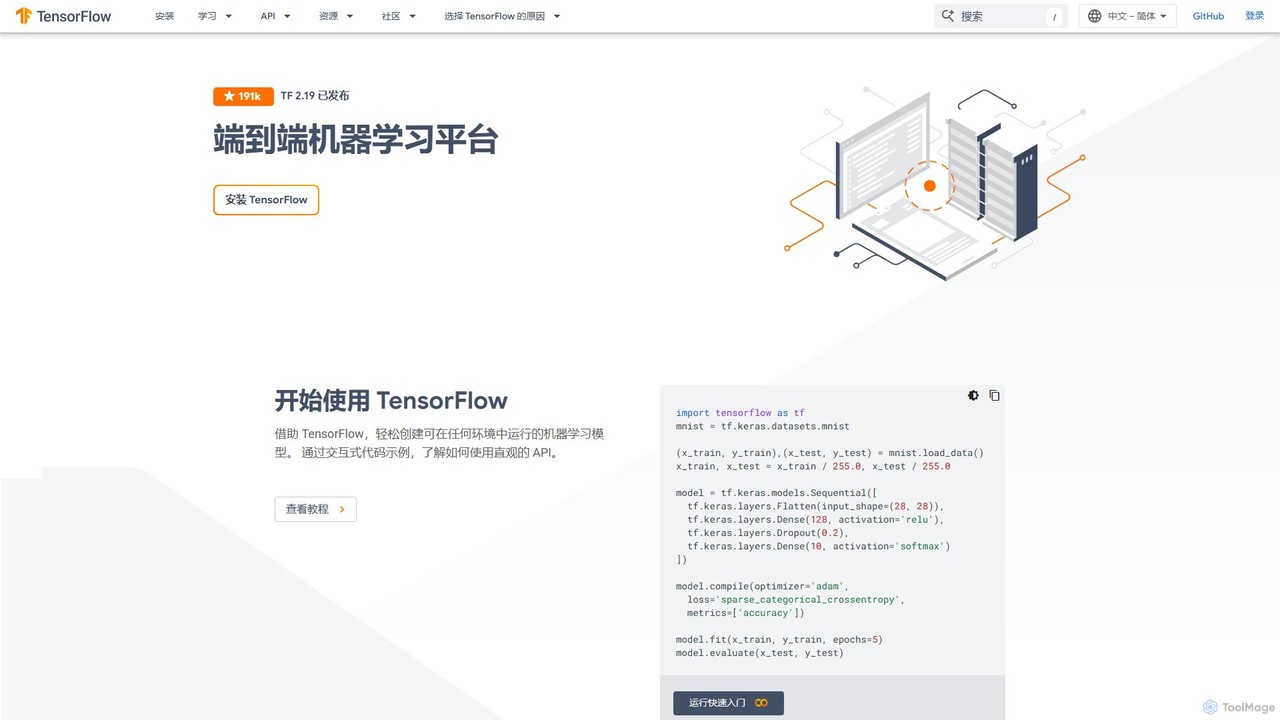
TensorFlow is an end-to-end open-source platform for machine learning developed by Google. It provides a comprehensive, flexible ecosystem of tools, libraries, and community resources that lets researchers and developers build and deploy ML-powered applications. From beginners to experts, TensorFlow offers intuitive high-level APIs for easy model building and powerful low-level APIs for advanced research, enabling deployment across servers, edge devices, and browsers.
Compare product focus, pricing models and audiences. Highlighted rows indicate different listed information; unknown pricing does not mean free.
| Quick facts | MLflow | TensorFlow |
|---|---|---|
| Pricing model | Freemium | Free |
| Product type | Web | Web |
| Primary focus | Data Science | Frameworks |
| Audience and roles | No data available | No data available |
| Categories | Data Science · Machine Learning · Developer Tools | Frameworks · Machine Learning · Developer Tools |
| Added | Aug 4, 2025 | Aug 11, 2025 |
| Updated | Nov 19, 2026 | Nov 19, 2026 |
Explore the listed product descriptions, features and workflows. Taxonomy labels alone are not feature evaluations.
MLflow is a comprehensive open-source platform designed to streamline the entire machine learning lifecycle, from experimentation to deployment and management. Developed by the creators of Apache Spark and trusted by thousands of organizations, MLflow provides a robust framework for building production-ready AI applications with confidence. It caters to both traditional machine learning workflows and the rapidly evolving landscape of Generative AI (GenAI) applications and agents.
The platform is built on an open interface, allowing it to work with any ML library, algorithm, deployment tool, or language. This flexibility makes it a central hub for MLOps, ensuring that teams can maintain their preferred tools while benefiting from standardized lifecycle management. MLflow is structured around four primary components: Tracking, Projects, Models, and the Model Registry, which together provide a cohesive solution for managing complexity in AI development.
Getting started with MLflow is straightforward, with options for both local self-hosting and managed cloud services.
1. Installation: Begin by installing MLflow using pip: pip install mlflow.
2. Integration: Integrate MLflow into your training code. You can use the powerful one-line autologging feature for popular frameworks like PyTorch, TensorFlow, and scikit-learn (e.g., mlflow.pytorch.autolog()). This automatically captures metrics, parameters, models, and other artifacts. For more granular control, you can use manual logging APIs like mlflow.log_param(), mlflow.log_metric(), and mlflow.log_artifact().
3. Run Experiments: Execute your training script. MLflow will automatically log all the specified information into a local directory (mlruns) or a remote tracking server.
4. Visualize Results: Launch the MLflow UI by running mlflow ui in your terminal. This web-based interface allows you to compare the performance of different runs, visualize metrics, and inspect artifacts.
5. Package and Register Models: Once you've identified the best model, use MLflow to package it in a standard format. You can then register it with the MLflow Model Registry to manage its versions, stages (e.g., Staging, Production), and annotations.
6. Deploy: Deploy the versioned model from the registry to various production environments, including cloud platforms, Kubernetes, or local REST servers.
MLflow's versatility makes it suitable for a wide range of AI applications:
MLflow offers significant advantages for individuals and teams building AI systems:
MLflow is fundamentally a free and open-source tool with a flexible deployment model:
TensorFlow is a free and open-source software library for machine learning and artificial intelligence. Developed by the Google Brain team, it has become one of the most popular and widely used platforms for building and training neural networks. TensorFlow provides an end-to-end ecosystem that allows developers to easily build, train, and deploy ML models across a wide range of platforms, from large server farms to small edge devices and even web browsers.
The core of TensorFlow is a system for defining and running computations involving tensors, which are multi-dimensional arrays. This dataflow graph-based model allows for immense flexibility and scalability. It is designed to facilitate everything from large-scale research experiments to robust, production-ready applications, powering many of Google's own products like Search, Gmail, and Photos.
The typical workflow for using TensorFlow involves several key steps:
pip install tensorflow.tf.data API to build efficient and complex input pipelines. This allows you to load data from various sources, transform it, and feed it into your model seamlessly.tf.keras) is the recommended way to build models. You can create a simple sequential model or use the more flexible Functional API or Model Subclassing for complex architectures. A basic model might look like this:model = tf.keras.models.Sequential([...layers...])model.compile() method. Here, you specify the optimizer (e.g., 'adam'), the loss function (e.g., 'sparse_categorical_crossentropy'), and metrics to monitor (e.g., 'accuracy').model.fit() method, passing your training data, number of epochs, and validation data.model.evaluate() or make predictions on new data with model.predict().TensorFlow's versatility makes it suitable for a wide array of applications across industries:
TensorFlow stands out due to its numerous advantages:
TensorFlow is a completely free and open-source project, distributed under the Apache 2.0 License. There are no fees, subscriptions, or paid tiers for using the software itself. Users are free to download, modify, and distribute it for both research and commercial purposes. Costs associated with using TensorFlow are typically related to the underlying hardware (e.g., purchasing GPUs) or cloud computing resources (e.g., using Google Cloud AI Platform, AWS, or Azure for training and deployment).
Their taxonomy shows where the products overlap and where each one has a more distinct focus. Unknown fields are shown explicitly and are never filled with assumptions.
Traffic is shown on the same scale so differences in market visibility are not visually understated.
Both charts share the same months and vertical scale. Each tool identifies its latest reporting month; missing months are left blank, not counted as zero. Regional and source visit counts are estimates calculated from the reported shares.
| Country/region | Percentage | Estimated visits |
|---|---|---|
| 🇺🇸United States | 33.31% | 77.6K |
| 🇮🇳India | 29.36% | 68.4K |
| 🇻🇳Vietnam | 16.63% | 38.7K |
| 🇩🇪Germany | 10.89% | 25.4K |
| 🇮🇩Indonesia | 9.81% | 22.9K |
| Source type | Percentage | Estimated visits |
|---|---|---|
| Direct | 75.04% | 174.8K |
| Referral | 22.88% | 53.3K |
| 2.08% | 4.8K |
| Country/region | Percentage | Estimated visits |
|---|---|---|
| 🇺🇸United States | 40.89% | 281.6K |
| 🇮🇳India | 36.17% | 249.1K |
| 🇩🇪Germany | 9.26% | 63.8K |
| 🇳🇬Nigeria | 6.94% | 47.8K |
| 🇨🇳China | 6.74% | 46.4K |
| Source type | Percentage | Estimated visits |
|---|---|---|
| Direct | 63.62% | 438.1K |
| Referral | 33.53% | 230.9K |
| 2.85% | 19.6K |
Ratings, comments, favorites, and likes are community signals—not a substitute for product fit.
This page is assembled from ToolMage product listings, taxonomy, traffic statistics and on-site user feedback. It is not a hands-on test or an independent review.