
TensorFlow Overview
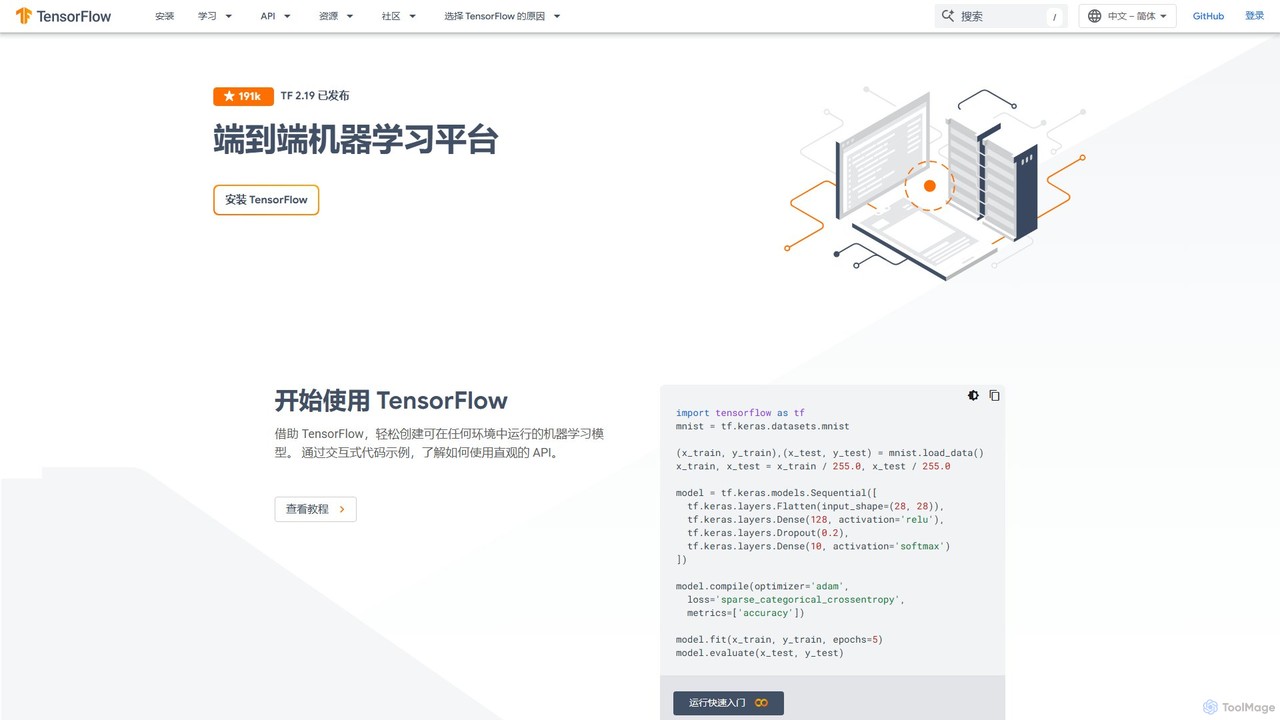
TensorFlow is a free and open-source software library for machine learning and artificial intelligence. Developed by the Google Brain team, it has become one of the most popular and widely used platforms for building and training neural networks. TensorFlow provides an end-to-end ecosystem that allows developers to easily build, train, and deploy ML models across a wide range of platforms, from large server farms to small edge devices and even web browsers.
The core of TensorFlow is a system for defining and running computations involving tensors, which are multi-dimensional arrays. This dataflow graph-based model allows for immense flexibility and scalability. It is designed to facilitate everything from large-scale research experiments to robust, production-ready applications, powering many of Google's own products like Search, Gmail, and Photos.
How to use TensorFlow
The typical workflow for using TensorFlow involves several key steps:
- Installation: TensorFlow can be easily installed using Python's package manager:
pip install tensorflow. - Data Loading and Preprocessing: Use the powerful
tf.dataAPI to build efficient and complex input pipelines. This allows you to load data from various sources, transform it, and feed it into your model seamlessly. - Model Building: For most use cases, the high-level Keras API (
tf.keras) is the recommended way to build models. You can create a simple sequential model or use the more flexible Functional API or Model Subclassing for complex architectures. A basic model might look like this:model = tf.keras.models.Sequential([...layers...]) - Model Compilation: Before training, you need to configure the learning process using the
model.compile()method. Here, you specify the optimizer (e.g., 'adam'), the loss function (e.g., 'sparse_categorical_crossentropy'), and metrics to monitor (e.g., 'accuracy'). - Training: Train the model by calling the
model.fit()method, passing your training data, number of epochs, and validation data. - Evaluation and Prediction: After training, evaluate your model's performance on a test set with
model.evaluate()or make predictions on new data withmodel.predict(). - Deployment: Save your trained model and deploy it using tools from the TensorFlow ecosystem like TensorFlow Serving for production servers, TensorFlow Lite for mobile and embedded devices, or TensorFlow.js for running models in the browser.
Core Features of TensorFlow
- Flexible Model Building: Offers both the simple and intuitive Keras API for rapid prototyping and low-level APIs for complete control and advanced research.
- Robust MLOps - Production Ready: TensorFlow Extended (TFX) provides a complete platform for deploying production ML pipelines, managing the entire lifecycle from data ingestion to model deployment and management.
- Multi-Platform Deployment: Train a model once and deploy it anywhere. TensorFlow Lite optimizes models for on-device inference on mobile (Android/iOS) and embedded systems, while TensorFlow.js enables ML applications to run directly in the browser or on Node.js.
- Powerful Experimentation Tools: TensorBoard provides a suite of web-based visualization tools to understand, debug, and optimize your TensorFlow programs. Track metrics like loss and accuracy, visualize the model graph, and view histograms of weights and biases.
- Comprehensive Ecosystem: Includes TensorFlow Hub for a vast repository of pre-trained models, TensorFlow Datasets for easy access to standard datasets, and specialized libraries like TF-Agents for reinforcement learning and TensorFlow GNN for graph neural networks.
Use Cases for TensorFlow
TensorFlow's versatility makes it suitable for a wide array of applications across industries:
- Computer Vision: Image classification, object detection, image segmentation, and facial recognition.
- Natural Language Processing (NLP): Sentiment analysis, text generation, machine translation, and chatbots.
- Reinforcement Learning: Training agents for games, robotics, and optimization problems like Spotify's playlist generation.
- Audio Processing: Speech recognition, voice synthesis, and music generation with projects like Magenta.
- Predictive Analytics: Time-series forecasting for finance, demand forecasting for retail, and traffic prediction.
- Medical Discovery: Analyzing medical images, predicting disease outbreaks, and aiding in drug discovery.
Advantages of TensorFlow
TensorFlow stands out due to its numerous advantages:
- Scalability: It is designed to run on a wide range of hardware, from single CPU/GPU systems to large, distributed clusters of servers and specialized hardware like TPUs (Tensor Processing Units).
- Maturity and Reliability: Backed by Google, it is a mature, well-tested framework that powers countless real-world, large-scale applications.
- Strong Community and Support: It boasts a massive global community of developers and researchers, extensive documentation, tutorials, and professional support.
- End-to-End Platform: It provides a cohesive and comprehensive set of tools that covers the entire machine learning workflow, reducing the need for multiple disparate tools.
Pricing and Plans
TensorFlow is a completely free and open-source project, distributed under the Apache 2.0 License. There are no fees, subscriptions, or paid tiers for using the software itself. Users are free to download, modify, and distribute it for both research and commercial purposes. Costs associated with using TensorFlow are typically related to the underlying hardware (e.g., purchasing GPUs) or cloud computing resources (e.g., using Google Cloud AI Platform, AWS, or Azure for training and deployment).
Traffic
Latest traffic
Status
Monthly traffic trend
- 2025-9: 894.8K
- 2026-1: 811.0K
- 2026-2: 769.2K
- 2026-3: 803.4K
- 2026-4: 735.1K
- 2026-5: 688.6K
Geography
Top 5 countries / regions
- 🇺🇸United States40.9%
- 🇮🇳India36.2%
- 🇩🇪Germany9.3%
- 🇳🇬Nigeria6.9%
- 🇨🇳China6.7%
Traffic sources
| Source type | Percentage |
|---|---|
Direct | 63.6% |
Referral | 33.5% |
Email | 2.9% |
Top keywords
| Keyword | Cost per click |
|---|---|
| tensorboard | $4.66 |
| tensor flow | $1.26 |
| tensorflow | $1.03 |
| tensorflow playground | $2.02 |
| word2vec | $4.06 |
TensorFlow Videos on YouTube


PyCharm, a JetBrains IDE


DailyAIWizard

Tutorial Horizon

CodeCrafter

AI and Machine Learning Explained

AI and Machine Learning Explained
TensorFlow Alternatives
PyTorch
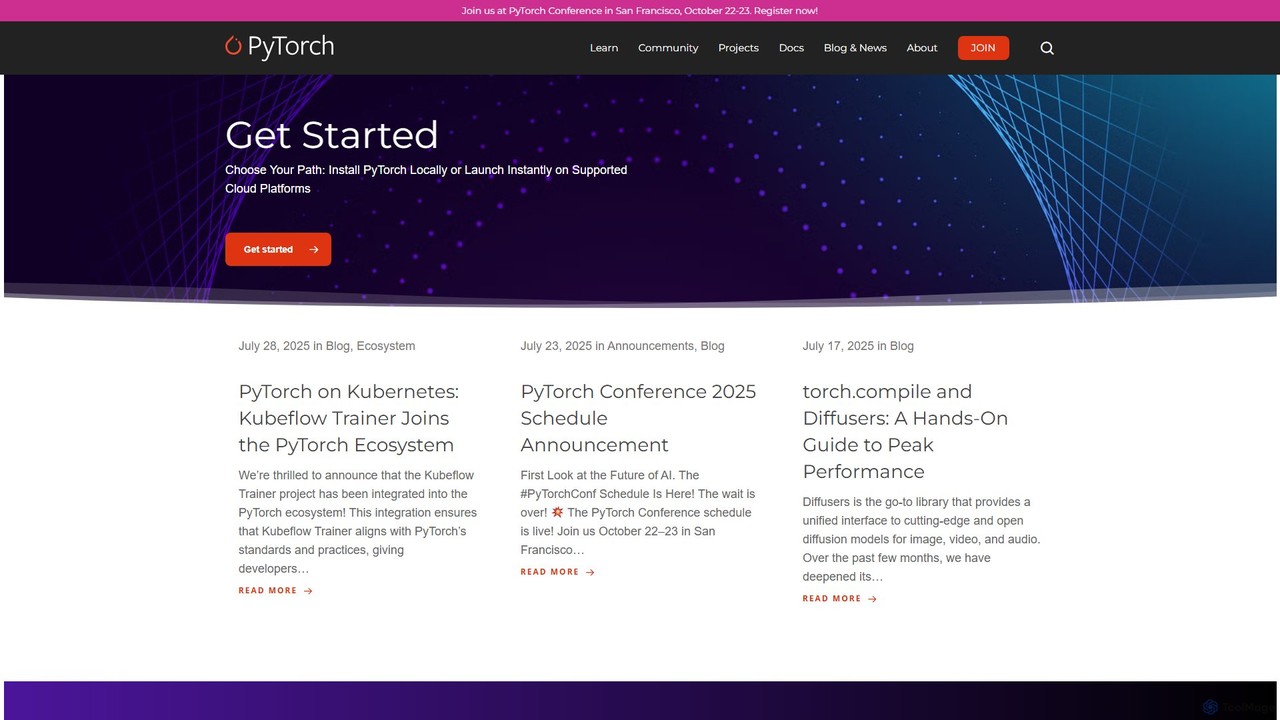
PyTorch is an open-source machine learning framework based on the Torch library, used for applications such as computer vision and natural language processing. It offers a flexible, Python-first environment that accelerates the path from research prototyping to production deployment.
Deep Learning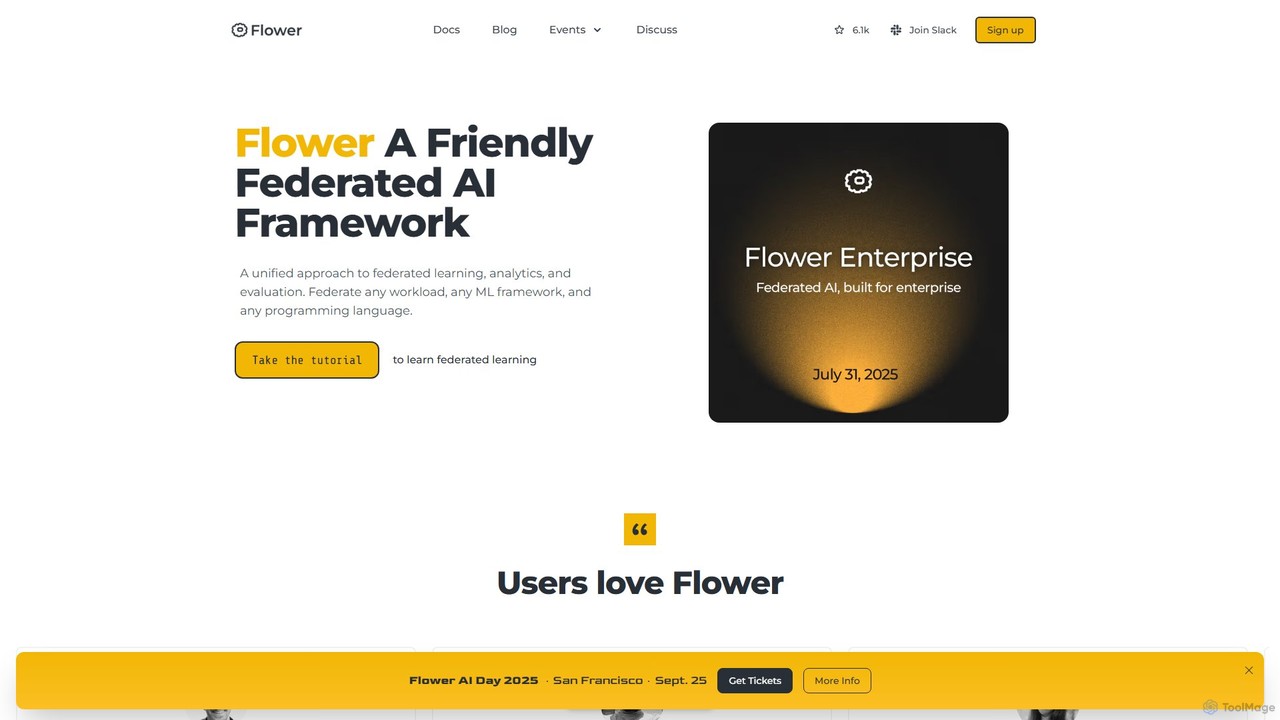
Flower
Flower is a friendly, open-source framework for federated learning, analytics, and evaluation. It enables training AI models on decentralized data across various devices and platforms without compromising privacy, supporting numerous ML frameworks like PyTorch, TensorFlow, and Hugging Face.
Frameworks
MLflow
MLflow is an open-source platform for managing the end-to-end machine learning lifecycle. It enables developers and data scientists to track experiments, package code into reproducible runs, version and share models, and deploy them to production, supporting both traditional ML and modern GenAI applications.
Data Science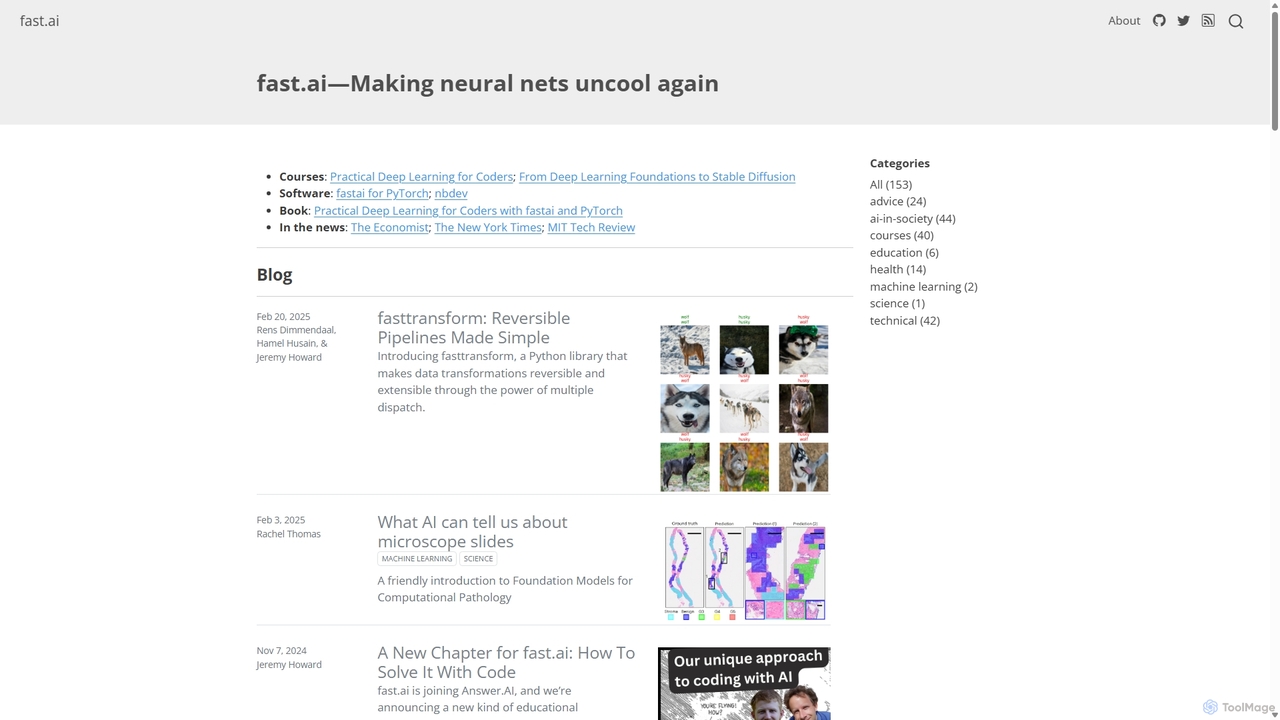
Fast.ai
Fast.ai is a research institute dedicated to making deep learning accessible to everyone. It offers free courses, an open-source software library (fastai), cutting-edge research, and a vibrant community, empowering coders of all backgrounds to become deep learning practitioners.
Machine Learning
PyBrain
PyBrain is a modular and flexible open-source Machine Learning Library for Python. It provides powerful, easy-to-use algorithms for machine learning tasks, with a particular focus on neural networks, reinforcement learning, and unsupervised learning. It is designed to be accessible for beginners while remaining powerful enough for research purposes.
Libraries & FrameworksTensorFlow Categories
TensorFlow Embed Widget
Copy this embed code to place the badge on your blog, article, or product site and send readers directly to this ToolMage detail page.

Related AI tools
Fast.ai
Fast.ai is a research institute dedicated to making deep learning accessible to everyone. It offers free courses, an open-source software library (fastai), cutting-edge research, and a vibrant community, empowering coders of all backgrounds to become deep learning practitioners.
Machine LearningPyTorch
PyTorch is an open-source machine learning framework based on the Torch library, used for applications such as computer vision and natural language processing. It offers a flexible, Python-first environment that accelerates the path from research prototyping to production deployment.
Deep Learning
MindSpore
MindSpore is an open-source, all-scenario AI computing framework designed for developers and data scientists. It provides a developer-friendly experience with flexible deployment across cloud, edge, and device environments. It excels in distributed training for large models and offers specialized toolkits for scientific computing (AI4S), ensuring high performance and efficiency, especially on Ascend hardware.
Scientific Computing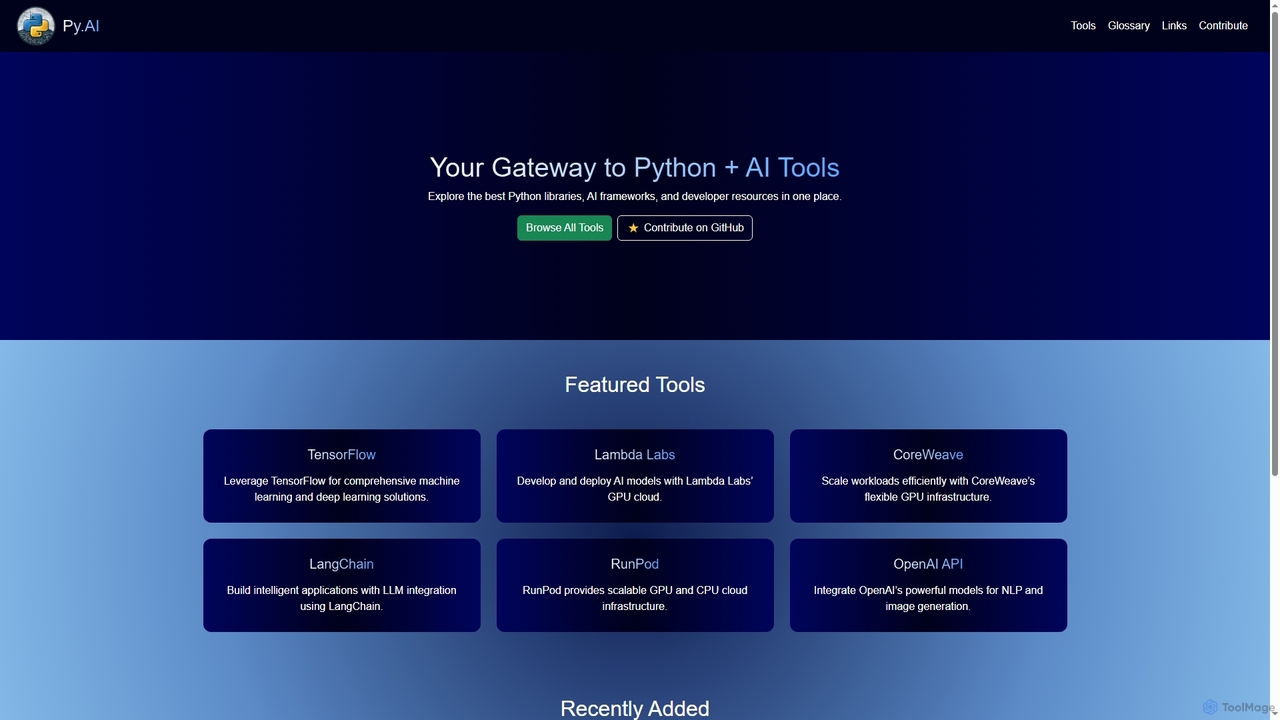
Py
Py is a curated online directory serving as a comprehensive gateway to the best Python libraries, AI frameworks, and developer resources. It helps users explore, discover, and find tools to enhance their machine learning and AI projects.
Tool DiscoveryPyBrain
PyBrain is a modular and flexible open-source Machine Learning Library for Python. It provides powerful, easy-to-use algorithms for machine learning tasks, with a particular focus on neural networks, reinforcement learning, and unsupervised learning. It is designed to be accessible for beginners while remaining powerful enough for research purposes.
Libraries & Frameworks
Google Research
Google Research is a premier hub for exploring groundbreaking advancements in science and AI. It provides open access to a vast repository of research papers, project showcases, and open-source resources across diverse fields like machine learning, quantum computing, and healthcare. It's an essential platform for researchers, developers, and enthusiasts to stay at the forefront of technological innovation and understand its real-world impact.
Learning Platform
aionlinecourse
An interactive online learning platform offering free, hands-on AI projects, in-depth tutorials, and comprehensive resources. It covers Machine Learning, Generative AI, NLP, and Computer Vision, designed for learners of all levels, from beginners to experienced professionals, to build practical, industry-relevant skills.
Code Libraries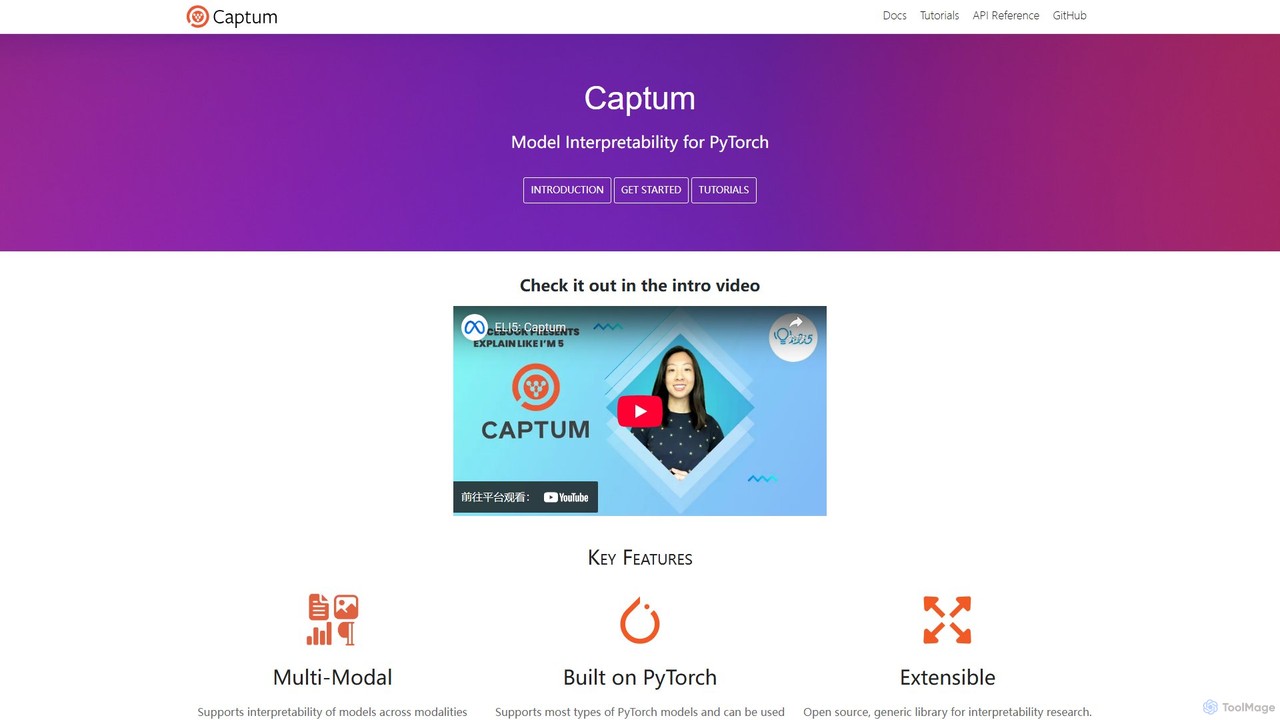
Captum
Captum is an open-source model interpretability and explainability library for PyTorch. It provides state-of-the-art algorithms to help developers and researchers understand which features influence a model's predictions. Supporting multi-modal data like text, vision, and more, Captum makes it easy to debug models, improve transparency, and benchmark new interpretability techniques within the PyTorch ecosystem.
Model Explainability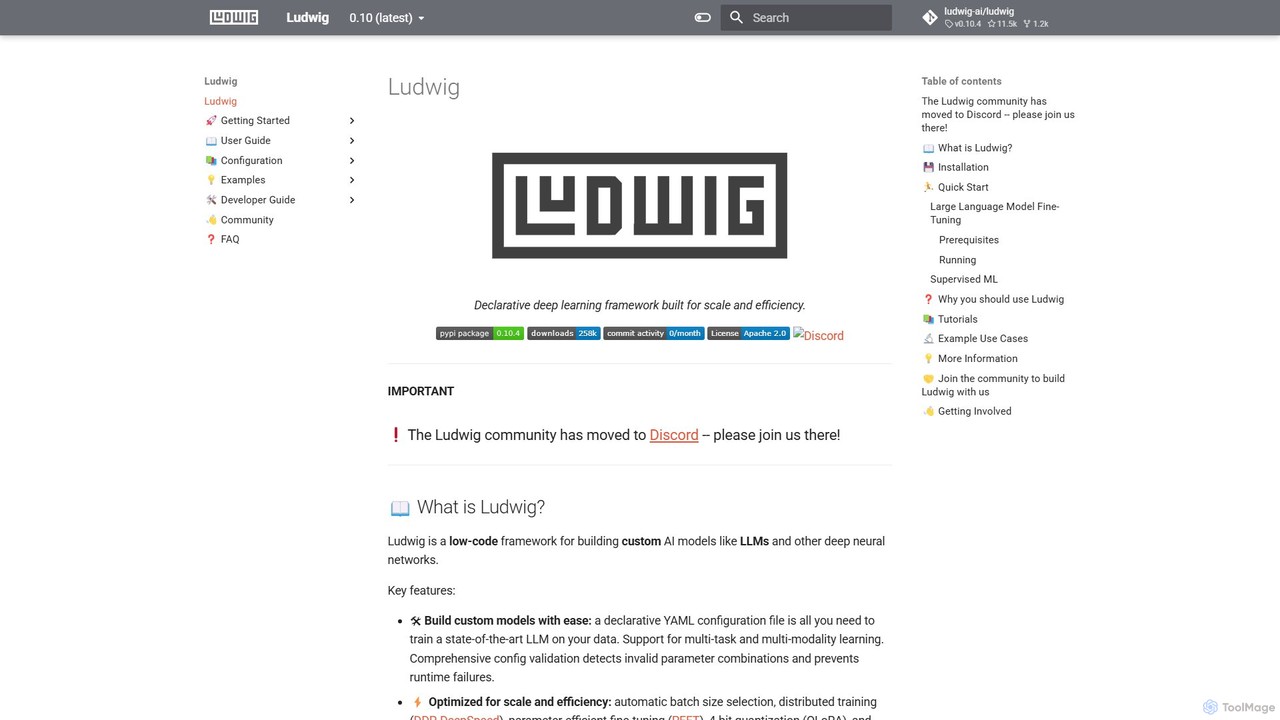
Ludwig
Ludwig is a low-code, open-source deep learning framework that simplifies building and training custom AI models. Using declarative YAML configurations, users can easily create complex models, including LLMs, for multi-modal and multi-task learning without extensive boilerplate code. It's designed for scalability, production-readiness, and integrates with popular tools like HuggingFace and MLFlow.
Model Training
Jyek
Jyek is an AI agent platform that understands objectives, creates execution plans, uses tools, and delivers verifiable results for complex, multi-step tasks.
Automation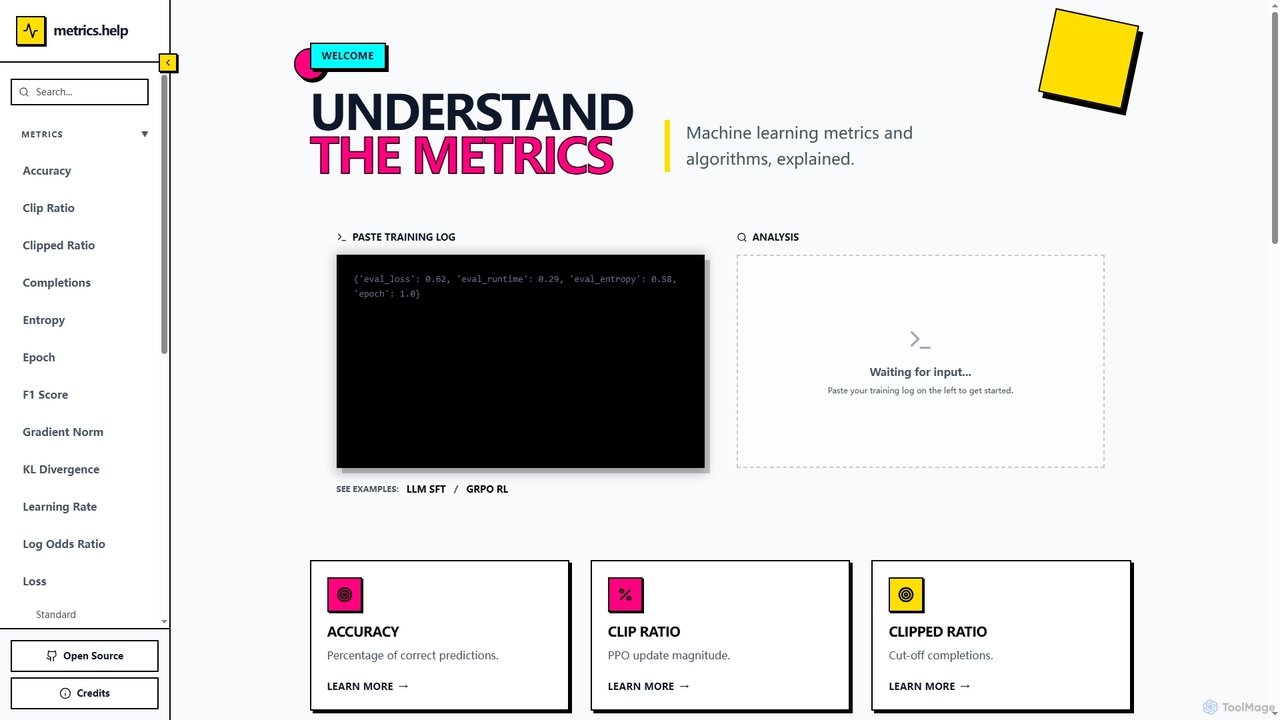
Metrics Help
Metrics Help is an open-source web tool for machine learning practitioners. It functions as a comprehensive guide and an interactive analyzer for ML training metrics. Users can paste training logs to get instant explanations for key metrics like accuracy, loss, and perplexity, aiding in model performance analysis and debugging.
Model Training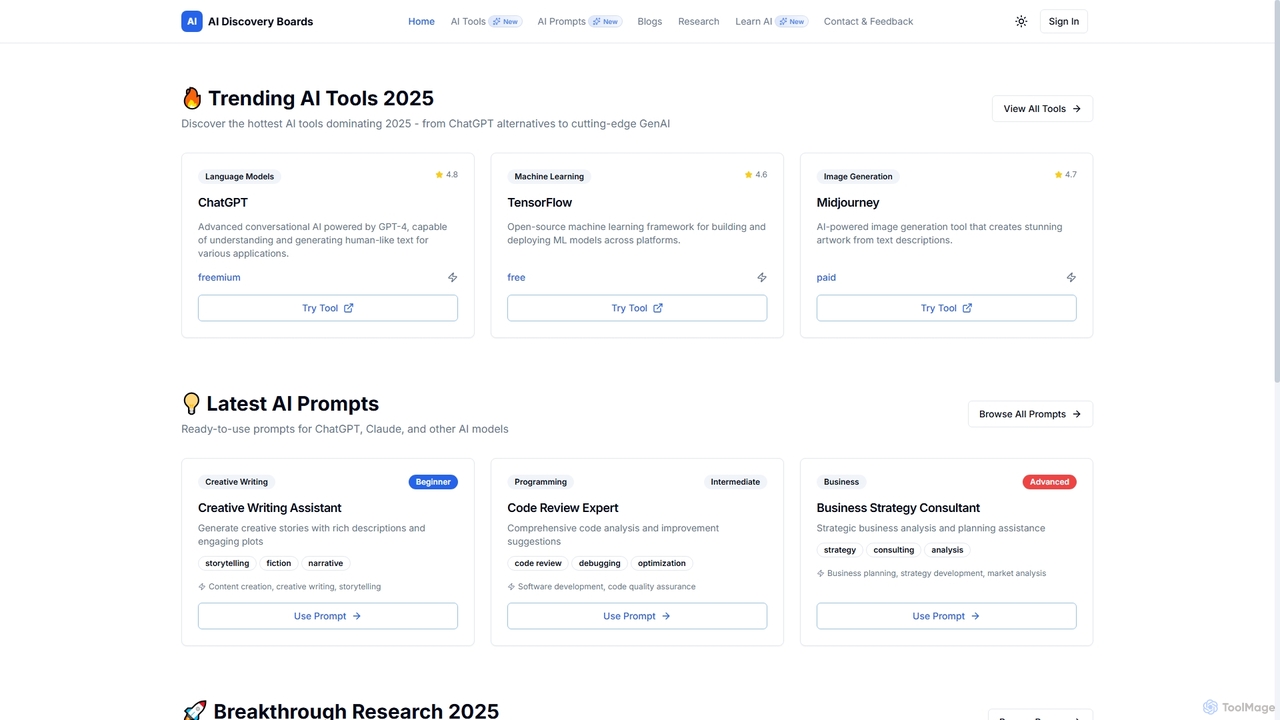
AIDiscoveryBoards
AIDiscoveryBoards is a comprehensive online platform designed to help users discover trending AI tools, explore the latest AI prompts, delve into groundbreaking AI research papers, and access curated AI learning resources. It serves as a central hub for staying updated on the rapidly evolving artificial intelligence landscape.
Tool Directory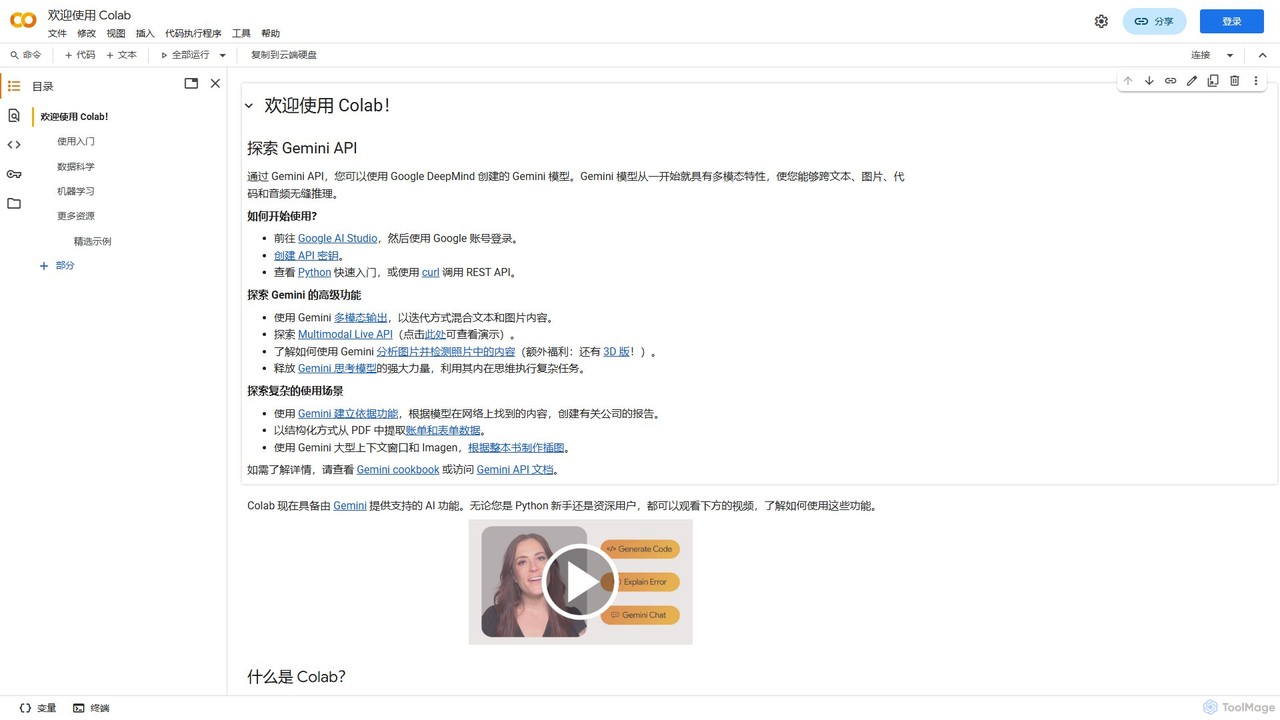
Colab
Colab (Google Colaboratory) is a free, browser-based interactive environment that allows you to write and execute Python code. It requires no setup and provides free access to powerful computing resources like GPUs and TPUs. Ideal for students, data scientists, and AI researchers, Colab facilitates machine learning, data analysis, and education, with seamless collaboration and Google Drive integration.
Data Science
dataset.gold
A curated directory of high-quality, open-source datasets for AI and machine learning. Discover the gold standard of data for training your models in computer vision, NLP, and more.
DatasetsFlower
Flower is a friendly, open-source framework for federated learning, analytics, and evaluation. It enables training AI models on decentralized data across various devices and platforms without compromising privacy, supporting numerous ML frameworks like PyTorch, TensorFlow, and Hugging Face.
Frameworks
TensorFlow Comments (0)
Sign in to comment.
Sign inNo comments yet.