Metrics Help
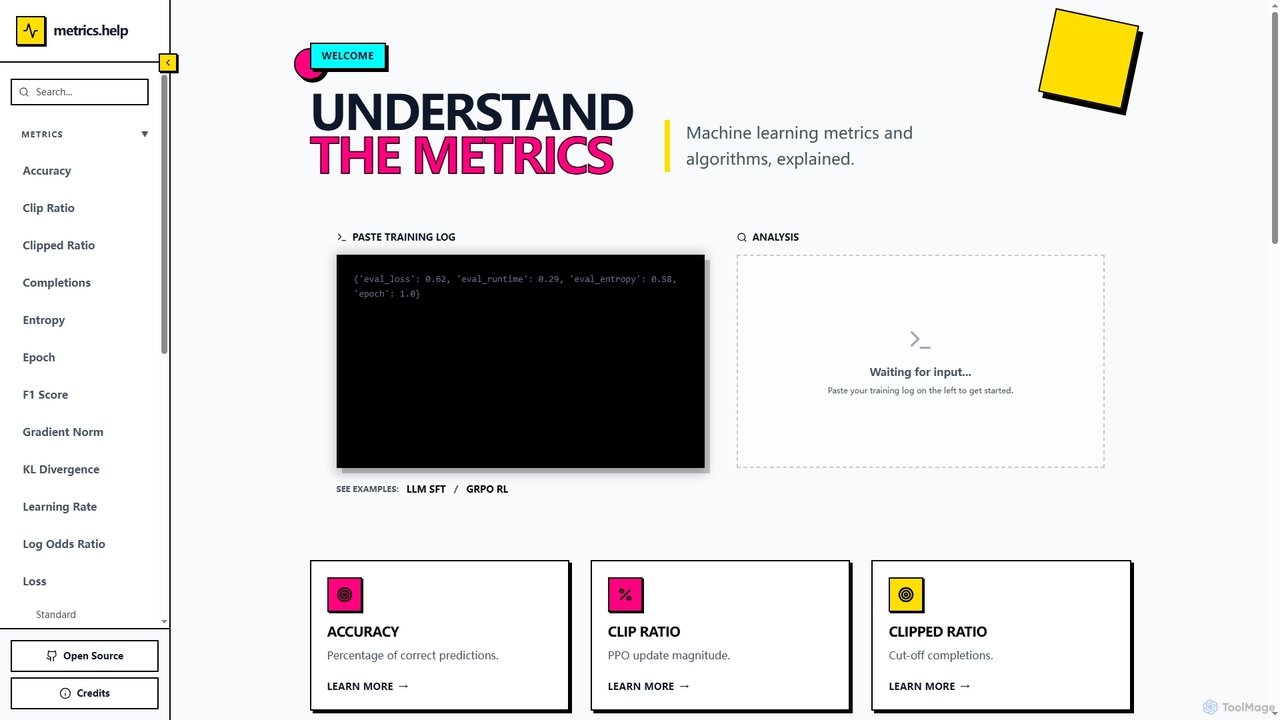
Metrics Help is an open-source web tool for machine learning practitioners. It functions as a comprehensive guide and …
Metrics Help is an open-source web tool for machine learning practitioners. It functions as a comprehensive guide and an interactive analyzer for ML training metrics. Users can paste training logs to get instant explanations for key metrics like accuracy, loss, and perplexity, aiding in model performance analysis and debugging.
Anyscale
Anyscale is a fully-managed compute platform for scaling AI and Python workloads. Built on the open-source Ray framework …
Anyscale is a fully-managed compute platform for scaling AI and Python workloads. Built on the open-source Ray framework by its original creators, it empowers developers to build, run, and scale distributed applications, from LLM training to data processing, with optimized performance and cost-efficiency on any cloud.
airtrain.ai
airtrain.ai is a no-code platform that empowers users to train, deploy, and manage custom AI models on their …
airtrain.ai is a no-code platform that empowers users to train, deploy, and manage custom AI models on their own data. It simplifies the entire machine learning workflow, enabling businesses and developers to build bespoke models for tasks like image recognition, text classification, and predictive analysis without extensive coding expertise.
Ludwig
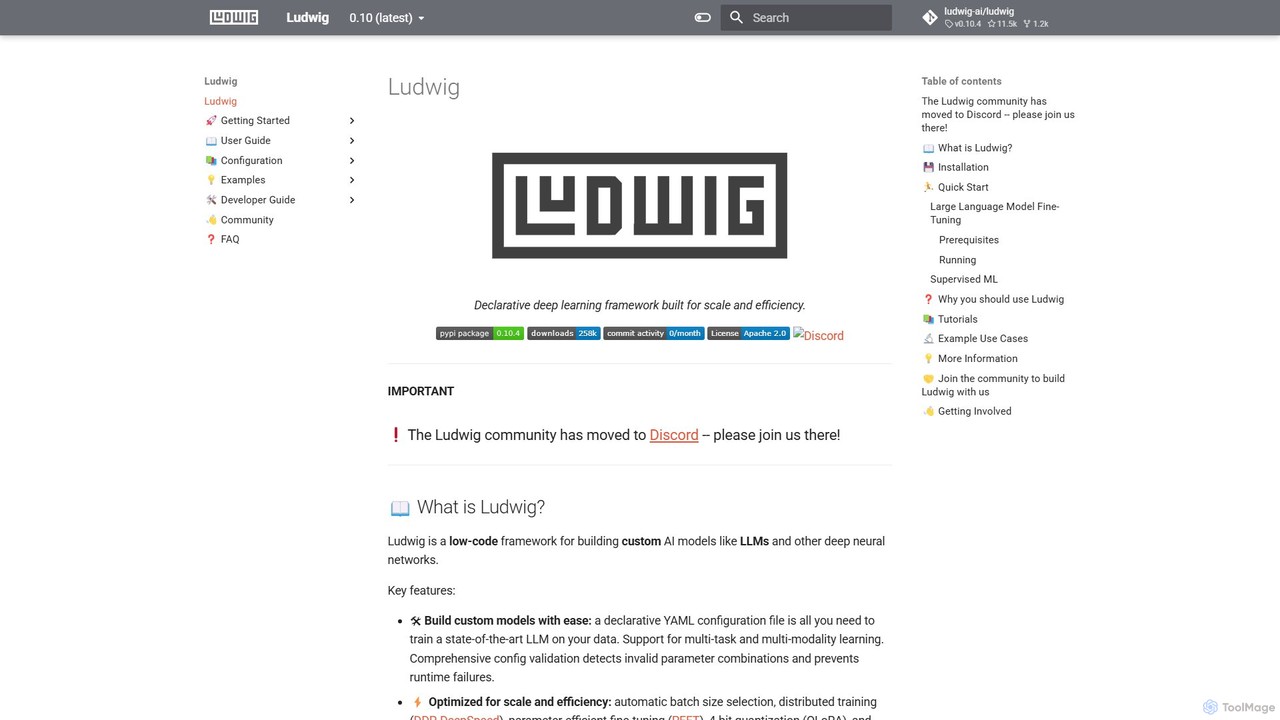
Ludwig is a low-code, open-source deep learning framework that simplifies building and training custom AI models. Using declarative …
Ludwig is a low-code, open-source deep learning framework that simplifies building and training custom AI models. Using declarative YAML configurations, users can easily create complex models, including LLMs, for multi-modal and multi-task learning without extensive boilerplate code. It's designed for scalability, production-readiness, and integrates with popular tools like HuggingFace and MLFlow.
denvrdata
Denvr Dataworks offers a high-performance AI cloud platform for training, inference, and data science. It provides vertically integrated …
Denvr Dataworks offers a high-performance AI cloud platform for training, inference, and data science. It provides vertically integrated infrastructure with on-demand and dedicated GPU compute services. Tailored for developers and startups, it features the Ascend Program, offering significant compute credits to accelerate AI innovation.
About Model Training
Model Training tools are a specialized category within Data Science, focusing on the iterative process of teaching machine learning models to recognize patterns and make predictions. These platforms provide environments for data scientists and developers to feed vast datasets to algorithms, optimize model parameters, and evaluate performance. They are crucial for transforming raw data and algorithms into intelligent, functional AI applications, forming the core of AI development.
Core Features
- Algorithm Selection & Configuration: Choose from various machine learning algorithms and configure their specific parameters for optimal learning.
- Data Ingestion & Preprocessing: Efficiently load, clean, and transform diverse datasets, preparing them for model input.
- Hyperparameter Tuning: Automatically or manually adjust model hyperparameters to fine-tune performance and prevent overfitting.
- Training Monitoring & Visualization: Track training progress, loss functions, and key metrics in real-time through intuitive dashboards.
- Model Evaluation & Validation: Assess model accuracy, precision, recall, and other performance metrics using dedicated validation datasets.
Applicable Scenarios
Data scientists utilize these tools for developing custom predictive analytics models, researchers for experimenting with novel AI architectures, and machine learning engineers for fine-tuning models for specific industry applications like fraud detection or medical imaging analysis.
How to Choose
When selecting a Model Training tool, consider its supported algorithms, scalability for large datasets, integration capabilities with existing data pipelines, ease of hyperparameter tuning, and the robustness of its evaluation and validation features. Also, assess the platform's user interface and community support.
Model TrainingUse Cases
Developing Custom Predictive Models
Data scientists in finance or marketing train models to predict customer churn, identify fraudulent transactions, or forecast market trends. By feeding historical data into model training platforms, they iteratively refine algorithms and hyperparameters to achieve high accuracy, enabling proactive business decisions and risk mitigation.
Fine-tuning Large Language Models (LLMs)
AI engineers adapt pre-trained Large Language Models (LLMs) with proprietary or domain-specific datasets to enhance their performance for niche tasks. For example, a legal firm might fine-tune an LLM on legal documents to improve contract analysis, significantly reducing manual review time and increasing accuracy in specialized legal contexts.
Optimizing Computer Vision Systems
Machine learning engineers train image recognition models for quality control in manufacturing or autonomous driving. By feeding vast amounts of labeled image data, these tools enable the iterative training and validation of convolutional neural networks (CNNs), ensuring high precision in detecting defects on assembly lines or identifying objects in real-time for self-driving cars.
Building Recommendation Engines
E-commerce platforms and streaming services train collaborative filtering or content-based recommendation models to suggest personalized products or media to users. By analyzing user behavior and item characteristics, model training tools help optimize these engines, leading to increased user engagement, higher conversion rates, and a more tailored user experience across various digital platforms.
Experimenting with New AI Architectures
Researchers and academic institutions leverage model training tools to test novel neural network designs, learning algorithms, or data augmentation techniques on benchmark datasets. These platforms provide the computational power and flexibility needed to rapidly iterate on experimental models, accelerating breakthroughs in fundamental AI research and pushing the boundaries of what AI can achieve.
Automating Anomaly Detection
Cybersecurity analysts or IoT engineers train models to identify unusual network activity, system failures, or sensor anomalies. By continuously feeding real-time data streams, model training tools enable the development of robust anomaly detection systems that can learn normal behavior patterns and flag deviations, crucial for preventing security breaches and predicting equipment maintenance needs.