
Daytona
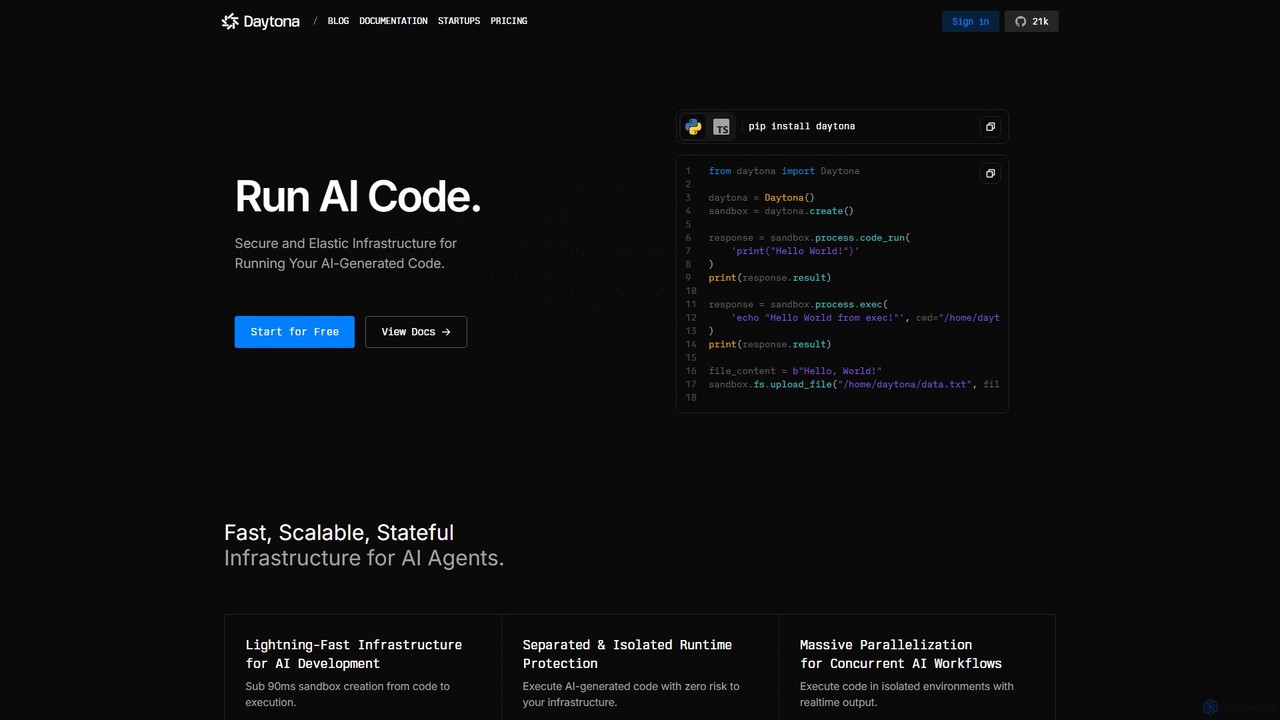
Daytona is a secure, elastic, and high-performance runtime environment designed for executing AI-generated code. It provides isolated sandboxes …
Daytona is a secure, elastic, and high-performance runtime environment designed for executing AI-generated code. It provides isolated sandboxes for AI agents, data analysis, and scalable evaluations, enabling developers to run untrusted code with zero risk to their infrastructure. It's built for speed, scalability, and stateful, long-running tasks.
About Code Execution
Code Execution tools are AI-powered platforms that provide environments for running programming code, particularly for data science and machine learning tasks. These tools often integrate with various programming languages and libraries, enabling users to develop, test, and deploy AI models efficiently. They streamline the computational aspects of data analysis and AI development, offering scalable and reproducible execution capabilities within the broader field of data science. This allows for rapid iteration and robust management of complex computational workflows.
Core Features
- Integrated Development Environment (IDE): Provides a comprehensive interface for writing, debugging, and managing code.
- Language Support: Compatibility with popular data science languages like Python, R, Julia, and SQL.
- Resource Management: Dynamic allocation of CPU, GPU, and memory resources for demanding computations.
- Version Control Integration: Seamless connection with Git or other version control systems for collaborative development.
- Reproducibility & Sharing: Features to package code and environments for consistent execution and easy sharing.
Applicable Scenarios
Data scientists and machine learning engineers use these tools for iterative model training, hyperparameter tuning, and large-scale data processing. Researchers leverage them for reproducible scientific computing, while developers integrate them into CI/CD pipelines for automated testing and deployment of AI applications.
How to Choose
Consider the required programming languages and libraries, the availability of GPU/TPU resources, collaboration features, integration with existing data sources and MLOps platforms, and the pricing model based on compute usage and storage needs.
Code ExecutionUse Cases
Accelerate AI Model Training with Scalable Resources
Data scientists use cloud-based code execution platforms to run computationally intensive deep learning models. By leveraging scalable GPU/TPU resources on demand, they can significantly reduce model training times from days to hours, enabling faster experimentation and iteration without managing local hardware limitations. This accelerates the entire AI development lifecycle.
Ensure Reproducible Data Analysis and Research
Researchers and data analysts utilize integrated code execution environments to perform statistical analyses and generate reports. These tools allow them to package their code, data dependencies, and environment configurations, ensuring that their analyses can be consistently reproduced by colleagues or for future verification, enhancing the credibility and transparency of scientific work.
Automate ETL Workflows for Data Preparation
Data engineers deploy Python or R scripts within serverless code execution services to automate Extract, Transform, Load (ETL) processes. This allows for the scheduled cleaning, transformation, and loading of large datasets from various sources into data warehouses or lakes, ensuring data readiness for downstream analytics and machine learning models with minimal manual intervention.
Interactive Prototyping and Experimentation with Notebooks
Machine learning engineers and researchers use Jupyter-like environments provided by code execution tools for interactive data exploration, algorithm prototyping, and result visualization. This allows them to rapidly iterate on model ideas, test hypotheses, and gain immediate feedback on code changes, significantly accelerating the initial stages of AI model development and feature engineering.
Secure Code Execution for Sensitive Data Analysis
Financial analysts and healthcare professionals employ secure, isolated code execution environments to run proprietary algorithms on sensitive financial or patient data. These tools provide robust access controls, encryption, and audit trails, ensuring compliance with regulatory requirements like GDPR or HIPAA and preventing unauthorized data leakage while performing critical analyses.
Integrate Code Execution into MLOps CI/CD Pipelines
MLOps teams integrate code execution tools into their Continuous Integration/Continuous Deployment (CI/CD) pipelines to automate the testing, validation, and deployment of new machine learning model code changes. This ensures that every code commit is automatically checked for performance regressions, bugs, and compliance, maintaining model integrity and accelerating the deployment of production-ready AI solutions.