Voxel51
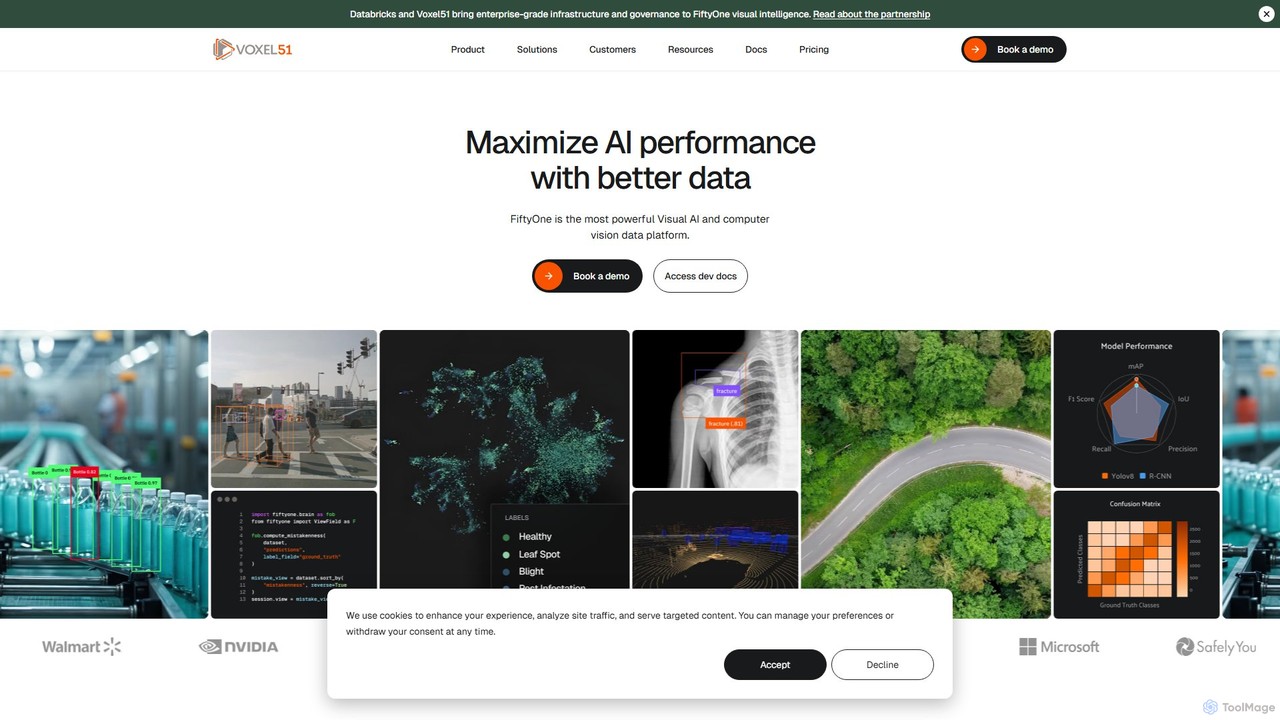
Voxel51 provides FiftyOne, an enterprise-grade computer vision and multimodal AI platform. It empowers developers and data scientists to …
Voxel51 provides FiftyOne, an enterprise-grade computer vision and multimodal AI platform. It empowers developers and data scientists to curate, visualize, and evaluate complex datasets, leading to higher-performing models. By focusing on data-centric AI, FiftyOne streamlines workflows for data annotation, quality improvement, and model analysis, accelerating the entire development lifecycle.
About Data Labeling
Data Labeling tools are AI-powered platforms designed to annotate raw data, such as images, text, audio, and video, making it suitable for machine learning model training. These tools provide structured labels that help algorithms learn patterns and make accurate predictions, serving as a foundational step within the broader field of data science. They streamline the often complex and time-consuming process of preparing high-quality datasets for AI development.
Core Features
- Image Annotation: Tools for drawing bounding boxes, polygons, semantic segmentation masks, and keypoints on images to identify objects or regions.
- Text Annotation: Features for named entity recognition (NER), sentiment analysis, text classification, and relation extraction in textual data.
- Audio/Video Labeling: Capabilities for transcribing speech, identifying speakers, tagging events, and tracking objects over time in multimedia content.
- Quality Assurance: Built-in mechanisms for review, consensus scoring, and automated checks to ensure label accuracy and consistency.
- Workflow Management: Tools for task assignment, progress tracking, and efficiently managing large-scale labeling projects.
Applicable Scenarios
Autonomous vehicle development relies on labeled images and video to train object detection and scene understanding models. In healthcare, medical images are annotated to assist AI in diagnosing diseases. For natural language processing, text data is labeled to train chatbots and sentiment analysis systems.
How to Choose
When selecting a Data Labeling tool, consider the types of data you need to label (images, text, audio, video) and the specific annotation techniques required. Evaluate its scalability for large datasets, the robustness of its quality assurance features, and its integration capabilities with your existing machine learning pipelines. Pricing models and the availability of managed labeling services are also crucial factors.

Data LabelingUse Cases
Training Autonomous Driving Systems
Automotive companies use data labeling tools to annotate millions of images and video frames with precise bounding boxes, polygons, and semantic segmentation masks for vehicles, pedestrians, traffic signs, and road conditions. This labeled data is critical for training AI models that enable self-driving cars to perceive and understand their environment safely.
Developing Medical AI Diagnostics
Healthcare researchers and AI developers utilize data labeling to annotate medical images like X-rays, MRIs, and CT scans. Radiologists or medical experts draw precise boundaries around tumors, lesions, or anatomical structures, creating datasets that train AI to assist in early disease detection and diagnosis, improving patient outcomes.
Enhancing E-commerce Product Search
E-commerce platforms employ data labeling to categorize product images and descriptions. Annotators tag product attributes, colors, brands, and types, allowing AI-powered search engines to provide more accurate and relevant results for customers, improving the shopping experience and conversion rates.
Building Advanced Chatbots and Virtual Assistants
Companies developing conversational AI use data labeling for text and audio. Human annotators label user queries with specific intents and entities (e.g., "book flight" as intent, "New York" as destination entity), and transcribe audio, enabling chatbots to understand natural language and respond appropriately.
Improving Agricultural Crop Monitoring
Farmers and agricultural tech companies use data labeling to analyze drone imagery of fields. Experts annotate images to identify crop health, pest infestations, or areas needing irrigation. This labeled data trains AI models to provide actionable insights for precision agriculture, optimizing yields and resource use.
Securing Public Spaces with AI Surveillance
Security firms and urban planners apply data labeling to video footage for training AI surveillance systems. Annotators mark individuals, objects, and specific behaviors (e.g., suspicious activity), creating datasets that help AI detect anomalies, enhance public safety, and manage crowd control more effectively.