Data Science Best in category 1 results Dataset Marketplace AI Tool

Popular AI tools in the Dataset Marketplace field of Data Science include Ouro, etc., helping you quickly improve efficiency.

Ouro

Ouro

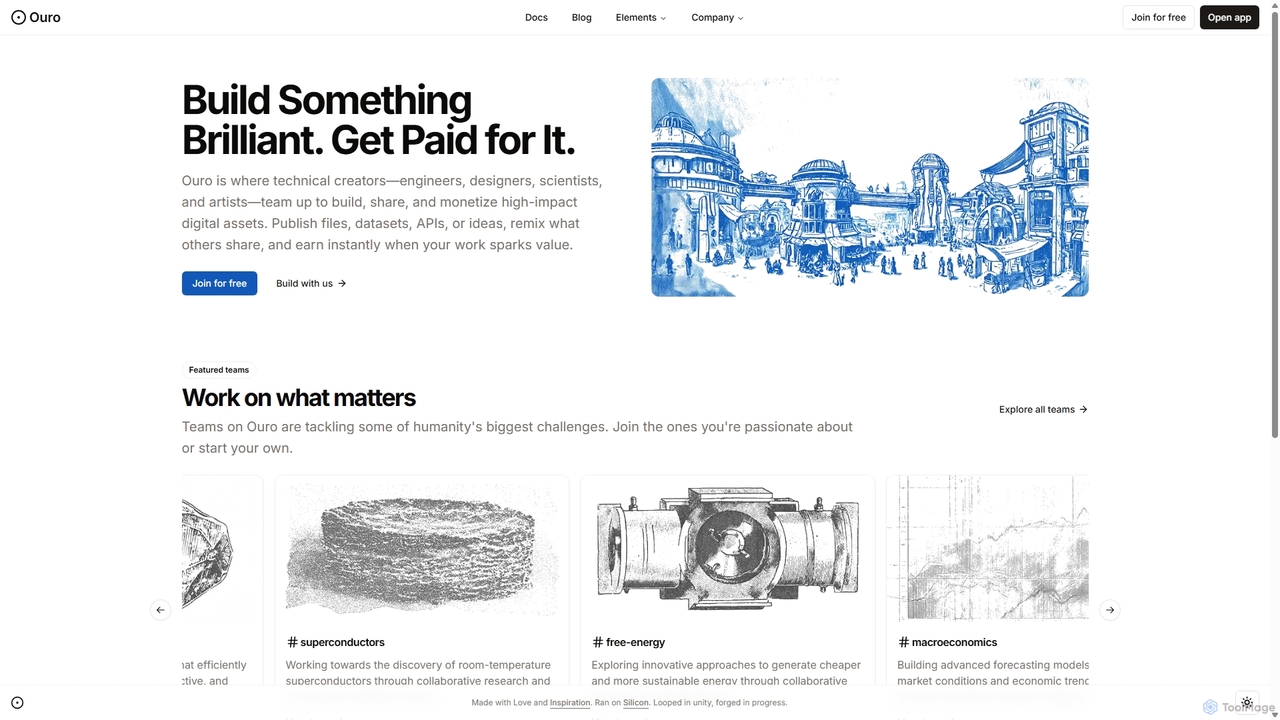
Ouro is a collaborative platform for technical creators—engineers, scientists, and AI developers—to build, share, and monetize high-impact digital …

5.8K

About Dataset Marketplace

A Dataset Marketplace is an online platform for discovering, buying, selling, and sharing datasets for machine learning and data analysis. These platforms function as centralized hubs, connecting data providers with consumers like AI developers and researchers. They streamline the data acquisition process by offering curated, pre-processed, and often labeled data across diverse industries. This provides a crucial starting point for training models, validating hypotheses, or conducting market research, significantly reducing the time and cost associated with manual data collection.

Core Features

  • Data Discovery & Search: Advanced filters to find datasets by type, format, industry, or licensing.
  • Data Quality & Curation: Provides metadata, quality scores, and previews to assess dataset suitability.
  • Secure Transactions & Licensing: Manages secure payments and various data usage licenses (e.g., commercial, research).
  • API Access: Allows programmatic access to download and integrate datasets directly into workflows.
  • Community & Collaboration: Features for users to rate, review, and discuss datasets, fostering a data-centric community.

Use Cases

Dataset Marketplaces are essential in fields like AI development, academic research, and business intelligence. AI startups use them to acquire training data for computer vision or NLP models without the high cost of in-house collection. Researchers access specialized datasets to validate their findings. Financial analysts might purchase alternative data, such as satellite imagery or consumer transaction data, to gain a competitive edge in market predictions.

How to Choose

When selecting a Dataset Marketplace, consider the diversity and relevance of its data catalog to your specific domain. Evaluate the data quality standards, including how data is sourced, cleaned, and verified. Assess the licensing options to ensure they align with your intended use (commercial vs. non-commercial). Finally, consider the platform's pricing models (subscription vs. pay-per-dataset) and the ease of data access, such as API availability and supported data formats.

Dataset MarketplaceUse Cases

1

Acquiring Labeled Images for Computer Vision Models

A machine learning engineer at a startup is tasked with building an object detection model for autonomous vehicles. Instead of spending months collecting and manually labeling millions of road images, they turn to a Dataset Marketplace. They can search for specific datasets containing labeled images of pedestrians, traffic signs, and other vehicles. By purchasing a high-quality, pre-labeled dataset, the engineer can immediately start training and iterating on their model, reducing the project timeline from a year to a few months and ensuring data diversity and quality from the outset.

2

Sourcing Financial Data for Algorithmic Trading

A quantitative analyst at a hedge fund needs diverse historical and real-time financial data to develop and backtest a new trading algorithm. A Dataset Marketplace provides a single point of access to various data types, including stock prices, corporate filings, and alternative data like sentiment analysis from news articles. The analyst can license multiple datasets through one platform, simplifying procurement and legal processes. This allows them to quickly integrate rich, multi-source data into their models, improving the algorithm's predictive accuracy and reducing the time to deployment.

3

Fueling Academic Research with Specialized Datasets

A university researcher studying climate change needs access to longitudinal satellite imagery and meteorological data from specific regions. Instead of navigating complex government portals or making individual data requests, they use a Dataset Marketplace focused on scientific data. They can find, preview, and access decades of curated environmental data with clear documentation and licensing for academic use. This accelerates their research by providing immediate access to high-quality, analysis-ready data, allowing them to focus on modeling and analysis rather than data wrangling.

4

Enhancing NLP Models with Diverse Text Corpora

A data scientist is developing a sentiment analysis model for customer reviews. To ensure the model performs well on diverse language styles and slang, they need a broad text corpus. On a Dataset Marketplace, they can find and purchase datasets of customer reviews from various e-commerce sites, social media platforms, and forums. This access to varied, real-world text data allows them to train a more robust and accurate model that generalizes better than one trained on a single, clean dataset. The marketplace simplifies the process of aggregating these disparate sources.

5

Monetizing Proprietary Data Assets

A company in the logistics industry has collected years of proprietary data on shipping routes, delivery times, and supply chain inefficiencies. They realize this data could be valuable to other businesses for optimization or market analysis. By listing their anonymized dataset on a Dataset Marketplace, they create a new revenue stream. The marketplace handles the hosting, marketing, and transaction processing, allowing the company to monetize its data assets without building its own distribution infrastructure. This turns a passive asset into an active source of income.

6

Benchmarking AI Models with Standardized Datasets

An AI research lab is developing a new image classification algorithm and needs to compare its performance against existing state-of-the-art models. They use a Dataset Marketplace to access well-known benchmark datasets like ImageNet or COCO. These standardized datasets come with established evaluation metrics and leaderboards. Using these datasets ensures that their performance evaluation is fair, reproducible, and directly comparable to other published results. The marketplace provides easy access to these essential resources, saving the lab the effort of sourcing and preparing the data themselves.

Dataset MarketplaceFrequently Asked Questions