Data Science Best in category 2 results Frameworks AI Tool

Popular AI tools in the Frameworks field of Data Science include TensorFlow、Flower, etc., helping you quickly improve efficiency.

Free
TensorFlow

TensorFlow

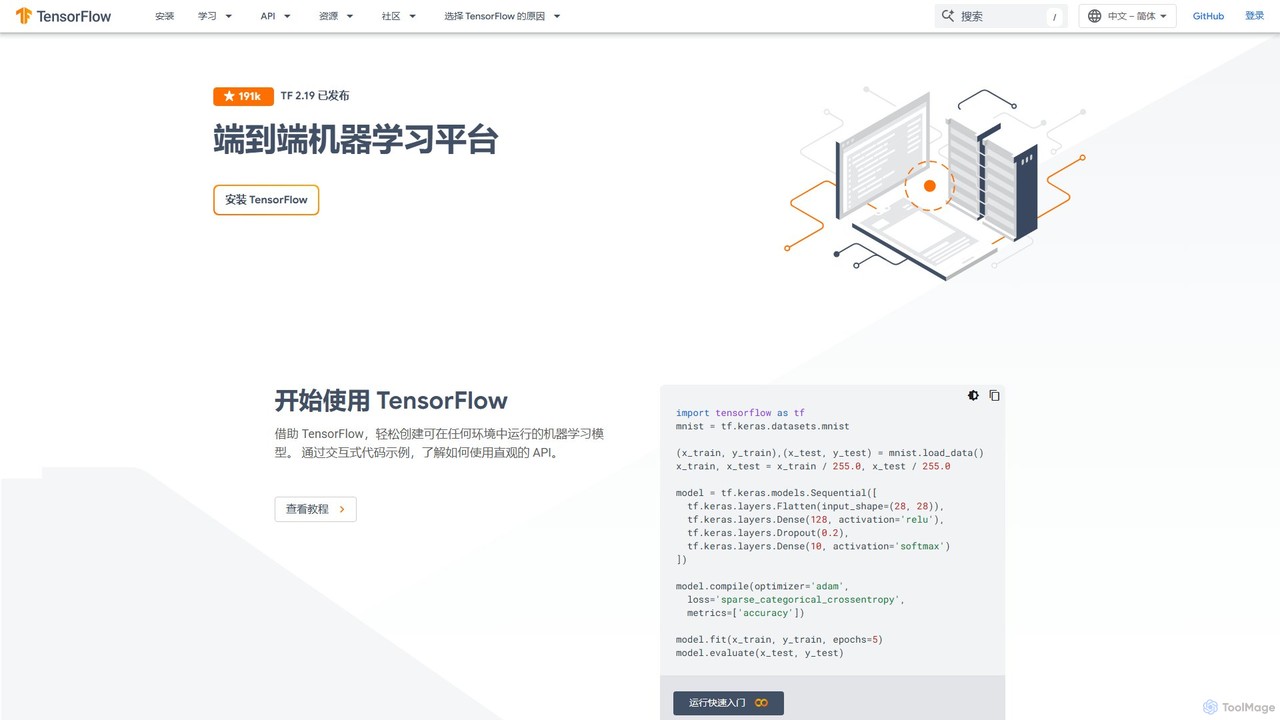
TensorFlow is an end-to-end open-source platform for machine learning developed by Google. It provides a comprehensive, flexible ecosystem …

737.3K
Free
Flower

Flower

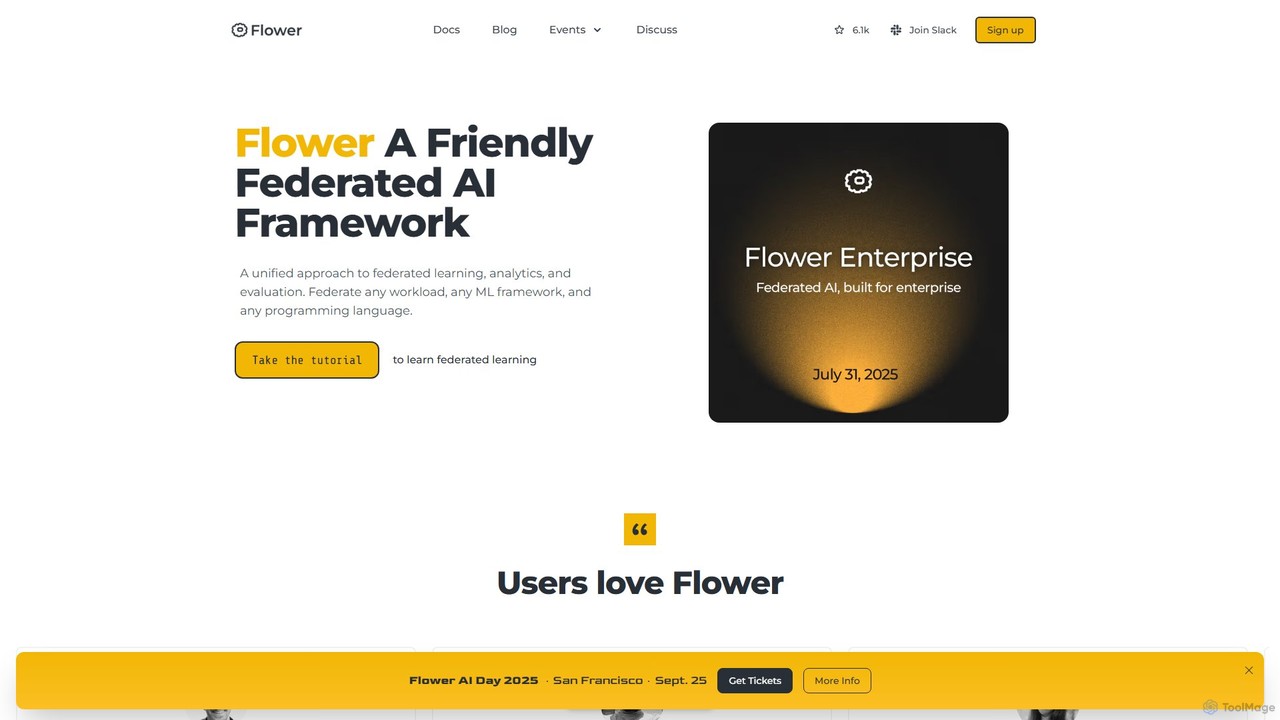
Flower is a friendly, open-source framework for federated learning, analytics, and evaluation. It enables training AI models on …

70.4K

About Frameworks

AI Frameworks are foundational software libraries that provide a structured environment for building, training, and deploying machine learning models. These tools offer pre-built components, such as neural network layers and optimizers, which abstract away complex low-level computations. Their primary value lies in accelerating the development cycle, enabling data scientists and developers to focus on model architecture rather than foundational coding. Frameworks are the essential scaffolding within the data science workflow for creating robust and scalable AI applications.

Core Features

  • Model Building APIs: Provide high-level and low-level interfaces for defining and customizing machine learning model architectures.
  • Automatic Differentiation: Automatically calculates gradients, a crucial function for training neural networks through backpropagation.
  • Hardware Acceleration: Offer built-in support for GPUs and TPUs to significantly speed up model training and inference computations.
  • Deployment Utilities: Include tools and libraries for exporting trained models and serving them in production environments.
  • Extensive Ecosystems: Often supported by large communities, providing access to pre-trained models, tutorials, and supplementary tools.

Use Cases

AI Frameworks are used across academia and industry for nearly all machine learning tasks. In research, they enable rapid prototyping of new model architectures. In business, they are used to build applications for computer vision (e.g., object detection), natural language processing (e.g., sentiment analysis), and predictive analytics (e.g., demand forecasting).

How to Choose

Selecting an AI Framework depends on several factors. Consider the project's goal: PyTorch is often favored for research due to its flexibility, while TensorFlow has a more mature ecosystem for production deployment. Evaluate the learning curve and your team's existing skills. Also, assess the community support, available pre-trained models, and compatibility with target deployment platforms (e.g., mobile, web, or cloud).

FrameworksUse Cases

1

Develop a Custom Image Recognition Model

A computer vision engineer needs to create a system for identifying product defects on a manufacturing line. Using a framework like PyTorch or TensorFlow, they can design a custom Convolutional Neural Network (CNN). The framework provides pre-built layers (convolutional, pooling, dense) and handles the complex backpropagation and optimization algorithms. By leveraging GPU acceleration through the framework, the engineer can train the model on thousands of images in hours instead of days, leading to a highly accurate defect detection system ready for deployment.

2

Fine-tune a Language Model for Sentiment Analysis

A data scientist at an e-commerce company wants to analyze customer reviews. Instead of building a model from scratch, they use a framework that integrates with a model hub like Hugging Face. They select a pre-trained language model (e.g., BERT) and fine-tune it on their specific dataset of reviews. The framework simplifies data loading, manages the training loop, and provides metrics for evaluation. This approach significantly reduces development time and computational cost, delivering a powerful sentiment analysis tool in a fraction of the time.

3

Rapid Prototyping for AI Research

An academic researcher is exploring a novel neural network architecture for medical imaging. Time is critical for publishing their findings. By using a framework with a high-level API like Keras, they can quickly assemble and test different model configurations with just a few lines of code. The framework's modular design allows them to easily swap layers, activation functions, and optimizers. This rapid iteration capability enables them to validate their hypothesis and achieve promising results much faster than if they had to implement everything from basic mathematical operations.

4

Deploying Models on Edge Devices

A mobile app developer wants to add a real-time object detection feature to their application. Running the model in the cloud would introduce latency. They use a framework like TensorFlow Lite to convert a pre-trained model into a format optimized for mobile devices. The framework provides tools to quantize the model, reducing its size and power consumption without a significant loss in accuracy. This allows the object detection to run directly on the user's phone, providing a fast and responsive experience while preserving user privacy.

5

Building a Classical Machine Learning Pipeline

A business analyst needs to predict customer churn using tabular data like purchase history and demographics. For this task, a comprehensive framework like Scikit-learn is ideal. They use its modules for data preprocessing (scaling, encoding categorical variables), model selection (training a logistic regression or random forest model), and evaluation (calculating accuracy and F1-score). The framework's consistent API (e.g., `.fit()`, `.predict()`) makes it easy to experiment with different algorithms and build a complete, reproducible machine learning pipeline from data cleaning to final prediction.

6

Scaling Model Training with Distributed Computing

An enterprise machine learning team is tasked with training a large recommendation engine on terabytes of data. Training on a single machine would take weeks. They use a framework like TensorFlow or PyTorch, which supports distributed training. The framework handles the complex logic of splitting the data and model across multiple GPUs or a cluster of machines. It manages synchronization between nodes to ensure the model learns correctly. This allows the team to reduce training time from weeks to days, enabling faster model iteration and deployment.

FrameworksFrequently Asked Questions