ToolMage
Sign in

AI TOOL COMPARISON

Modelbit vs UbiOps

What is the difference, and which fits your workflow? Compare features, usage, pricing models and traffic side by side.

Jump to key differences

Product overview

Modelbit Product overview

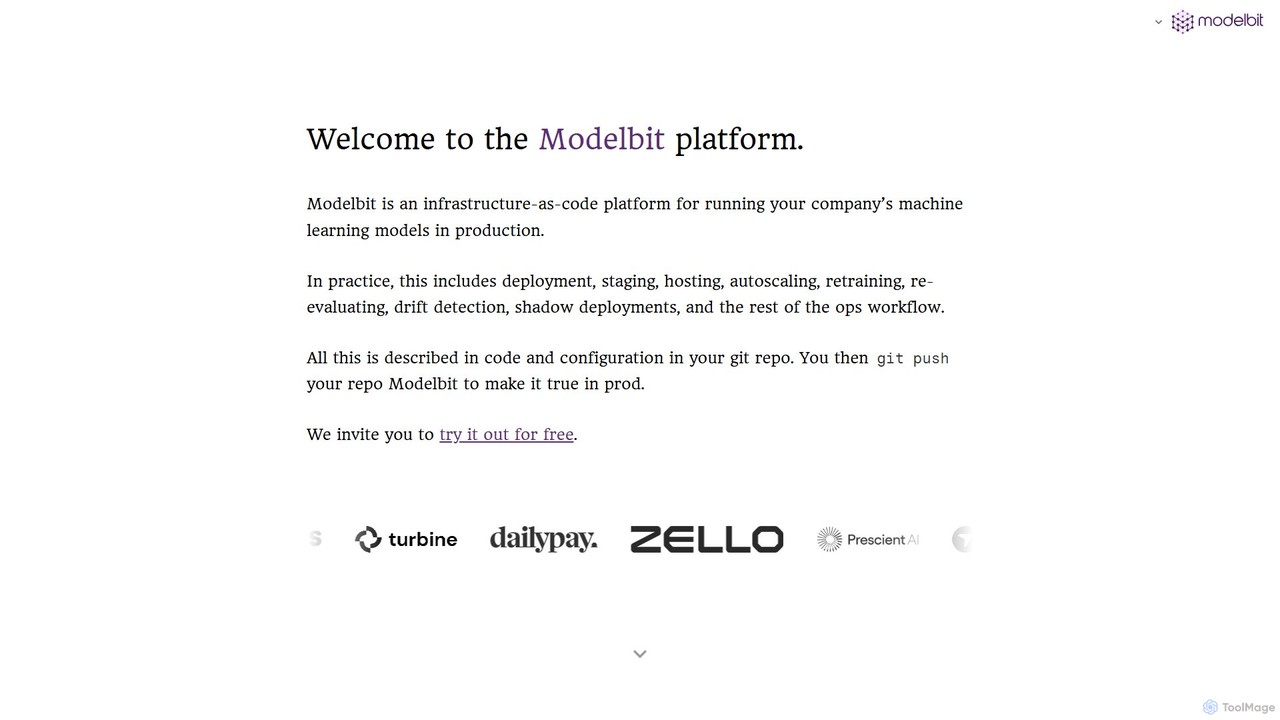
Modelbit is an MLOps platform for deploying machine learning models directly from Python notebooks to production. It provides an infrastructure-as-code workflow, enabling data scientists to deploy, host, scale, and manage models with a single line of code and a git push.

Preview

UbiOps Product overview

UbiOps is a powerful MLOps platform for AI model serving, orchestration, and training. It enables data scientists and AI teams to seamlessly deploy, manage, and scale their models on any infrastructure—local, hybrid, or multi-cloud—without deep engineering expertise. The platform handles containerization, API creation, and auto-scaling, accelerating the path from development to production for various AI applications, including Generative AI and Computer Vision.

Preview

Quick facts

Compare product focus, pricing models and audiences. Highlighted rows indicate different listed information; unknown pricing does not mean free.

Modelbit VS UbiOps — Quick facts
Quick factsModelbitUbiOps
Pricing modelFreemiumFreemium
Product typeWebWeb
Primary focusMlopsPlatform As A Service (Paas)
Audience and rolesNo data availableNo data available
CategoriesMlops · AutomationPlatform As A Service (Paas) · Model Deployment · Mlops
AddedAug 2, 2025Aug 3, 2025
UpdatedNov 19, 2026Nov 19, 2026

Features, usage and use cases

Explore the listed product descriptions, features and workflows. Taxonomy labels alone are not feature evaluations.

Modelbit

Modelbit is a comprehensive infrastructure-as-code platform designed to streamline the deployment and management of machine learning models in production environments. It specifically targets teams with serious ML infrastructure needs, bridging the gap between model development in Python notebooks and robust, scalable production systems. The platform handles the entire operational lifecycle, including deployment, staging, hosting, autoscaling, retraining, drift detection, and shadow deployments, all managed through code and configuration within a Git repository.

With Modelbit, data scientists are empowered to take their models from a Jupyter or Colab notebook to a live, scalable API endpoint in minutes. The core philosophy is to let data scientists work in their preferred environment while providing a seamless, automated path to production, eliminating the traditional friction and long lead times associated with ML deployment.

How to use Modelbit

The workflow is designed for simplicity and integration with existing data science and engineering practices:

  1. Develop in a Notebook: Train and finalize your machine learning model in your preferred Python environment, such as a Jupyter notebook or Google Colab.
  2. Import and Deploy: Import the Modelbit library into your notebook. With your trained model and any necessary data processing functions ready, call the `modelbit.deploy()` function. This single command initiates the deployment process.
  3. Automated Packaging: Modelbit automatically captures your model, its code dependencies, and the specific Python environment (including package versions), ensuring perfect replication in production.
  4. Git-Based Management: Connect your Modelbit account to a GitHub repository. Deployments are managed through Git. For instance, pushing code to a 'staging' branch deploys the model to a staging environment, while merging to the 'main' branch promotes it to production.
  5. Access and Scale: Once deployed, Modelbit automatically generates a unique REST API and a Snowflake API for your model. You can then use the web interface or CLI to monitor performance, view logs, manage different versions, set up A/B tests, or roll back to a previous version if needed. The system automatically scales resources, including GPUs, based on traffic.

Core Features of Modelbit

  • Direct Notebook Deployment: Go from a model in a notebook to a production API with the `modelbit.deploy()` command, eliminating complex manual steps.
  • Git-Based MLOps (Infrastructure-as-Code): Manage your entire ML deployment lifecycle through Git. Every `git push` creates a new, versioned, and idempotent deployment.
  • Automatic API Generation: Each model version gets its own containerized environment with a unique REST API and Snowflake API, ready for integration.
  • Auto-Scaling and GPU Support: Deployments are containerized and isolated, with automatic scaling to handle variable loads. Full support for GPU-intensive models like large vision transformers.
  • Advanced Deployment Strategies: Natively supports shadow deployments to test new models on production traffic without impacting users, A/B testing between versions, and instant rollbacks.
  • Hybrid Cloud Flexibility: Run models in Modelbit's secure, multi-tenant cloud or deploy them within your own cloud environment (VPC) for maximum control and privacy.
  • Environment Parity: Automatically captures and recreates the exact Python environment, preventing the common "it works on my machine" problem.

Use Cases for Modelbit

Modelbit is trusted by companies for demanding, real-time applications:

  • Real-time Threat Detection: Companies like Ambient AI use Modelbit to deploy large, multi-modal computer vision models that analyze security footage in real-time to detect threats, leveraging its GPU support and rapid iteration capabilities.
  • Fintech and Risk Assessment: Used for deploying models for fraud detection and loan underwriting, where high availability (99.99% uptime) and low latency are critical.
  • Logistics and E-commerce: Teams at companies like Inventa deploy models to reduce predicted shipping times and forecast order volumes, directly optimizing business operations.
  • Healthcare and Life Sciences: OM1 uses Modelbit to power ML applications that help detect rare diseases, demonstrating its capability to handle complex and sensitive workloads.

Advantages of Modelbit

The platform offers significant advantages for ML teams:

  • Speed and Agility: Reduces deployment cycles from months or weeks to just minutes, allowing for faster experimentation and delivery of new features.
  • Empowers Data Scientists: Gives data scientists the autonomy to deploy and manage their own models, freeing up DevOps and ML engineering resources.
  • Production-Grade Reliability: Built for mission-critical systems with features like container isolation, idempotent deployments, and a proven 99.99% uptime.
  • Seamless Integration: Fits perfectly into modern data science (Python, notebooks) and software engineering (Git, CI/CD) workflows.
  • Cost-Effective: The autoscaling feature ensures that you only use and pay for the compute resources required at any given moment.

Pricing and Plans

Modelbit operates on a freemium model. It offers a free tier that allows individual developers and small teams to try out the platform and deploy models. For larger teams and enterprise use cases with requirements such as hybrid cloud deployments, advanced security features, and dedicated support, custom-priced plans are available. For the most accurate and up-to-date pricing information, it is recommended to visit the official Modelbit website.

UbiOps

UbiOps is a comprehensive software platform designed to simplify and accelerate the deployment, management, and scaling of AI and machine learning models. It empowers organizations to run their 'Private AI' on their own terms, whether on-premise, in a hybrid setup, or across multiple cloud providers. By abstracting away the underlying engineering complexity of technologies like Kubernetes, UbiOps allows AI teams to focus on building and iterating on their models, significantly reducing time-to-market and ensuring robust compliance and governance. It's a battle-tested solution used in critical sectors like healthcare and the public sector, providing a reliable and scalable backbone for production-grade AI.

How to use UbiOps

Getting started with UbiOps is a structured process designed for both new and advanced users:

  1. Sign Up: Create a free UbiOps account on their website to access the platform.
  2. Choose Your Interface: Interact with the platform in a way that suits your workflow. You can use the user-friendly WebApp for visual management, the Python Client Library for programmatic integration into your scripts, the powerful Command Line Interface (CLI) for terminal-based operations, or the REST API for custom integrations.
  3. Define an Environment: Create a reusable 'Environment' by specifying the necessary libraries, packages, and dependencies for your code (e.g., Python version, PyTorch, TensorFlow). UbiOps will build a container image for you, ensuring consistency.
  4. Deploy Your Model: Package your AI model or data processing script into a 'Deployment'. UbiOps automatically containerizes the code and exposes it as a secure, scalable microservice with its own API endpoint. You can manage multiple versions of each deployment.
  5. Build Pipelines: For complex workflows, use the 'Pipelines' feature. This allows you to chain multiple deployments together, orchestrating the flow of data between different models or processing steps to build a complete dataflow.
  6. Train Models: Utilize the 'Training' feature to run and manage model training jobs. Define an 'Experiment' with your desired hardware (including GPUs) and execute multiple 'Training Runs' in parallel to efficiently test different parameters and find the best model.
  7. Run & Scale: Send requests to your deployment or pipeline APIs to process data. UbiOps handles request queuing, load balancing, and automatic scaling based on demand, ensuring your application is always responsive.

Core Features of UbiOps

  • Unified Model Serving & Orchestration: Deploy models as versioned, scalable microservices with automatic API generation. Build complex, multi-step workflows (Pipelines) to connect models and data processing tasks seamlessly.
  • Flexible Infrastructure Support: Run AI workloads anywhere—on-premise servers, private cloud, public clouds (AWS, Azure, GCP), or a hybrid combination. It supports Kubernetes, Virtual Machines, and even bare metal infrastructure.
  • Integrated Model Training: A dedicated environment for running, managing, and tracking model training experiments. Scale training jobs on powerful hardware, including various GPU types, and manage artifacts with ease.
  • Environment Management: Define and reuse container environments with specific libraries and dependencies, ensuring perfect consistency between development, testing, and production.
  • Advanced Governance & Security: Features for version management, job scheduling, detailed monitoring, and robust security protocols to ensure compliance and full control over your AI assets.
  • Multiple Interaction Methods: Full platform functionality is accessible through a WebApp, Python Client Library, REST API, and CLI, catering to different user preferences and enabling powerful automation.

Use Cases for UbiOps

UbiOps is versatile and can be applied to a wide range of AI applications:

  • Generative AI Deployment: Deploy and serve large language models (LLMs) and other generative models for applications like chatbots, content creation, and code generation.
  • Computer Vision: Run image and video analysis models for object detection, image classification, and facial recognition in production environments.
  • Predictive Analytics: Deploy classical machine learning models for forecasting, fraud detection, and customer churn prediction.
  • Data Processing Pipelines: Create automated workflows for data cleaning, transformation, and feature engineering as a precursor to model inference.
  • Hybrid Cloud MLOps: Ideal for organizations that need to process sensitive data on-premise while leveraging the scalability of the public cloud for less sensitive tasks.

Advantages of UbiOps

UbiOps offers significant advantages for AI teams:

  • Accelerated Time-to-Market: Drastically reduces the time and engineering effort required to move AI models from a laptop to a production-grade, scalable service.
  • Infrastructure Agnostic: Avoids vendor lock-in by providing the freedom to run AI on any hardware or cloud provider, giving you full control.
  • Simplified MLOps: Abstracts away complex infrastructure management (like Kubernetes), allowing data scientists to be more self-sufficient and focus on model development.
  • Scalability and Reliability: Built to handle production workloads with automatic scaling, request handling, and high availability, ensuring robust performance.
  • Enhanced Security & Compliance: Perfect for 'Private AI' initiatives, ensuring data stays within your control and meets strict regulatory requirements.

Pricing and Plans

UbiOps offers a flexible pricing structure to suit different needs, from individual developers to large enterprises. While specific prices should be checked on the official website, the plans generally follow this structure:

  • Free Plan: A generous free tier for individuals and small projects, allowing users to explore the platform's core features with certain usage limits.
  • Professional Plan: A paid plan for professionals and small teams needing more compute resources, higher request volumes, and additional features.
  • Business Plan: Designed for growing businesses, offering more capacity, advanced features, and dedicated support.
  • Enterprise Plan: A custom plan for large organizations with specific requirements for on-premise/private cloud deployment, advanced security, custom integrations, and premium support. Interested parties are encouraged to book a call for a custom quote.

Positioning

Their taxonomy shows where the products overlap and where each one has a more distinct focus. Unknown fields are shown explicitly and are never filled with assumptions.

Categories

Shared
Mlops
Only Modelbit
Automation
Only UbiOps
Platform As A Service (Paas)Model Deployment

Tags

Shared
data sciencemachine learningMLOpsmodel deployment
Only Modelbit
AI developer toolsautoscalingCI/CD for MLinfrastructure as codemodel hostingpython
Only UbiOps
AI orchestrationhybrid cloudkubernetesmodel servingPaaSprivate AI

Audience and roles

Shared
No listed items
Only Modelbit
No listed items
Only UbiOps
No listed items

Traffic comparison

Traffic is shown on the same scale so differences in market visibility are not visually understated.

How to interpret the traffic data

Both charts share the same months and vertical scale. Each tool identifies its latest reporting month; missing months are left blank, not counted as zero. Regional and source visit counts are estimates calculated from the reported shares.

Modelbit monthly traffic:

Latest traffic · 2026-05

Monthly visits
438
Avg. visit duration
0:25
Pages per visit
1.62
Bounce rate
34.27%
Data updated 2026-06-15

Monthly traffic trend

  • 2025-09: 8.1K
  • 2026-01: 2.5K
  • 2026-02: 1.6K
  • 2026-03: 2.4K
  • 2026-04: 3K
  • 2026-05: 438

Top regions

Top 5 countries/regions
Country/regionPercentageEstimated visits
🇮🇳India100%438

Search keywords

dbt incremental modelssam segment anything checkpoint bsam_vit_b_01ec64sam_vit_b_01ec64.pthsam_vit_b_01ec64.pth (1)

UbiOps monthly traffic:

Latest traffic · 2026-05

Monthly visits
13.8K
Avg. visit duration
13:51
Pages per visit
25.97
Bounce rate
20.37%
Data updated 2026-06-11

Monthly traffic trend

  • 2025-09: 9.4K
  • 2026-01: 18.2K
  • 2026-02: 13.6K
  • 2026-03: 18K
  • 2026-04: 21.3K
  • 2026-05: 13.8K

Top regions

Top 5 countries/regions
Country/regionPercentageEstimated visits
🇳🇱Netherlands83.82%11.6K
🇺🇸United States9.39%1.3K
🇮🇳India4.08%563
🇩🇪Germany1.48%204
🇬🇧United Kingdom1.23%170

Traffic sources

Source typePercentageEstimated visits
Direct80.99%11.2K
Email17.45%2.4K
Referral1.56%215

Search keywords

machine learning operations (mlops) what does it mean in documentationmondomonger deepfakeonnx cpu vs gpuubiopsubi platform api docs

Community signals

Ratings, comments, favorites, and likes are community signals—not a substitute for product fit.

Modelbit

Rating
No data available
Comments
0
Favorites
176
Likes
178

UbiOps

Rating
No data available
Comments
0
Favorites
182
Likes
197

Modelbit vs UbiOps · Comparison FAQ

What do Modelbit and UbiOps have in common?
Both tools are listed under Mlops. These categories indicate overlapping use cases; compare their detailed descriptions for workflows, capabilities and limitations.
Are Modelbit and UbiOps free?
Listed pricing models: Modelbit — Freemium; UbiOps — Freemium. Missing pricing is not proof of a free plan, and freemium does not mean every feature is free. Check official sites for current plans, limits and trials.
How should I choose between Modelbit and UbiOps?
The primary listed category is Mlops for Modelbit, and Platform As A Service (Paas) for UbiOps. Compare features, steps and use cases, then verify pricing, data permissions and deployment needs. This page does not include hands-on testing and does not declare a winner from traffic or tags.

Sources and comparison methodology

This page is assembled from ToolMage product listings, taxonomy, traffic statistics and on-site user feedback. It is not a hands-on test or an independent review.
  • Feature and plan descriptions reflect information in the listings, not real-time guarantees. Verify pricing, quotas, availability and privacy terms on the official sites.
  • Traffic uses the reporting months shown. Missing statistics do not mean zero visits, and different periods do not establish growth or superiority. Regional and source visit counts are estimates based on shares.
  • Different tags indicate differences in the listings, not proof that the other product lacks a capability. Ratings, favorites and visits are not used to declare a winner.

Related comparisons