ToolMage
Sign in

AI TOOL COMPARISON

SQL Chat vs SQLPilot

What is the difference, and which fits your workflow? Compare features, usage, pricing models and traffic side by side.

Jump to key differences

Product overview

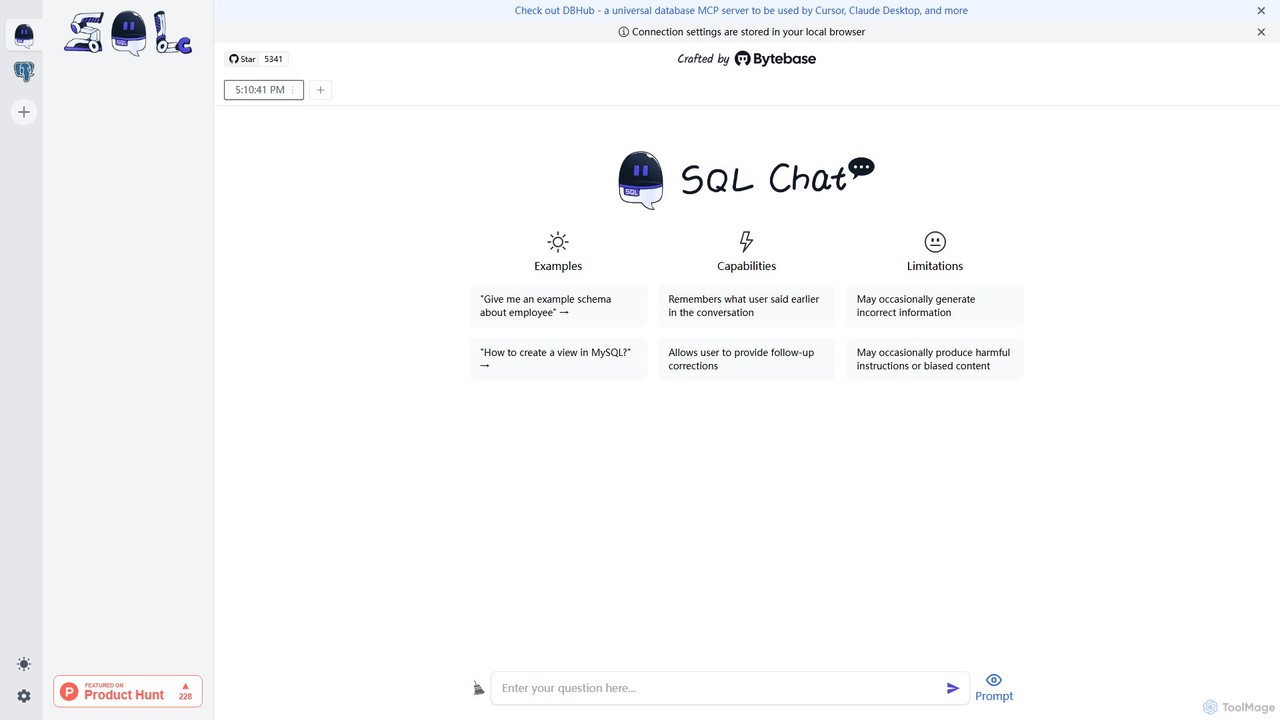
SQL Chat Product overview

SQL Chat is an open-source, chat-based SQL client and editor that uses AI to translate natural language questions into SQL queries. Connect to your database, ask questions in plain English, and get results instantly, democratizing data access for both technical and non-technical users.

Preview

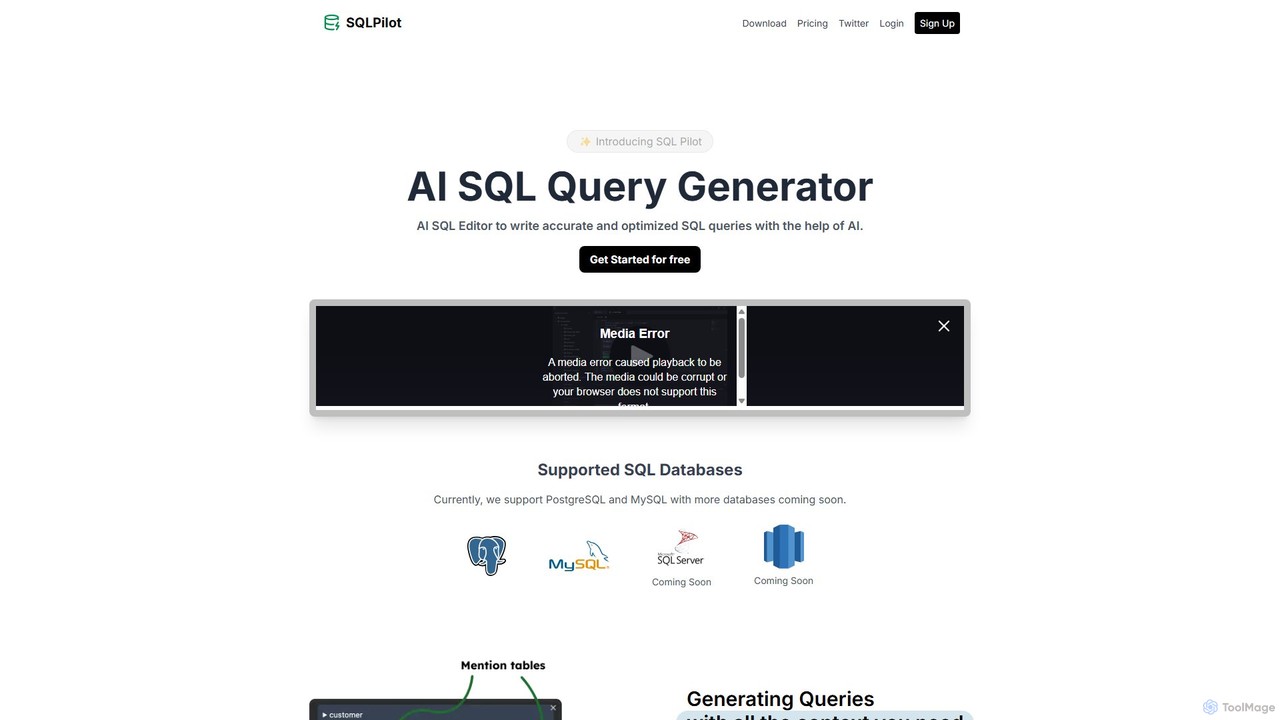
SQLPilot Product overview

SQLPilot is an AI-powered SQL query generator and editor that transforms natural language prompts into accurate, optimized SQL queries. It supports multiple databases like PostgreSQL and MySQL, various GPT models, and ensures data privacy by not storing your credentials or schemas.

Preview

Quick facts

Compare product focus, pricing models and audiences. Highlighted rows indicate different listed information; unknown pricing does not mean free.

SQL Chat VS SQLPilot — Quick facts
Quick factsSQL ChatSQLPilot
Pricing modelFreemiumFreemium
Product typeWebWeb
Primary focusCode AssistantCode Assistant
Audience and rolesNo data availableNo data available
CategoriesCode Assistant · Database · Business IntelligenceCode Assistant · Database · Automation
AddedAug 6, 2025Aug 6, 2025
UpdatedNov 19, 2026Nov 19, 2026

Features, usage and use cases

Explore the listed product descriptions, features and workflows. Taxonomy labels alone are not feature evaluations.

SQL Chat

SQL Chat is a revolutionary, open-source AI tool designed to function as a chat-based SQL client and editor for the modern era. It fundamentally changes how users interact with databases by allowing them to use natural language to query data. Instead of writing complex SQL code, you can simply ask questions in plain English, and SQL Chat's advanced AI will translate them into accurate SQL queries, execute them, and return the results. This makes data exploration and analysis accessible to a much broader audience, including product managers, marketers, and business analysts, while also serving as a powerful productivity tool for experienced developers and data scientists.

Built with security and flexibility in mind, SQL Chat is self-hostable, meaning you can deploy it within your own infrastructure. This ensures that your sensitive database credentials and data never leave your control, addressing a critical concern for many organizations. It supports a wide range of popular databases, making it a versatile solution for various data stacks.

How to use SQL Chat

Using SQL Chat is designed to be an intuitive and straightforward process, centered around a conversational interface.

  1. Connect to Your Database: The first step is to establish a secure connection to your database. SQL Chat supports various SQL databases like MySQL, PostgreSQL, and more. You provide the connection details (host, port, username, password), and the tool securely connects to your data source. Since it can be self-hosted, these credentials remain within your private network.
  2. Ask Questions in Natural Language: Once connected, you can start interacting with the chat interface. Type your data request as a simple question, just as you would ask a colleague. For example, you could ask, "Show me the total revenue from last month" or "Which 10 customers have the highest lifetime value?".
  3. AI-Powered Query Generation: SQL Chat's AI analyzes your question, understands the intent, and automatically generates the corresponding SQL query. The tool is aware of your database schema (tables and columns), which allows it to construct precise and valid queries.
  4. Review, Edit, and Execute: The generated SQL query is displayed for your review. This is a great feature for both learning and validation. Technical users can fine-tune the query if needed, while new users can learn SQL syntax by observing the translations. Once you're satisfied, you can execute the query with a single click.
  5. Explore and Visualize Results: The query results are presented in a clean, tabular format. You can then ask follow-up questions to drill down further into the data, such as "Group these results by country" or "What's the weekly trend for this data?", making data exploration a seamless, continuous conversation.

Core Features of SQL Chat

  • Natural Language to SQL: The core engine that translates plain English questions into executable SQL code.
  • Broad Database Support: Natively supports connections to popular databases including MySQL, PostgreSQL, and more.
  • Self-Hosting for Maximum Security: As an open-source tool, it can be deployed on your own servers, ensuring data privacy and security.
  • Interactive SQL Editor: Provides an interface to view, edit, and refine the AI-generated SQL queries before execution.
  • Context-Aware Conversational Interface: Remembers the context of your conversation, allowing for intuitive follow-up questions and iterative data exploration.
  • Schema Awareness: Automatically analyzes your database schema to generate accurate and relevant queries.
  • Open-Source: Free to use, modify, and contribute to, with a transparent development process driven by the community.

Use Cases for SQL Chat

SQL Chat is a versatile tool that caters to various roles within an organization:

  • Business Teams (Sales, Marketing, Operations): Empower non-technical team members to self-serve their data needs. They can track KPIs, generate reports, and analyze campaign performance without relying on the engineering team.
  • Data Analysts and Scientists: Accelerate the data exploration and query prototyping process. Quickly generate baseline queries for ad-hoc requests and spend more time on complex analysis rather than boilerplate SQL writing.
  • Product Managers: Gain quick insights into user behavior, feature adoption, and product metrics directly from the database to make data-informed decisions.
  • Developers and Engineers: Use it for quick data lookups, debugging, and database checks without the need to switch to a heavy, traditional SQL client.
  • SQL Learners: An excellent educational tool for understanding how to structure SQL queries by seeing direct translations from natural language questions.

Advantages of SQL Chat

The primary advantage of SQL Chat is its ability to democratize data access. It breaks down the technical barriers associated with SQL, empowering anyone to interact with data. This leads to increased productivity across the board, as it significantly reduces the time from question to insight. The self-hosted, open-source model provides unparalleled security, control, and flexibility, which is a critical differentiator from many cloud-only AI services. Its intuitive, chat-based UX requires virtually no training, making adoption seamless for any team.

Pricing and Plans

SQL Chat is an open-source project and is available for free. You can download the source code from its GitHub repository and host it on your own infrastructure without any licensing fees. While the core product is free, commercial support or managed cloud hosting options may be offered by the maintainers or third-party services. For the most up-to-date information, it is recommended to check the official SQL Chat website or its GitHub page.

SQLPilot

SQLPilot is an advanced AI-powered tool designed to streamline database management and data analysis by generating accurate and optimized SQL queries from natural language. It serves as an intelligent SQL editor and assistant, empowering developers, data analysts, and database administrators to interact with their data more efficiently. By simply describing the desired outcome in plain English, users can obtain complex SQL code in seconds, significantly reducing development time and minimizing the risk of syntax errors. The platform is built with a strong emphasis on user control, flexibility, and security.

Currently, SQLPilot supports popular databases like PostgreSQL and MySQL, with plans to expand its compatibility. It integrates seamlessly into existing workflows, allowing users to connect to an unlimited number of databases. One of its standout features is the commitment to privacy; SQLPilot does not store user database schemas, queries, or credentials, ensuring that sensitive information remains secure and confidential.

How to use SQLPilot

Using SQLPilot is an intuitive process designed for both technical and non-technical users:

  1. Connect Your Database: Start by establishing a secure connection to your PostgreSQL or MySQL database. You can add and manage an unlimited number of connections.
  2. Provide Context (Optional but Recommended): For more accurate queries, you can leverage the RAG (Retrieval-Augmented Generation) support by connecting your knowledge base. This allows the AI to understand your specific database schema and context.
  3. Write Your Prompt: In the editor, type a prompt in natural language. For example, you could write, "Show me all users who signed up in the last 30 days and have made more than 5 purchases."
  4. Select an AI Model: Choose from a range of powerful AI models, including GPT-3.5, GPT-4, and the latest GPT-4o, to balance speed and query complexity.
  5. Generate and Refine: Click the generate button. The AI will produce the corresponding SQL query. You can review, edit, and refine the query directly in the editor.
  6. Execute and Download: Once satisfied, you can execute the query. The results can be easily downloaded in CSV format for further analysis, with Excel support planned for the future.

Core Features of SQLPilot

  • Natural Language to SQL: Translates plain English prompts into precise and efficient SQL queries.
  • Multiple AI Model Support: Offers flexibility by supporting GPT-3.5, GPT-4, and GPT-4o models, allowing users to choose the best model for their needs.
  • Knowledge Base / RAG Support: Connects to your knowledge base to provide the AI with schema context, resulting in highly accurate and relevant queries.
  • Bring Your Own Key (BYOK): Users can add their own OpenAI API key for greater control and potentially lower costs.
  • Multi-Database Support: Natively supports PostgreSQL and MySQL, with more database systems to be added soon.
  • Unlimited Database Connections: Add and manage as many database connections as you need without any limitations.
  • Strict Privacy and Security: Guarantees user privacy by not storing any database schemas, queries, or connection credentials.
  • Downloadable Results: Export query results directly to a CSV file for easy integration with other tools and reports.

Use Cases for SQLPilot

SQLPilot is a versatile tool beneficial for various roles:

  • Data Analysts: Quickly generate complex queries for ad-hoc analysis and reporting without needing to write intricate SQL from scratch.
  • Software Developers: Accelerate backend development by rapidly creating queries for application features and database management tasks.
  • Database Administrators: Automate the creation of routine maintenance queries and get AI-powered suggestions for query optimization.
  • Business Professionals & Students: An excellent learning tool to understand SQL logic by seeing how natural language questions are translated into structured queries.

Advantages of SQLPilot

The primary advantage of SQLPilot is its ability to dramatically increase productivity. It acts as a co-pilot, saving countless hours typically spent on writing, debugging, and optimizing SQL code. This makes database interaction more accessible to team members who may not be SQL experts, fostering a more data-driven culture. The flexibility to choose AI models and bring your own API key provides users with unparalleled control over performance and cost. Above all, its strong commitment to security and privacy makes it a trustworthy tool for handling sensitive data.

Pricing and Plans

SQLPilot operates on a freemium model, making it accessible to everyone.

  • Free Plan: Ideal for individuals, students, and small-scale projects. This plan allows users to experience the core features of AI-powered SQL query generation at no cost. No credit card is required to get started.
  • Paid Plans (Inferred): While specific details are not provided on the homepage, it is expected that SQLPilot offers premium plans for professionals and teams. These plans would likely include a higher number of queries, access to the most advanced AI models (like GPT-4o), advanced features like RAG support, and priority customer support.

Positioning

Their taxonomy shows where the products overlap and where each one has a more distinct focus. Unknown fields are shown explicitly and are never filled with assumptions.

Categories

Shared
Database
Only SQL Chat
Code AssistantBusiness Intelligence
Only SQLPilot
Code AssistantAutomation

Tags

Shared
data analysisdatabasedeveloper toolsmysqlnatural language processingpostgresqlSQL
Only SQL Chat
business intelligenceNLPopen sourcetext to sql
Only SQLPilot
AI assistantcode generatorRAG

Audience and roles

Shared
No listed items
Only SQL Chat
No listed items
Only SQLPilot
No listed items

Traffic comparison

Traffic is shown on the same scale so differences in market visibility are not visually understated.

How to interpret the traffic data

Both charts share the same months and vertical scale. Each tool identifies its latest reporting month; missing months are left blank, not counted as zero. Regional and source visit counts are estimates calculated from the reported shares.

SQL Chat monthly traffic:

Latest traffic · 2026-05

Monthly visits
133
Avg. visit duration
0:00
Pages per visit
1.04
Bounce rate
35.79%
Data updated 2026-06-15

Monthly traffic trend

  • 2025-09: 6.4K
  • 2026-01: 1.4K
  • 2026-02: 1.2K
  • 2026-03: 1.2K
  • 2026-04: 198
  • 2026-05: 133

Top regions

Top 5 countries/regions
Country/regionPercentageEstimated visits
🇮🇳India100%133

Search keywords

sql ai botsql chat

SQLPilot monthly traffic:

Latest traffic · 2026-05

Monthly visits
279
Avg. visit duration
0:00
Pages per visit
1.01
Bounce rate
44.25%
Data updated 2026-06-11

Monthly traffic trend

  • 2025-09: 3.3K
  • 2026-01: 1.1K
  • 2026-02: 1.2K
  • 2026-03: 735
  • 2026-04: 1.4K
  • 2026-05: 279

Top regions

Top 5 countries/regions
Country/regionPercentageEstimated visits
🇩🇪Germany71.2%199
🇮🇩Indonesia28.8%80

Search keywords

ai sql query generatorsql code generatorusign ai to generate a queryusing ai to generate a query

Community signals

Ratings, comments, favorites, and likes are community signals—not a substitute for product fit.

SQL Chat

Rating
No data available
Comments
0
Favorites
196
Likes
189

SQLPilot

Rating
No data available
Comments
0
Favorites
182
Likes
199

SQL Chat vs SQLPilot · Comparison FAQ

What do SQL Chat and SQLPilot have in common?
Both tools are listed under Database. These categories indicate overlapping use cases; compare their detailed descriptions for workflows, capabilities and limitations.
Are SQL Chat and SQLPilot free?
Listed pricing models: SQL Chat — Freemium; SQLPilot — Freemium. Missing pricing is not proof of a free plan, and freemium does not mean every feature is free. Check official sites for current plans, limits and trials.
How should I choose between SQL Chat and SQLPilot?
The primary listed category is Code Assistant for SQL Chat, and Code Assistant for SQLPilot. Compare features, steps and use cases, then verify pricing, data permissions and deployment needs. This page does not include hands-on testing and does not declare a winner from traffic or tags.

Sources and comparison methodology

This page is assembled from ToolMage product listings, taxonomy, traffic statistics and on-site user feedback. It is not a hands-on test or an independent review.

  • Feature and plan descriptions reflect information in the listings, not real-time guarantees. Verify pricing, quotas, availability and privacy terms on the official sites.
  • Traffic uses the reporting months shown. Missing statistics do not mean zero visits, and different periods do not establish growth or superiority. Regional and source visit counts are estimates based on shares.
  • Different tags indicate differences in the listings, not proof that the other product lacks a capability. Ratings, favorites and visits are not used to declare a winner.

Related comparisons