ToolMage
Sign in

AI TOOL COMPARISON

SQL Genius vs StataGPT

What is the difference, and which fits your workflow? Compare features, usage, pricing models and traffic side by side.

Jump to key differences

Product overview

SQL Genius Product overview

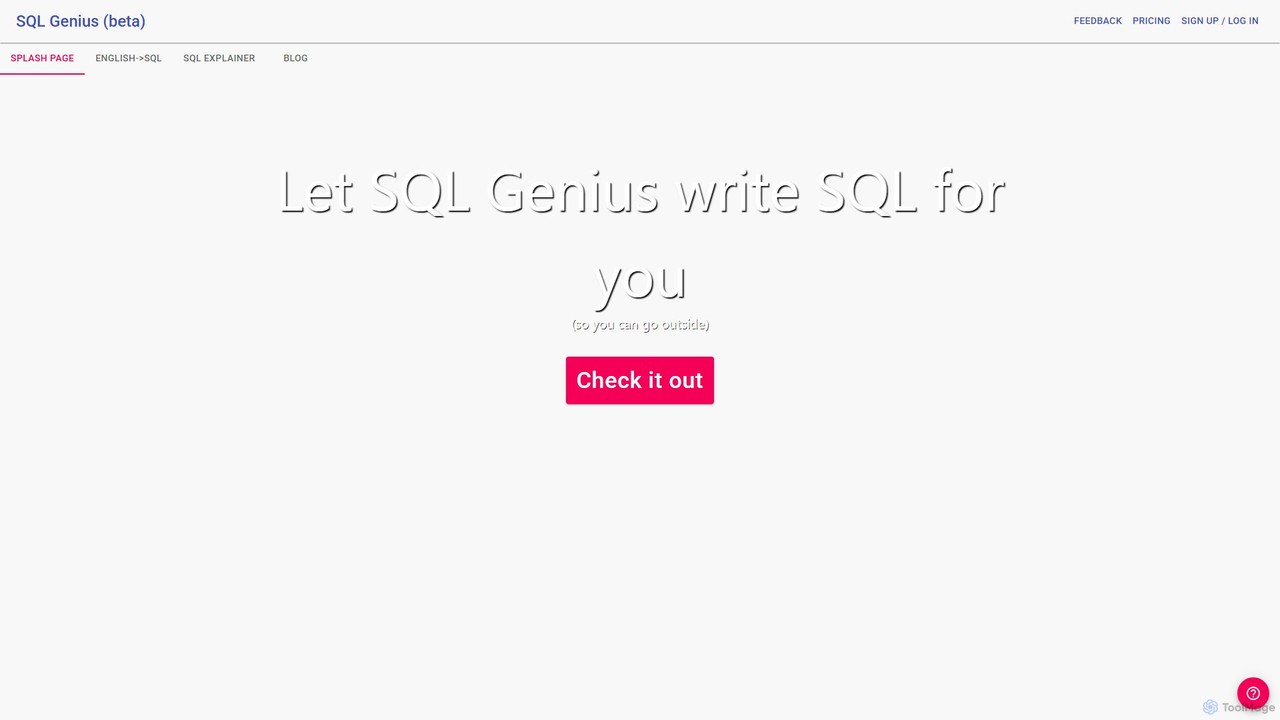
SQL Genius is an AI-powered tool that simplifies database interaction by converting plain English into SQL queries and explaining complex SQL code in simple terms. It's designed for developers, data analysts, and students to boost productivity and reduce the learning curve for SQL.

Preview

StataGPT Product overview

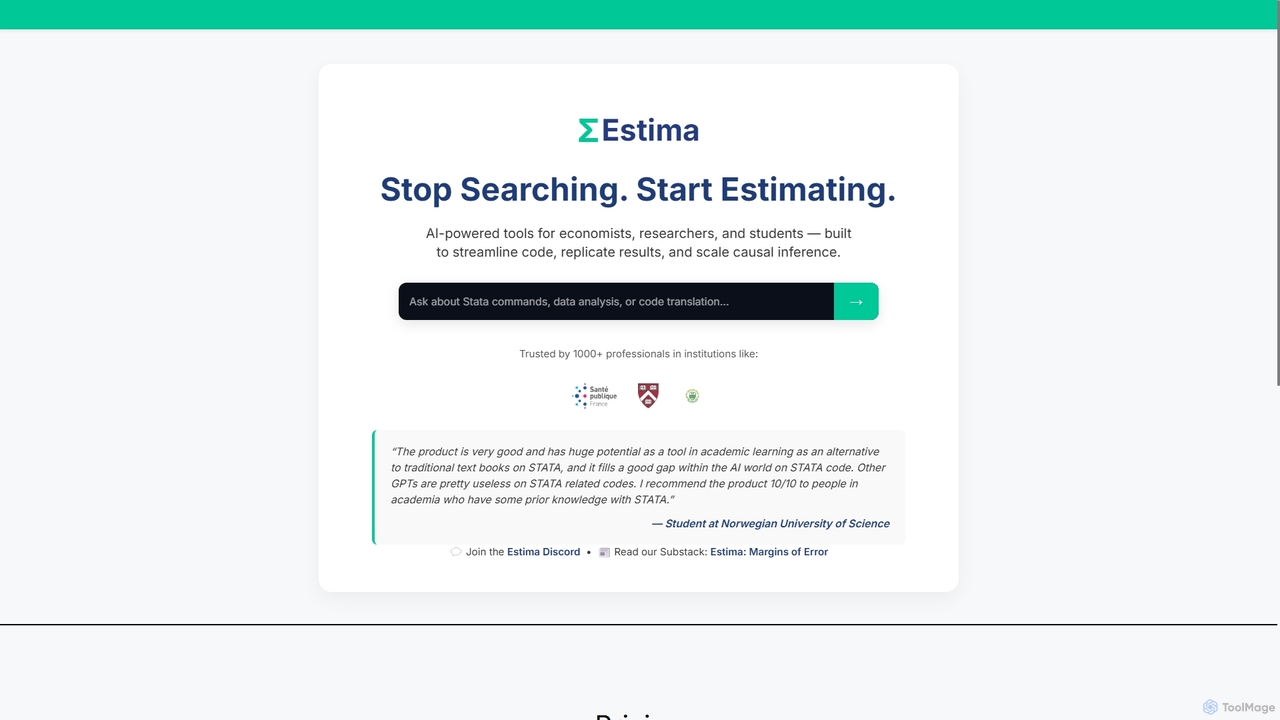
StataGPT (Estima) is an AI-powered assistant designed for economists, researchers, and students. It specializes in generating, debugging, and explaining STATA code to streamline data analysis, replicate research results, and scale causal inference, filling a critical gap where general AI models fall short.

Preview

Quick facts

Compare product focus, pricing models and audiences. Highlighted rows indicate different listed information; unknown pricing does not mean free.

SQL Genius VS StataGPT — Quick facts
Quick factsSQL GeniusStataGPT
Pricing modelFreemiumFreemium
Product typeWebWeb
Primary focusAnalyticsLearning
Audience and rolesNo data availableData Analyst · Economist · Policy Analyst · Researcher · Social Scientist · Statistician · Student
CategoriesAnalytics · Database · Learning · Code AssistantLearning · Code Assistant
AddedAug 10, 2025Sep 14, 2025
UpdatedNov 19, 2026Nov 19, 2026

Features, usage and use cases

Explore the listed product descriptions, features and workflows. Taxonomy labels alone are not feature evaluations.

SQL Genius

SQL Genius is an intelligent AI assistant designed to streamline the process of writing and understanding SQL queries. It empowers users of all skill levels, from beginners to seasoned professionals, to interact with databases more efficiently. By leveraging advanced artificial intelligence, SQL Genius translates natural language instructions into ready-to-use, syntactically correct SQL code. This eliminates the need for manual coding, reduces the likelihood of errors, and significantly speeds up development and data analysis workflows.

The platform features a clean, intuitive interface that makes database querying accessible to everyone. Whether you're a developer building an application, a data analyst extracting insights, or a student learning the ropes of database management, SQL Genius acts as your personal database expert, available 24/7.

How to use SQL Genius

Using SQL Genius is a straightforward process designed for maximum efficiency:

  1. Define Your Database Schema: In the 'My Tables' section, you can add your database tables. For each table, specify the table name and its schema (column names and data types). This context is crucial for the AI to generate accurate and relevant queries. You can add multiple tables to represent your entire database structure.
  2. Write Your Query in English: Navigate to the 'English->SQL' feature. In the text box, describe the data you want to retrieve or the operation you want to perform in plain English. For example, you could write "Show me all patients over the age of 40 who were admitted in the last month" or "Find the doctor with the highest number of patients."
  3. Generate the SQL Code: Select the appropriate SQL dialect from the advanced options (e.g., PostgreSQL, MySQL) to ensure compatibility. Click the 'Write SQL' button, and the AI will instantly generate the corresponding SQL query.
  4. Explain an Existing SQL Query: If you have a complex SQL query that you need to understand, use the 'SQL Explainer' tab. Paste your code into the input field, and SQL Genius will provide a clear, step-by-step breakdown of what the query does, explaining each clause and function in simple terms.

Core Features of SQL Genius

  • Natural Language to SQL: Translates plain English prompts into high-quality, executable SQL queries.
  • SQL Explainer: Deconstructs and explains complex SQL code, making it easy to understand, debug, and learn from.
  • Custom Schema Awareness: Allows users to input their specific table schemas, enabling the AI to generate highly accurate, context-aware queries tailored to their database.
  • Multi-Dialect Support: Supports various SQL dialects (like PostgreSQL, MySQL, etc.), ensuring the generated code works seamlessly with your specific database system.
  • Intuitive User Interface: A simple and clean web-based interface that requires no installation and is easy to navigate for all users.

Use Cases for SQL Genius

SQL Genius is a versatile tool suitable for a wide range of users and scenarios:

  • Data Analysts & Scientists: Quickly generate complex queries for data exploration, reporting, and analysis without getting bogged down in syntax.
  • Software Developers: Accelerate backend development by rapidly creating SQL queries for application features, APIs, and database migrations.
  • Students & Educators: An excellent learning aid for understanding the logic behind SQL and the relationship between a request and the resulting code.
  • Product Managers & Business Analysts: Enables non-technical team members to perform their own data lookups and gain insights without needing to rely on engineering resources.
  • Database Administrators: Helps in quickly scripting maintenance tasks or understanding legacy queries within the system.

Advantages of SQL Genius

  • Productivity Boost: Automates the time-consuming task of writing SQL, freeing up valuable time for more critical tasks.
  • Error Reduction: AI-generated code minimizes the risk of syntax errors, typos, and logical flaws that are common in manually written queries.
  • Democratizes Data Access: Lowers the barrier to entry for database interaction, empowering more team members to work with data directly.
  • Accelerated Learning: Serves as an interactive tutor, helping users learn SQL faster by providing instant examples and explanations.

Pricing and Plans

SQL Genius appears to operate on a freemium model. This typically includes a free plan with a limited number of queries for users to try out the service. For more extensive usage, higher query limits, advanced features, and priority support, paid subscription plans are likely available. For the most current and detailed pricing information, please visit the official SQL Genius website.

StataGPT

StataGPT, commercially known as Estima, is a specialized AI-powered tool meticulously crafted for the STATA statistical software ecosystem. It is designed to serve the specific needs of economists, academic researchers, and students who rely on STATA for their data analysis and econometric modeling. The platform's core mission is to transform the often time-consuming and complex process of coding in STATA into a seamless and efficient experience. By providing intelligent code generation, debugging, and explanation, StataGPT empowers users to stop searching for syntax and start focusing on their research and analysis.

Unlike general-purpose AI models that often struggle with the nuances and specific syntax of STATA, StataGPT is fine-tuned on a vast corpus of STATA-related knowledge. This specialization ensures higher accuracy and relevance in its outputs, making it an indispensable assistant for tasks ranging from simple data manipulation to complex causal inference modeling. It has already gained the trust of over a thousand professionals and students from renowned institutions, who praise its ability to bridge the gap between statistical concepts and practical code implementation.

How to use StataGPT

Using StataGPT is designed to be intuitive and straightforward, integrating directly into the user's workflow. The process typically involves these steps:

  1. Sign Up: Create a free account on the Estima website to get started.
  2. Describe Your Task: In the user interface, type a natural language description of the statistical task you want to perform. For example, 'Run a fixed-effects regression of wage on education and experience, clustering standard errors by industry.'
  3. Generate Code: The AI will process your request and generate the corresponding STATA code.
  4. Review and Refine: Review the generated code for accuracy. You can ask the AI to modify or explain parts of the code if needed.
  5. Copy and Execute: Copy the finalized code and paste it directly into your STATA console or do-file to run the analysis. For debugging, you can paste your problematic code and ask the AI to identify and fix the errors.

Core Features of StataGPT

  • AI-Powered STATA Code Generation: Instantly convert natural language prompts into clean, efficient, and accurate STATA code.
  • Advanced Code Debugging: Paste your non-working STATA code and receive detailed explanations of the errors along with corrected versions.
  • Code Explanation: Demystify complex STATA commands or entire code blocks with clear, easy-to-understand explanations.
  • Research Replication Assistance: Accelerate the process of replicating academic papers by generating the necessary code from methodological descriptions.
  • Causal Inference Specialization: Get expert assistance in implementing advanced econometric techniques like instrumental variables (IV), difference-in-differences (DiD), and regression discontinuity design (RDD).
  • Data Management Solutions: Generate code for complex data cleaning, merging, reshaping, and management tasks.

Use Cases for StataGPT

StataGPT is a versatile tool for various user groups:

  • Students: An invaluable learning aid for understanding STATA syntax, completing assignments, and grasping complex econometric concepts through practical application.
  • Academic Researchers: Dramatically speeds up the research workflow, from initial data exploration and cleaning to final model estimation and result replication.
  • Economists and Data Analysts: Enhances productivity by automating the generation of routine code, allowing more time for interpretation and strategic thinking.
  • Educators: Can be used as a teaching tool to demonstrate STATA programming and statistical methods in an interactive way.

Advantages of StataGPT

The primary advantage of StataGPT is its deep specialization in STATA, which general AI models lack. This results in higher accuracy and reliability. It significantly lowers the barrier to entry for complex statistical analysis, making powerful econometric tools more accessible. By automating tedious coding tasks, it boosts productivity, reduces the likelihood of human error, and allows researchers and students to focus on the substance of their work rather than the syntax of their tools.

Pricing and Plans

StataGPT operates on a freemium model, making it accessible to everyone.

  • Free Plan: Users can start for free and receive 20 credits per month. This is ideal for students, casual users, or anyone wanting to test the platform's capabilities.
  • Monthly Subscription: For professionals and heavy users requiring more capacity, a paid monthly subscription is available. This plan offers a significantly higher number of credits and may include access to premium features. For the most current pricing details, please visit the official website.

Positioning

Their taxonomy shows where the products overlap and where each one has a more distinct focus. Unknown fields are shown explicitly and are never filled with assumptions.

Categories

Shared
LearningCode Assistant
Only SQL Genius
AnalyticsDatabase
Only StataGPT
No listed items

Tags

Shared
data analysis
Only SQL Genius
code assistantdatabasedeveloper toolsno-codepostgresqlquery generatorsql explainersql generatortext to sql
Only StataGPT
academicAI code assistantcausal inferencecode generationdata scienceeconometricsresearchSTATAstatistical softwarestatistics

Audience and roles

Shared
No listed items
Only SQL Genius
No listed items
Only StataGPT
Data AnalystEconomistPolicy AnalystResearcherSocial ScientistStatisticianStudent

Traffic comparison

Traffic is shown on the same scale so differences in market visibility are not visually understated.

How to interpret the traffic data

Both charts share the same months and vertical scale. Each tool identifies its latest reporting month; missing months are left blank, not counted as zero. Regional and source visit counts are estimates calculated from the reported shares.

SQL Genius

No data available

StataGPT monthly traffic:

Latest traffic · 2026-05

Monthly visits
512
Avg. visit duration
0:00
Pages per visit
1.01
Bounce rate
42.94%
Data updated 2026-06-11

Monthly traffic trend

  • 2025-09: 1.5K
  • 2026-01: 1.3K
  • 2026-02: 1.3K
  • 2026-03: 1.2K
  • 2026-04: 559
  • 2026-05: 512

Top regions

Top 5 countries/regions
Country/regionPercentageEstimated visits
🇧🇷Brazil59.61%305
🇲🇽Mexico24.55%126
🇩🇪Germany8.22%42
🇮🇳India7.62%39

Search keywords

stata aistata kistats gpt

Community signals

Ratings, comments, favorites, and likes are community signals—not a substitute for product fit.

SQL Genius

Rating
No data available
Comments
0
Favorites
134
Likes
141

StataGPT

Rating
No data available
Comments
0
Favorites
134
Likes
168

SQL Genius vs StataGPT · Comparison FAQ

What do SQL Genius and StataGPT have in common?
Both tools are listed under Learning、Code Assistant. These categories indicate overlapping use cases; compare their detailed descriptions for workflows, capabilities and limitations.
Are SQL Genius and StataGPT free?
Listed pricing models: SQL Genius — Freemium; StataGPT — Freemium. Missing pricing is not proof of a free plan, and freemium does not mean every feature is free. Check official sites for current plans, limits and trials.
How should I choose between SQL Genius and StataGPT?
The primary listed category is Analytics for SQL Genius, and Learning for StataGPT. Compare features, steps and use cases, then verify pricing, data permissions and deployment needs. This page does not include hands-on testing and does not declare a winner from traffic or tags.

Sources and comparison methodology

This page is assembled from ToolMage product listings, taxonomy, traffic statistics and on-site user feedback. It is not a hands-on test or an independent review.

  • Feature and plan descriptions reflect information in the listings, not real-time guarantees. Verify pricing, quotas, availability and privacy terms on the official sites.
  • Traffic uses the reporting months shown. Missing statistics do not mean zero visits, and different periods do not establish growth or superiority. Regional and source visit counts are estimates based on shares.
  • Different tags indicate differences in the listings, not proof that the other product lacks a capability. Ratings, favorites and visits are not used to declare a winner.

Related comparisons