Koke
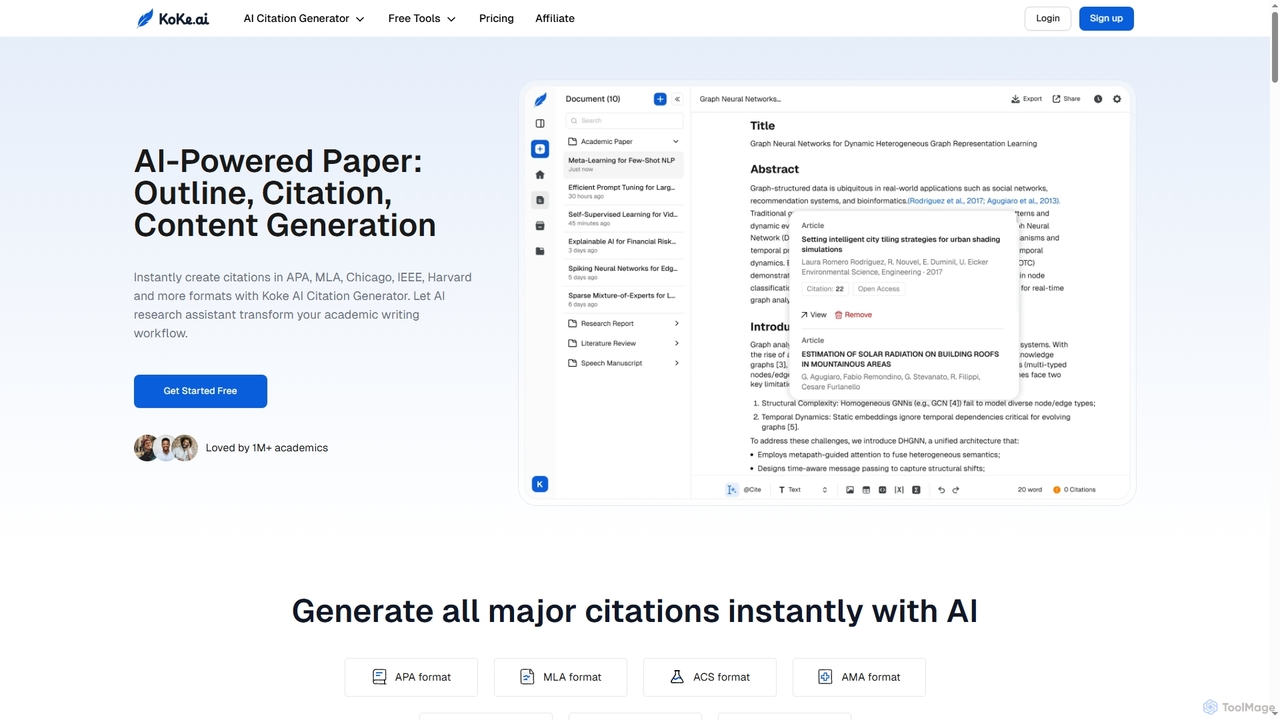
Koke is an AI-powered academic writing assistant that streamlines the entire paper creation process. It offers an instant …
Koke is an AI-powered academic writing assistant that streamlines the entire paper creation process. It offers an instant citation generator for APA, MLA, Chicago, IEEE, and Harvard styles, an outline generator, and advanced content generation tools for sentences, paragraphs, and research questions. Koke helps students and academics write smarter, manage references, and refine drafts efficiently.
About Academic Writing
AI Academic Writing tools are specialized applications designed to assist students, researchers, and academics throughout the scholarly writing process. Leveraging natural language processing (NLP), these tools analyze text for clarity, style, and correctness, offering features like advanced grammar checks, citation generation, and literature discovery. They streamline the creation of research papers, theses, and essays by automating tedious tasks and enhancing the quality of the final manuscript. Unlike general writing assistants, these tools are trained on vast academic databases, understanding the specific conventions, terminology, and structural requirements of scholarly publications.
Core Features
- Literature Discovery: Uses AI to search academic databases and find relevant papers, articles, and sources for a given topic.
- Automated Citation Management: Generates and formats in-text citations and bibliographies in various styles like APA, MLA, Chicago, and IEEE.
- Advanced Grammar & Style Check: Provides suggestions tailored for formal academic language, improving clarity, conciseness, and tone.
- AI Paraphrasing & Summarization: Rephrases complex sentences to avoid plagiarism and condenses long articles into key points to aid comprehension.
- Outline Generation: Creates logical structures and outlines for research papers or theses based on a research question or abstract.
Use Cases
These tools are widely used by PhD candidates drafting dissertations, researchers preparing manuscripts for journal submission, and university students writing term papers. They are particularly valuable in STEM, social sciences, and humanities for maintaining consistency in formatting and citations. For non-native English speakers, they serve as a crucial aid in polishing their writing to meet the standards of international publications.
How to Choose
When selecting an AI Academic Writing tool, consider the following: First, evaluate the range and accuracy of supported citation styles. Second, check for integrations with your preferred word processor, such as Microsoft Word, Google Docs, or LaTeX. Third, assess the quality of its grammar and style suggestions for your specific discipline. Finally, consider whether it offers additional features like a plagiarism checker or research discovery capabilities that align with your workflow.

Academic WritingUse Cases
Streamlining Literature Reviews for Research Papers
A PhD candidate in sociology needs to conduct a comprehensive literature review for their dissertation. Instead of spending weeks manually searching databases like JSTOR and Google Scholar, they use an AI academic tool. By inputting their core research questions and keywords, the tool scans thousands of papers, identifies seminal works, and generates annotated summaries of the most relevant articles. It also visualizes citation networks, helping the candidate quickly grasp the key debates and influential authors in their field. This process reduces the literature discovery phase from a month to a few days, providing a robust foundation for their research.
Generating Accurate Citations and Bibliographies
An undergraduate student is writing a history essay that requires strict adherence to the Chicago citation style. Manually formatting footnotes and a bibliography is time-consuming and prone to error. The student uses an AI writing tool with a browser extension. While researching, they click a button to save sources directly from web pages and academic journals. When writing in Google Docs, the tool automatically inserts perfectly formatted footnotes and compiles a complete bibliography at the end. This ensures every source is cited correctly, saving the student hours of tedious work and helping them avoid penalties for incorrect formatting.
Enhancing Clarity in Scientific Manuscripts
A research scientist, who is not a native English speaker, has drafted a manuscript for a high-impact biology journal. The science is sound, but the language is occasionally awkward and unclear. They use an AI academic writing assistant to refine the text. The tool suggests alternative phrasing to improve sentence flow, replaces jargon with clearer terms where appropriate, and ensures consistent use of technical terminology. It also flags sentences that are too long or complex and offers ways to simplify them. The result is a polished, professional manuscript that clearly communicates the research findings, significantly increasing its chances of acceptance.
Structuring and Outlining a Thesis
A master's student in political science is overwhelmed by the task of structuring their 100-page thesis. They use an AI tool's outline generator. By providing their research proposal, including the main question and hypotheses, the AI generates a detailed, hierarchical outline. This includes suggested chapters (Introduction, Literature Review, Methodology, Analysis, Conclusion), section headings within each chapter, and bullet points of key arguments to cover. This structured roadmap breaks the daunting project into manageable parts, helps maintain a logical flow, and ensures all aspects of the research question are addressed systematically.
Paraphrasing to Avoid Plagiarism
A student is writing a review article and needs to synthesize information from dozens of sources without committing plagiarism. They identify a key paragraph from a published paper that perfectly explains a concept. Instead of risking improper citation or patchwriting, they use an AI paraphrasing tool. The tool offers several alternative versions of the paragraph, rephrasing it with different sentence structures and vocabulary while preserving the original meaning and technical accuracy. The student selects the best option and integrates it into their work, followed by a proper citation, ensuring academic integrity and improving the overall flow of their writing.
Preparing and Polishing Grant Proposals
A principal investigator is preparing a grant proposal for a major funding agency, which has strict page and word count limits. They use an AI academic tool to refine their draft. The tool's summarizer helps condense lengthy background sections without losing critical information. Its style editor suggests more concise and impactful language, replacing passive voice with active voice to make the proposal more persuasive. Finally, the grammar checker ensures the entire document is free of errors. This comprehensive polishing process helps the investigator submit a clear, compelling, and compliant proposal, increasing their chances of securing funding for their research.