
Pieces Technologies
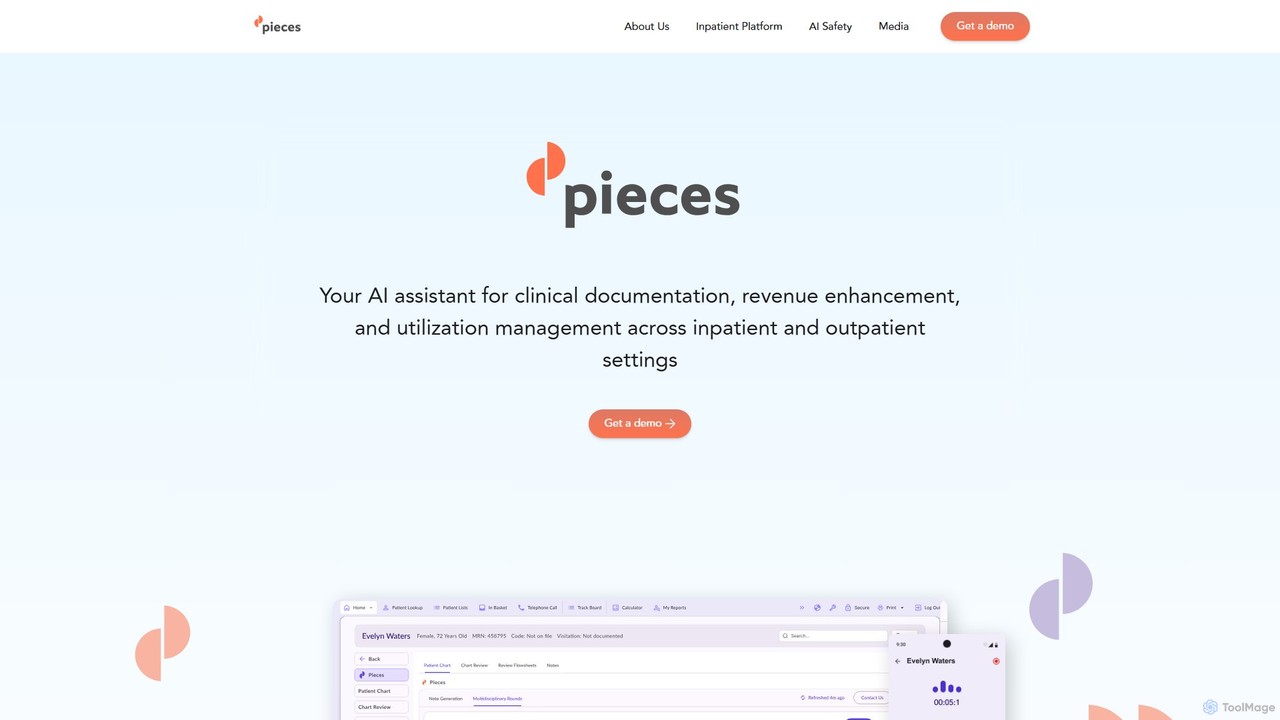
Pieces Technologies is a physician-led AI company providing a secure, generative AI assistant for clinical documentation. It helps …
Pieces Technologies is a physician-led AI company providing a secure, generative AI assistant for clinical documentation. It helps healthcare teams streamline workflows, improve patient outcomes, and reduce administrative burden. Its patented SafeRead system ensures the accuracy and safety of AI-generated content.
About Fact Checking
AI Fact Checking tools are a specialized class of software that uses artificial intelligence to assess the accuracy and veracity of statements and claims. These tools leverage natural language processing (NLP) and machine learning to scan text, identify verifiable claims, and cross-reference them against vast databases of credible sources like news archives, scientific journals, and official reports. Their primary value lies in rapidly providing evidence-based assessments to combat the spread of misinformation and support critical analysis. This focus on truthfulness distinguishes them within the broader field of AI detection, which may also include identifying AI-generated content.
Core Features
- Claim Extraction: Automatically identifies specific, verifiable statements within a larger body of text.
- Source Verification: Cross-references claims against a curated database of reliable and authoritative sources.
- Evidence Synthesis: Gathers and presents both supporting and conflicting evidence for a comprehensive view.
- Credibility Scoring: Assigns a confidence score or rating (e.g., True, False, Misleading) to a claim based on the available evidence.
- Contextual Analysis: Evaluates the context in which a claim is made to detect potential manipulation or logical fallacies.
Use Cases
These tools are essential for journalists, researchers, and academic institutions for verifying information before publication. Social media platforms and content moderators use them to flag and manage the spread of fake news. Additionally, corporations employ them for brand reputation management and market intelligence, ensuring decisions are based on accurate data.
How to Choose
When selecting an AI Fact Checking tool, consider the breadth and quality of its source database. Evaluate its language support and its ability to handle nuanced or complex claims. Look for transparency in its verification process, showing how it reached its conclusions. Finally, consider its integration capabilities, such as API access or browser extensions, to fit your workflow.
Fact CheckingUse Cases
Verifying Claims for Journalistic Reporting
A political journalist is covering a live press conference where a candidate makes several bold claims about economic performance and policy impacts. Using an AI Fact Checking tool via a browser extension, the journalist inputs these claims in real-time. The tool instantly scans news archives, government reports, and academic studies, providing a summary of supporting and conflicting evidence. This allows the journalist to include accurate, verified context in their article, distinguishing factual statements from political rhetoric and publishing a well-researched piece within minutes of the event ending.
Enhancing Academic Research Integrity
A university researcher is writing a literature review for a new study. To ensure the foundational papers they are citing are based on solid, verifiable data, they use an AI Fact Checking tool. They paste key hypotheses and conclusions from previous studies into the tool. The AI cross-references these claims against a vast database of scientific journals and conference proceedings, flagging any claims that have been contested, retracted, or lack strong supporting evidence. This process helps the researcher build their study on a reliable foundation and maintain high academic integrity.
Automating Content Moderation on Social Platforms
A trust and safety team at a social media company needs to quickly identify and review posts containing potential misinformation about a major public event. They integrate an AI Fact Checking API into their moderation workflow. The API automatically scans new posts, extracts claims, and assigns a credibility score. Posts with claims that are rated as 'False' or 'Misleading' by the AI are automatically flagged and prioritized in the human review queue. This allows the moderation team to focus their efforts on the most harmful content, significantly speeding up their response time and reducing the spread of fake news.
Conducting Corporate Due Diligence
An investment analyst is evaluating a potential acquisition target. As part of the due diligence process, they need to verify claims made in the target company's press releases, investor reports, and media coverage. The analyst uses an AI Fact Checking tool to process these documents. The tool flags inconsistencies, cross-references financial figures with public records, and assesses the sentiment and credibility of news articles about the company. This provides the analyst with a verified, data-driven overview, helping them identify potential risks and make a more informed investment decision.
Creating Factually Accurate Educational Content
A curriculum developer for an online education platform is creating a new history course. To ensure all dates, names, and event descriptions are accurate, they use an AI Fact Checking tool. As they write the course material, they run paragraphs through the tool, which verifies the information against academic encyclopedias, historical archives, and peer-reviewed papers. The tool highlights any potential inaccuracies or areas where historical consensus is debated, allowing the developer to create highly reliable and trustworthy educational content for students.
Empowering Individuals to Combat Misinformation
A regular internet user frequently encounters questionable news articles and posts on their social media feed. To avoid accidentally sharing false information, they install an AI Fact Checking browser extension. Now, when they read an article, the extension automatically analyzes the content in the background. It displays a small icon next to the headline indicating the content's likely credibility (e.g., verified, unverified, or misleading). By hovering over the icon, the user can see a summary of the tool's findings and links to credible sources, empowering them to make informed decisions about what to trust and share online.