reallife3d
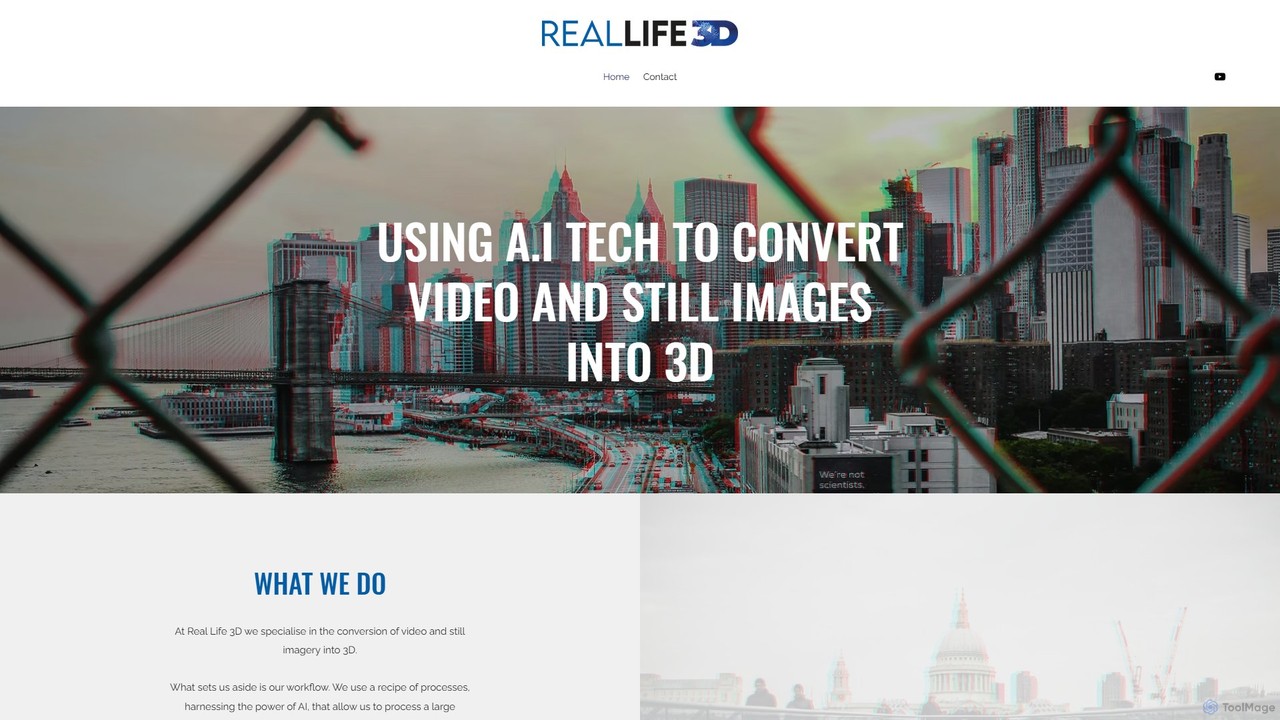
reallife3d is a specialized service that uses a proprietary AI-powered workflow to convert standard 2D videos and still …
reallife3d is a specialized service that uses a proprietary AI-powered workflow to convert standard 2D videos and still images into immersive stereoscopic 3D. It offers a fast, cost-effective solution for creators to produce content for 3D and VR platforms like YouTubeVR, supporting formats such as side-by-side, VR180, and anaglyph.
About Cultural Heritage
Cultural Heritage AI tools are specialized artificial intelligence applications designed to preserve, analyze, and disseminate global cultural assets. These tools leverage advanced computer vision, natural language processing, and machine learning to digitize artifacts, restore historical records, and create immersive educational experiences. As a vital part of AI For Good, they empower institutions and researchers to safeguard invaluable heritage for future generations, ensuring accessibility and deeper understanding.
Core Features
- 3D Reconstruction & Digitization: Captures and reconstructs physical artifacts into high-fidelity digital models for preservation and study.
- Text & Language Analysis: Deciphers ancient scripts, translates historical documents, and analyzes linguistic patterns in heritage texts.
- Restoration & Anomaly Detection: Identifies and suggests repairs for damaged artworks or structures, and detects subtle changes in heritage sites.
- Virtual & Augmented Reality Experiences: Creates immersive digital environments for exploring historical sites or interacting with artifacts remotely.
- Predictive Conservation: Uses data to forecast environmental risks or material degradation, aiding proactive preservation efforts.
Applicable Scenarios
These tools are invaluable for museums, archives, archaeological sites, and educational institutions. They enable the digital archiving of fragile manuscripts, the virtual reconstruction of lost historical buildings, and the creation of interactive exhibits that bring history to life for diverse audiences.
How to Choose
When selecting Cultural Heritage AI tools, consider the specific type of heritage data (e.g., text, image, 3D), the required accuracy of AI models for analysis or restoration, and the tool's compatibility with existing archival systems. Evaluate its user-friendliness for non-technical staff and its adherence to ethical guidelines for cultural data handling.

Cultural HeritageUse Cases
Digitizing and Deciphering Ancient Manuscripts
Archivists and researchers utilize AI tools to scan and digitize fragile ancient manuscripts, often with faded or damaged text. AI-powered optical character recognition (OCR) can then decipher these complex scripts, even in multiple languages, making previously inaccessible historical information searchable and analyzable. This significantly accelerates research and preserves invaluable textual heritage.
Creating Immersive Virtual Heritage Experiences
Museums and educational institutions employ Cultural Heritage AI to develop interactive virtual and augmented reality experiences. By reconstructing historical sites or artifacts in 3D, AI allows users to explore ancient cities, interact with digital replicas of relics, or witness historical events through immersive simulations, enhancing public engagement and learning without physical wear and tear on artifacts.
AI-Assisted Archaeological Site Analysis
Archaeologists leverage AI for processing vast amounts of data from excavation sites, including aerial imagery, LiDAR scans, and geophysical surveys. AI algorithms can identify subtle patterns, anomalies, or potential buried structures that might be missed by the human eye, guiding excavation efforts more efficiently and revealing new insights into ancient civilizations and their settlements.
Restoring and Conserving Damaged Artworks
Art conservators use AI to analyze and suggest restoration techniques for damaged paintings, sculptures, or frescoes. AI models can identify missing fragments, predict original color palettes, or even generate plausible reconstructions of deteriorated sections. This aids in the delicate process of physical restoration, ensuring historical accuracy and preserving the aesthetic integrity of precious art pieces.
Translating and Interpreting Historical Documents
Historians and linguists utilize AI-powered natural language processing (NLP) to translate and interpret historical documents written in archaic or obscure languages. These tools can identify linguistic shifts, contextual nuances, and provide preliminary translations, significantly reducing the manual effort required to understand vast archives of foreign or ancient texts, thus broadening access to global history.
Predictive Monitoring for Heritage Site Preservation
Conservationists deploy AI systems to continuously monitor the structural integrity and environmental conditions of historical buildings, monuments, and archaeological sites. Using sensors and data analysis, AI can detect early signs of degradation, predict potential risks from weather or seismic activity, and recommend proactive maintenance strategies, preventing irreversible damage and ensuring long-term preservation.