Kunduz
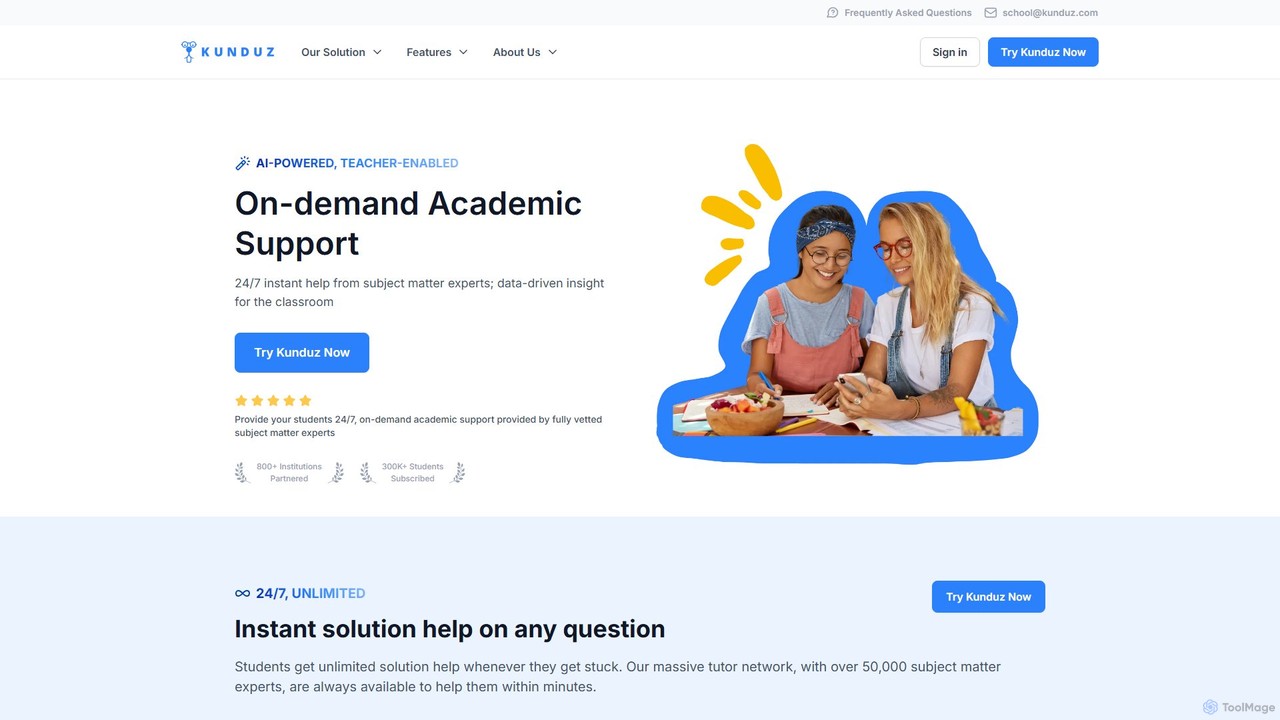
Kunduz is an AI-powered, teacher-enabled educational platform providing 24/7 on-demand academic support. It connects students with over 50,000 …
Kunduz is an AI-powered, teacher-enabled educational platform providing 24/7 on-demand academic support. It connects students with over 50,000 expert tutors for instant homework help and problem-solving. For educators and institutions, Kunduz offers a data-driven dashboard to track student progress and personalize learning, making quality education accessible anytime, anywhere.
About Social Impact
AI for Social Impact tools are a specialized category of applications designed to address and measure positive societal outcomes. These tools leverage machine learning, data analytics, and predictive modeling to tackle complex challenges in public health, environmental conservation, and humanitarian aid. They provide non-profits, researchers, and public sector organizations with actionable insights to optimize resource allocation, forecast critical events, and quantify their impact. Unlike broader 'AI for Good' initiatives, these tools focus specifically on creating measurable, scalable, and sustainable social change.
Core Features
- Impact Analytics: Quantify social outcomes and generate reports on key performance indicators (KPIs) for stakeholders.
- Predictive Modeling: Forecast future events such as disease outbreaks, climate patterns, or resource shortages to enable proactive interventions.
- Resource Optimization: Use algorithms to determine the most effective allocation of aid, funding, or personnel.
- Data-driven Insights: Analyze complex datasets from diverse sources to uncover patterns and inform strategic decisions for social programs.
Use Cases
These tools are primarily used by non-governmental organizations (NGOs), public health agencies, environmental scientists, and international development bodies. For example, an NGO might use a tool to predict areas most vulnerable to famine, while a conservation group could analyze satellite imagery to track deforestation in real-time.
How to Choose
When selecting an AI for Social Impact tool, consider the specific problem you are trying to solve. Evaluate the tool's data requirements and your organization's capacity to provide clean data. Assess its ability to integrate with your existing systems, its transparency in how models work (explainability), and whether its pricing model is suitable for a non-profit or public sector budget.
Social ImpactUse Cases
Optimizing Humanitarian Aid Distribution
A logistics manager for an international relief organization is tasked with distributing food and medical supplies after a natural disaster. Using an AI for Social Impact tool, they input data on affected populations, road accessibility, and available supply depots. The AI model analyzes this information to generate optimal delivery routes, prioritizing the most vulnerable communities and minimizing transportation costs and time. This data-driven approach ensures that aid reaches those in need up to 40% faster than with traditional planning methods.
Predicting Disease Outbreaks in Public Health
Public health officials aim to prevent the spread of infectious diseases. They use a predictive analytics platform that integrates climate data, anonymized mobility data, and historical health records. The AI model identifies patterns that precede an outbreak, flagging high-risk regions weeks in advance. This allows officials to proactively deploy resources, launch vaccination campaigns, and issue public health warnings, effectively containing the spread and saving lives.
Monitoring Deforestation for Conservation Efforts
A conservation scientist works to protect a vital rainforest ecosystem. They employ an AI tool that continuously analyzes high-resolution satellite imagery. The system is trained to detect subtle changes indicating illegal logging or agricultural encroachment. When a potential threat is identified, an alert is automatically sent to park rangers on the ground, enabling a rapid response to stop deforestation before significant damage occurs. This automates a task that would manually take thousands of hours.
Enhancing Education in Underserved Areas
An educational non-profit wants to improve literacy rates among children in remote villages with limited access to teachers. They deploy an AI-powered adaptive learning platform on low-cost tablets. The platform assesses each student's skill level and provides personalized lessons, exercises, and feedback. The system tracks progress and adjusts the curriculum in real-time, ensuring each child learns at their own pace and maximizing educational outcomes.
Managing Crisis Information During Emergencies
During a flood, an emergency response team needs to understand the situation on the ground. They use an AI tool that scans social media posts, news reports, and emergency calls in real-time. The tool's Natural Language Processing (NLP) capabilities filter out noise, identify urgent requests for help, map the locations of incidents, and detect the spread of misinformation. This provides a unified operational picture, allowing commanders to allocate rescue teams more effectively.
Measuring the Impact of Social Programs
A foundation director needs to report to donors on the effectiveness of their funded programs. They use an impact analytics platform to collect and analyze data from various projects, such as student attendance, community health metrics, and economic indicators. The AI tool visualizes trends, correlates interventions with outcomes, and generates comprehensive reports. This provides clear, evidence-based proof of the foundation's social return on investment, helping to secure future funding.