CustomJS
CustomJS is a powerful platform that bridges the gap between no-code and custom development. It allows you to …
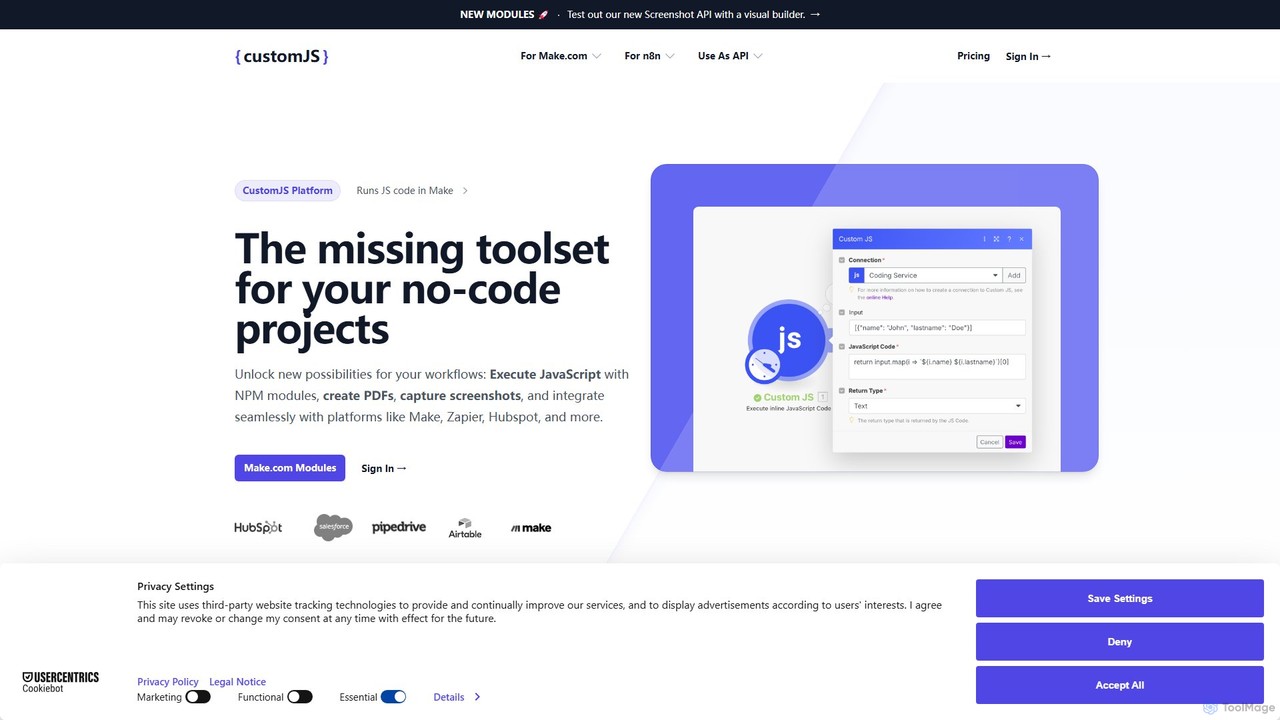
CustomJS is a powerful platform that bridges the gap between no-code and custom development. It allows you to execute JavaScript, use NPM modules, and integrate custom logic into your favorite automation platforms like Make, Zapier, and Airtable. Unlock advanced functionalities like PDF generation, web scraping, and API creation without managing your own servers.
About Backend
Backend AI tools are specialized solutions that manage the server-side logic, data processing, and infrastructure required to power AI applications and services. These tools provide the robust foundation for deploying, scaling, and maintaining AI models, often interacting with various APIs to deliver intelligent functionalities. They enable developers to build and operate complex AI systems efficiently, ensuring high performance and reliability for user-facing applications.
Core Features
- AI Model Deployment: Facilitates the seamless deployment of trained AI models into production environments.
- Data Pipeline Management: Automates the ingestion, transformation, and storage of data essential for AI model training and inference.
- Scalable Inference: Ensures AI models can handle high volumes of requests efficiently, scaling resources as needed.
- API Management for AI: Provides tools to create, secure, and manage APIs that expose AI model functionalities to client applications.
- Security & Monitoring: Offers features for securing AI endpoints and monitoring model performance and resource usage.
Use Cases
Backend AI tools are crucial for developers and MLOps engineers building intelligent applications. They are used to host custom machine learning models, manage the flow of data for real-time AI predictions, and ensure the secure and efficient delivery of AI capabilities through well-defined APIs. These tools streamline the operational aspects of AI, allowing focus on model development.
How to Choose
When selecting Backend AI tools, consider the specific AI models you need to deploy and their resource requirements. Evaluate the tool's scalability, ease of integration with existing infrastructure, and support for various programming languages and frameworks. Look for robust security features, comprehensive monitoring capabilities, and a pricing model that aligns with your operational budget and expected usage.

BackendUse Cases
Deploying Custom Machine Learning Models at Scale
A data science team needs to deploy a newly trained recommendation engine model to production, capable of handling millions of user requests per second. Backend AI tools provide the infrastructure for containerizing the model, setting up auto-scaling groups, and integrating with load balancers, ensuring the model remains highly available and performs optimally under varying traffic loads. This allows the team to quickly bring their innovative models to users without extensive infrastructure management overhead.
Building Real-time AI-powered Chatbots and Virtual Assistants
Companies developing AI chatbots require robust backend infrastructure to process natural language, integrate with knowledge bases, and manage conversational states. Backend AI tools facilitate the deployment of NLP models, handle API calls to external services (like CRM or payment gateways), and ensure low-latency responses. This enables seamless, intelligent interactions for customer service, sales, and internal support, enhancing user experience and operational efficiency.
Managing Data Pipelines for AI Model Training and Retraining
MLOps engineers need to ensure a continuous flow of high-quality data for training and retraining AI models. Backend AI tools offer capabilities for building and orchestrating data pipelines, including data ingestion from various sources, transformation, feature engineering, and storage in data lakes or warehouses. This automation ensures that models are always trained on the freshest data, leading to improved accuracy and performance over time, crucial for dynamic environments.
Securing and Monitoring AI API Endpoints
Enterprises exposing AI models via APIs need robust security and monitoring to prevent unauthorized access and ensure service reliability. Backend AI tools provide features like API key management, authentication/authorization, rate limiting, and encryption. They also offer real-time monitoring of API calls, latency, error rates, and model drift, allowing operations teams to quickly detect and respond to security threats or performance degradation, maintaining trust and service quality.
Orchestrating Complex AI Workflows with Multiple Models
For advanced AI applications, multiple models might need to work in sequence or parallel, such as a sentiment analysis model feeding into a response generation model. Backend AI tools provide workflow orchestration capabilities, allowing developers to define, manage, and execute complex pipelines involving various AI services and data transformations. This ensures efficient coordination between different AI components, enabling sophisticated functionalities like personalized content generation or multi-stage decision-making systems.
Integrating AI Capabilities into Existing Enterprise Systems
Large enterprises often need to infuse AI into their legacy systems without a complete overhaul. Backend AI tools facilitate this by providing robust API layers and SDKs that allow existing applications to consume AI services. Whether it's adding intelligent search to an e-commerce platform or predictive analytics to an ERP system, these tools bridge the gap, enabling seamless integration and leveraging existing data infrastructure to enhance business processes with AI.