TwoBirthy
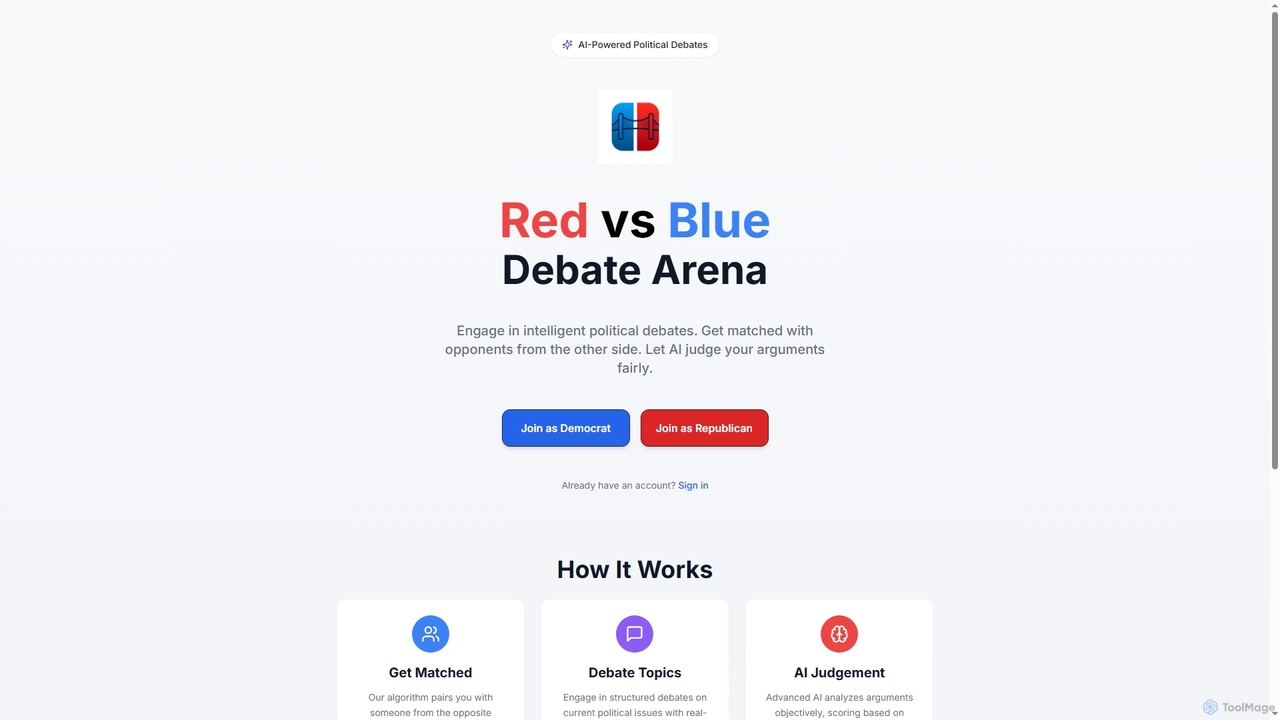
TwoBirthy is an AI-powered online debate arena designed for engaging in intelligent political discussions. It matches users with …
TwoBirthy is an AI-powered online debate arena designed for engaging in intelligent political discussions. It matches users with opponents from opposing political parties for structured, real-time video debates, where an advanced AI objectively judges arguments based on logic, evidence, and rhetoric.
About Argument Analysis
Argument Analysis tools are AI-powered platforms designed to systematically deconstruct, evaluate, and visualize the logical structure and rhetorical effectiveness of arguments presented in text or speech. Leveraging advanced natural language processing (NLP) and machine learning, these tools identify premises, conclusions, underlying assumptions, and potential fallacies within complex discourse. They empower users to enhance critical thinking, improve decision-making, and strengthen their own argumentative capabilities across various professional and academic fields.
Core Features
- Premise & Conclusion Identification: Automatically extracts and labels the core statements and their supporting evidence.
- Fallacy Detection: Identifies common logical fallacies such as ad hominem, straw man, or false dilemma.
- Argument Mapping & Visualization: Creates visual diagrams of argument structures, showing relationships between claims.
- Rhetorical Analysis: Evaluates persuasive techniques, tone, and emotional appeals used within an argument.
- Bias & Assumption Uncovering: Helps reveal implicit biases and unstated assumptions influencing the argument.
Use Cases
These tools are invaluable for professionals and academics who regularly engage with complex information and require rigorous evaluation. They are used in legal research to dissect case arguments, in academic settings for critical review of papers, and in journalism to analyze political speeches or public discourse. By providing a structured breakdown, Argument Analysis tools facilitate deeper understanding and more informed responses.
How to Choose
When selecting an Argument Analysis tool, consider its accuracy in identifying logical components and fallacies, the breadth of language support, and its visualization capabilities for clear argument mapping. Evaluate its integration options with existing research or writing workflows, and assess the level of customization for specific analytical needs. Finally, consider the user interface's intuitiveness and the tool's ability to handle diverse text formats and lengths.

Argument AnalysisUse Cases
Academic Research & Essay Structuring
University students and academic researchers utilize Argument Analysis tools to deconstruct complex scholarly articles, identifying core arguments, supporting evidence, and potential counter-arguments. This helps them critically evaluate existing literature, structure their own research papers more logically, and ensure their essays present coherent, well-supported arguments, ultimately improving the quality and rigor of their academic work.
Analyzing Legal Briefs for Logical Coherence
Legal professionals, such as lawyers and paralegals, utilize Argument Analysis tools to meticulously examine legal briefs, court transcripts, and contracts. By inputting these documents, the AI can quickly identify key arguments, supporting evidence, and potential logical inconsistencies or fallacies in opposing counsel's statements. This process significantly reduces manual review time, enhances the precision of legal strategy development, and helps in preparing more robust counter-arguments.
Legal Document Review & Case Preparation
Legal professionals, including lawyers and paralegals, employ these AI tools to meticulously analyze legal briefs, contracts, and court transcripts. The tools help in quickly identifying key claims, premises, and conclusions made by opposing parties, uncovering logical inconsistencies, and pinpointing areas where arguments are weak or unsupported by evidence. This significantly streamlines case preparation and strengthens legal strategies.
Deconstructing Academic Research Papers
Academics, researchers, and students employ Argument Analysis tools to critically evaluate scholarly articles and dissertations. The tools help in mapping the author's main thesis, identifying the premises used to support it, and uncovering any gaps in logic or unstated assumptions. This application aids in peer review, strengthens research methodologies, and improves the quality of academic writing by ensuring arguments are sound and well-supported.
Debate & Public Speaking Strategy
Debaters and public speakers use Argument Analysis tools to prepare for competitive debates or important presentations. By inputting an opponent's speech or a proposed topic, they can analyze the underlying arguments, detect logical fallacies, and identify vulnerable points. This enables them to formulate more effective rebuttals, strengthen their own persuasive arguments, and anticipate potential challenges, leading to more impactful communication.
Evaluating Political Speeches and Public Discourse
Journalists, political analysts, and policy makers use Argument Analysis tools to dissect political speeches, policy documents, and public debates. These tools can highlight rhetorical strategies, detect propaganda techniques, and expose logical fallacies used to sway public opinion. This enables a more objective assessment of political narratives, helps in fact-checking, and contributes to more informed public commentary and policy formulation.
Policy Analysis & Impact Assessment
Government analysts, think tanks, and policy advisors leverage Argument Analysis AI to evaluate the logical foundations of proposed policies, legislative texts, and public consultations. These tools help in understanding the stated rationale, identifying implicit assumptions, and assessing the coherence of arguments for and against a policy. This supports more objective policy formulation and a clearer understanding of potential societal impacts.
Enhancing Critical Thinking in Education
Educators and students in fields like philosophy, rhetoric, and critical thinking utilize these tools as a learning aid. By inputting essays, debates, or historical texts, students can visualize argument structures and identify fallacies, thereby developing stronger analytical skills. This interactive approach provides immediate feedback, helping students to understand complex logical concepts and improve their own argumentative writing and reasoning abilities.
Journalism, Fact-Checking & Media Literacy
Journalists, fact-checkers, and media literacy educators use Argument Analysis tools to critically examine news articles, editorials, political speeches, and social media discourse. The tools assist in identifying biased language, unsupported claims, and logical fallacies, helping to distinguish between factual reporting and persuasive rhetoric. This enhances journalistic integrity and empowers the public to consume information more critically.
Assessing Business Proposals and Pitches
Business analysts, investors, and decision-makers apply Argument Analysis tools to evaluate business proposals, investment pitches, and strategic reports. The tools help in scrutinizing the underlying logic of market analyses, financial projections, and proposed solutions. This ensures that decisions are based on sound reasoning rather than emotional appeal or flawed assumptions, leading to more robust business strategies and reduced risks.
Business Strategy & Negotiation Analysis
Business leaders and strategists apply Argument Analysis tools to evaluate competitor proposals, internal reports, or negotiation positions. By analyzing the arguments presented, they can uncover underlying assumptions, identify logical gaps, and assess the strength of various strategic options. This facilitates more informed decision-making, strengthens negotiation tactics, and helps in building more robust business cases.
Moderating Online Discussions and Forums
Community managers and content moderators leverage Argument Analysis tools to maintain constructive dialogue in online forums, social media groups, and comment sections. The AI can automatically flag posts containing logical fallacies, personal attacks (ad hominem), or inflammatory rhetoric, helping to identify and manage unproductive or harmful arguments. This fosters a healthier online environment and ensures discussions remain focused and respectful.