Humsana
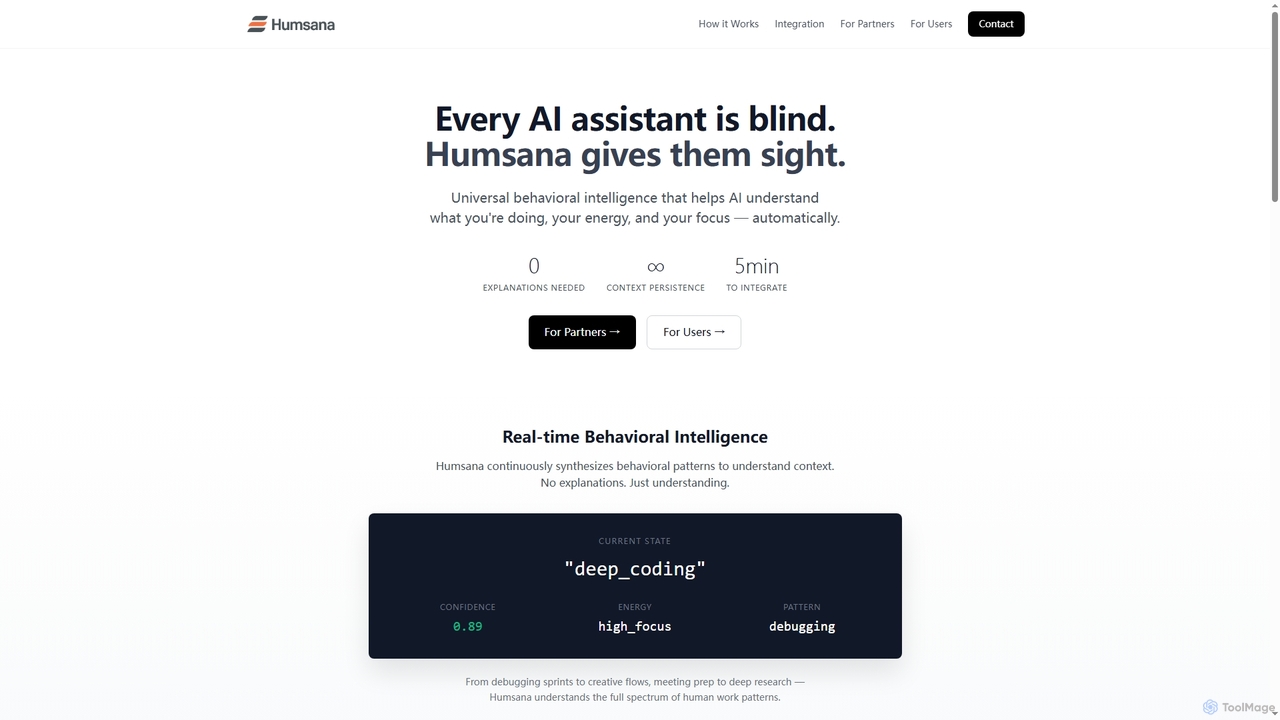
Humsana provides universal behavioral intelligence, giving AI assistants real-time context about user actions, energy, and focus. It enables …
Humsana provides universal behavioral intelligence, giving AI assistants real-time context about user actions, energy, and focus. It enables AI to understand what users are doing without explicit explanations, leading to more adaptive and relevant responses. Integrate quickly to enhance any AI assistant's awareness.
About Contextual Ai
Contextual AI refers to a sophisticated class of artificial intelligence tools designed to understand, interpret, and respond based on the specific context of an interaction or environment. Unlike general AI, it leverages real-time data, user history, and environmental cues to provide highly relevant and personalized outputs. This capability enables more natural, intuitive, and effective human-AI collaboration across various applications, significantly enhancing user experience and decision-making processes.
Core Features
- Semantic Understanding: Interprets the meaning and intent behind language, considering nuances and implicit information.
- Memory and History Integration: Recalls past interactions and user preferences to maintain continuity and personalize responses over time.
- Real-time Adaptation: Adjusts its behavior and output dynamically based on immediate environmental changes or user input.
- Personalization Engine: Delivers tailored content, recommendations, or assistance by analyzing individual user profiles and behaviors.
- Multimodal Context Processing: Integrates information from various sources like text, voice, images, and sensor data to form a comprehensive understanding.
Use Cases
Contextual AI is invaluable in scenarios requiring deep understanding and adaptive responses. It's widely adopted in advanced customer service to provide personalized support, in e-commerce for highly relevant product recommendations, and in healthcare for adaptive patient monitoring and personalized treatment plans. Its ability to process and react to dynamic environments makes it crucial for intelligent automation and interactive systems.
How to Choose
When selecting a Contextual AI tool, evaluate its data integration capabilities with your existing systems, the breadth of context it can process (e.g., text, voice, sensor data), and its real-time processing speed. Consider the level of customization offered for specific industry needs, its ethical AI guidelines, and the scalability to handle growing data volumes and user interactions. Prioritize solutions that offer robust security and privacy features for sensitive contextual data.

Contextual AiUse Cases
Enhancing Customer Service with Context-Aware Chatbots
Customer service teams leverage Contextual AI chatbots to provide highly personalized support. By integrating past interaction history, purchase records, and real-time sentiment analysis, the AI understands the full context of a customer's query. This enables the chatbot to offer accurate, relevant solutions, troubleshoot issues more effectively, and even proactively suggest next steps, significantly reducing resolution times and improving customer satisfaction.
Personalized Customer Service Automation
Customer service managers can deploy Contextual AI chatbots that remember past interactions, understand customer sentiment, and access CRM data in real-time. This allows the AI to provide highly personalized and empathetic responses, resolve complex queries more efficiently, and escalate issues appropriately, significantly reducing resolution times and improving customer satisfaction without repetitive information gathering.
Delivering Hyper-Personalized Content Recommendations
Media platforms and e-commerce sites utilize Contextual AI to offer dynamic content and product recommendations. The AI analyzes a user's viewing history, browsing patterns, current location, time of day, and even inferred mood. This deep contextual understanding allows the system to suggest movies, articles, or products that are most likely to resonate with the user at that specific moment, driving engagement and increasing conversion rates.
Adaptive E-commerce Product Recommendations
Online retailers utilize Contextual AI to analyze a user's browsing history, purchase patterns, current session behavior, and even external factors like time of day or weather. The AI then dynamically generates highly relevant product recommendations, personalized offers, and tailored search results, leading to increased conversion rates and a more engaging shopping experience for individual customers.
Creating Adaptive Smart Home Environments
Homeowners benefit from Contextual AI in smart home systems that adapt to their lifestyle. The AI integrates data from motion sensors, smart thermostats, and user schedules, learning individual preferences for lighting, temperature, and music. It can then proactively adjust settings based on who is home, the time of day, external weather conditions, or even a user's current activity, creating a truly personalized and energy-efficient living space.
Dynamic Content Generation for Marketing
Marketing teams leverage Contextual AI to create dynamic content that adapts to the user's profile, location, device, and interaction history. For instance, an email campaign can automatically adjust its subject line, body text, and call-to-action based on whether the recipient has previously engaged with similar content, maximizing open rates and click-throughs by delivering hyper-relevant messages.
Proactive Health Monitoring and Early Anomaly Detection
Healthcare providers and individuals use Contextual AI for continuous, proactive health monitoring. Wearable devices collect vital signs and activity data, which the AI analyzes alongside a patient's medical history, genetic predispositions, and environmental factors. This contextual analysis helps identify subtle changes or potential health risks early, enabling timely interventions and personalized wellness advice, thereby improving preventative care outcomes.
Intelligent Virtual Assistants in Enterprise
Employees in large organizations benefit from Contextual AI-powered virtual assistants that understand their role, current project, and access permissions. These assistants can provide immediate, context-aware information retrieval, schedule meetings based on team availability and project deadlines, or automate routine tasks, streamlining workflows and boosting productivity across departments.
Tailored Financial Advice Based on Life Context
Financial advisors employ Contextual AI to offer highly personalized investment and planning advice. The AI processes a client's financial goals, risk tolerance, current market conditions, and significant life events (e.g., marriage, new job). By understanding this comprehensive context, the system can recommend suitable investment strategies, retirement plans, or insurance products that align precisely with the client's evolving needs and circumstances.
Real-time Adaptive Learning Platforms
Educational institutions and corporate training departments use Contextual AI to power adaptive learning platforms. The AI monitors a student's progress, learning style, and areas of difficulty in real-time, then dynamically adjusts the curriculum, provides personalized feedback, and suggests supplementary materials, ensuring a more effective and engaging learning path tailored to individual needs.
Optimizing Marketing Campaigns with Real-time Context
Marketing professionals leverage Contextual AI to execute highly effective, real-time campaigns. The AI analyzes a potential customer's current browsing behavior, geographic location, demographic data, and past interactions with the brand. This allows for the immediate delivery of hyper-targeted advertisements, personalized email offers, or relevant website content, significantly increasing engagement rates and campaign ROI by reaching the right person at the right time.
Proactive Healthcare Monitoring and Alerts
Healthcare providers employ Contextual AI in patient monitoring systems. By integrating data from wearables, electronic health records, and environmental sensors, the AI can detect subtle changes in a patient's condition, understand the context of these changes (e.g., activity level, medication schedule), and issue proactive alerts to medical staff, enabling timely interventions and improving patient outcomes.