Beanvest
Beanvest is an AI-powered investment analysis platform that helps investors identify the world's strongest companies with durable competitive …
Beanvest is an AI-powered investment analysis platform that helps investors identify the world's strongest companies with durable competitive advantages and buy them at fair prices. It provides in-depth qualitative and quantitative analysis, including a proprietary Quality Score and Fair Value estimates, to empower long-term, quality-focused investing.
TraderTrak
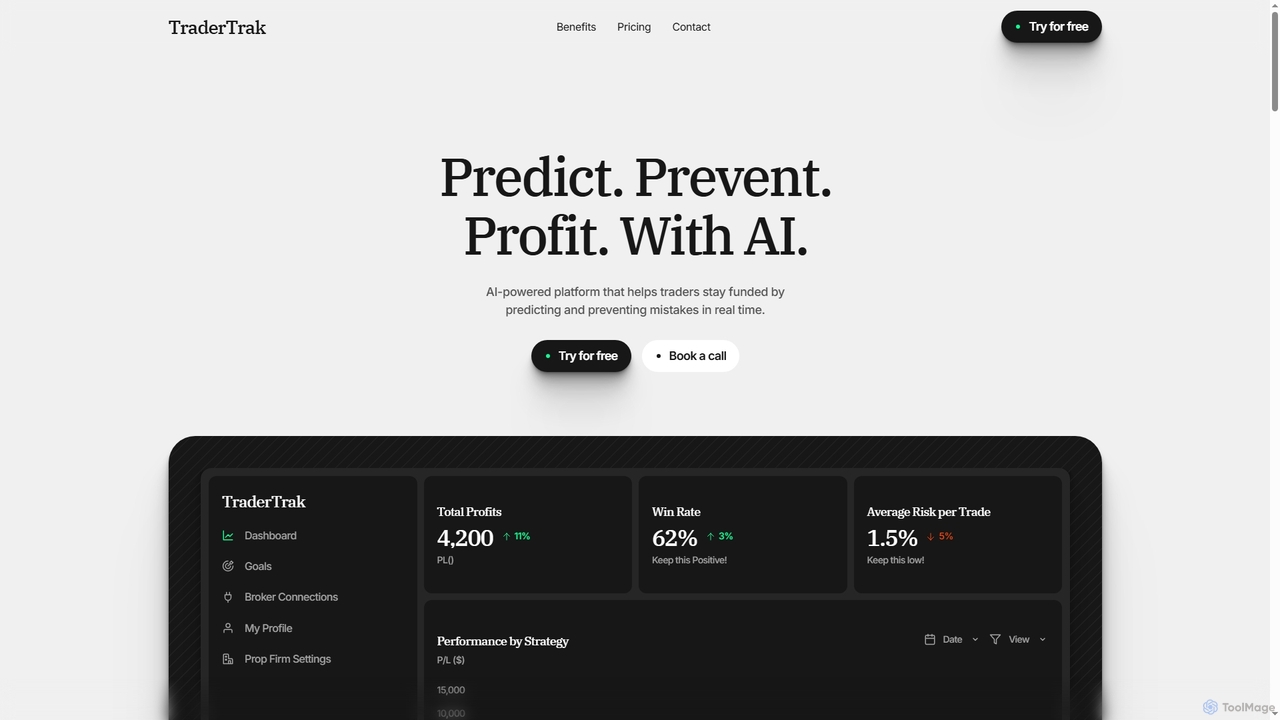
TraderTrak is an AI-powered trade management platform designed to help traders predict and prevent costly mistakes in real-time, …
TraderTrak is an AI-powered trade management platform designed to help traders predict and prevent costly mistakes in real-time, ensuring they stay funded and profitable. It offers automated tracking, smart recommendations, and personalized AI coaching to optimize trading performance.
About Financial Ai
Financial AI is a specialized category of artificial intelligence tools designed to optimize and automate processes within the financial sector. These tools leverage advanced machine learning, predictive analytics, and natural language processing to analyze vast datasets, identify patterns, and make data-driven decisions. They enhance efficiency, accuracy, and security across various financial operations, from investment management to fraud detection.
Core Features
- Algorithmic Trading: Automates trading decisions and execution based on predefined rules and real-time market data.
- Fraud Detection: Identifies suspicious transactions and behavioral anomalies to prevent financial crime.
- Risk Assessment: Evaluates creditworthiness, market volatility, and operational risks with high precision.
- Personalized Financial Advice: Provides tailored investment recommendations and financial planning through robo-advisors.
- Regulatory Compliance: Monitors transactions and data to ensure adherence to complex financial regulations.
Use Cases
Financial institutions, investment firms, and fintech companies utilize Financial AI to transform their operations. This includes automating back-office tasks, enhancing customer service with AI-powered chatbots, and gaining deeper insights into market trends for strategic decision-making.
How to Choose
When selecting Financial AI tools, consider the specific financial domain (e.g., banking, insurance, investment), the required level of data integration, compliance with regulatory standards, and the scalability of the solution. Evaluate the accuracy of predictive models and the robustness of security features.

Financial AiUse Cases
Automated Algorithmic Trading
Investment managers and traders use Financial AI to execute trades at optimal times, identify arbitrage opportunities, and manage portfolios with minimal human intervention. By analyzing real-time market data and complex algorithms, these tools can react to market changes faster than humans, aiming to maximize returns and minimize risks based on predefined strategies.
Automated Algorithmic Trading
Hedge fund managers and institutional investors deploy Financial AI for high-frequency and algorithmic trading strategies. The AI analyzes real-time market data, news sentiment, and historical patterns to execute trades automatically, optimizing entry and exit points and managing portfolio risk with minimal human intervention, leading to faster execution and potentially higher returns.
Real-time Fraud Detection
Banks and financial institutions deploy AI systems to continuously monitor transactions, detect unusual patterns, and flag potentially fraudulent activities instantly. This proactive approach significantly reduces financial losses from scams, unauthorized access, and other financial crimes, enhancing security for both the institution and its customers.
Real-time Fraud Detection and Prevention
Banks and credit card companies use Financial AI to monitor millions of transactions in real-time. The AI identifies unusual spending patterns, geographic anomalies, or suspicious transaction sequences that deviate from a customer's typical behavior. This proactive detection helps prevent fraudulent activities, minimizes financial losses, and enhances customer security by flagging potential fraud before it escalates.
Personalized Investment Portfolio Management
Robo-advisors and wealth management platforms leverage Financial AI to analyze individual risk tolerance, financial goals, and market conditions. They provide customized investment recommendations, automatically rebalance portfolios, and offer tailored financial planning advice, making sophisticated wealth management accessible to a broader range of investors.
Personalized Robo-Advisory Services
Wealth management firms and fintech platforms leverage Financial AI to offer personalized investment advice to a broad client base. Robo-advisors assess individual risk tolerance, financial goals, and time horizons to construct diversified portfolios and rebalance them automatically. This democratizes access to sophisticated financial planning, making it more accessible and cost-effective for individual investors.
Enhanced Credit Scoring and Loan Underwriting
Lenders utilize AI to process vast amounts of applicant data, including non-traditional sources like social media activity or utility payments, to assess creditworthiness more accurately and efficiently. This leads to faster loan approvals, reduced default rates, and the ability to offer financial products to underserved populations with lower risk.
Enhanced Credit Risk Assessment
Lending institutions utilize Financial AI to evaluate loan applicants' creditworthiness more accurately and efficiently. Beyond traditional credit scores, AI analyzes alternative data sources, behavioral patterns, and economic indicators to provide a holistic risk profile. This leads to more informed lending decisions, reduced default rates, and the ability to serve a wider range of borrowers responsibly.
Automated Financial Compliance Monitoring
Compliance officers employ Financial AI tools to continuously scan transactions, communications, and regulatory updates, ensuring adherence to anti-money laundering (AML) and know-your-customer (KYC) regulations. This automation reduces manual effort, minimizes human error, and generates comprehensive audit reports, significantly strengthening regulatory compliance frameworks.
Regulatory Compliance and Reporting (RegTech)
Financial institutions face stringent regulatory requirements. Financial AI tools automate the monitoring of transactions, communications, and data for compliance with regulations like AML (Anti-Money Laundering) and KYC (Know Your Customer). The AI can flag potential violations, generate audit trails, and produce comprehensive reports, significantly reducing the manual effort and risk of non-compliance.
Predictive Market Analysis for Investment Decisions
Financial analysts and hedge funds use AI to forecast market trends, predict stock price movements, and identify emerging investment opportunities. By analyzing vast historical data, news sentiment, and economic indicators, these tools provide sophisticated insights that inform strategic investment decisions, aiming for higher returns and proactive risk management.
Market Sentiment Analysis for Investment Decisions
Investment analysts and portfolio managers employ Financial AI to gauge market sentiment from vast amounts of unstructured data, including news articles, social media, and analyst reports. The AI uses natural language processing to identify positive or negative sentiment towards specific stocks, sectors, or the overall market, providing valuable insights that can inform investment strategies and predict market movements.