
Kaisel
Kaisel is an AI-powered financial platform designed for everyday users, freelancers, and modern businesses to intelligently manage, spend, …
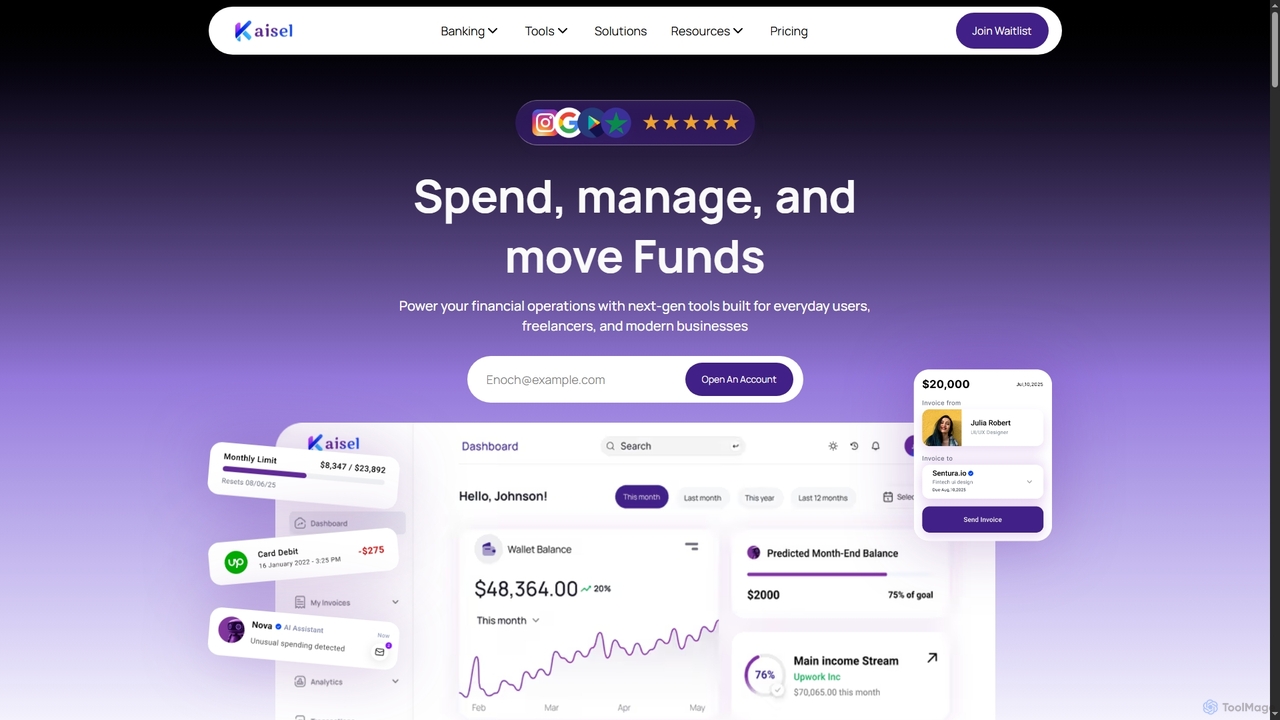
Kaisel is an AI-powered financial platform designed for everyday users, freelancers, and modern businesses to intelligently manage, spend, and move funds globally. It offers smart tools for international payments, virtual cards, expense tracking, invoicing, and AI-driven financial forecasting.
About Financial Forecasting
Financial Forecasting tools are a category of AI-powered solutions designed to predict future financial outcomes by analyzing historical data and market trends. These tools leverage advanced machine learning algorithms and statistical models to identify complex patterns, automate data analysis, and generate more accurate, dynamic, and scenario-based predictions. They empower businesses and individuals to make informed strategic decisions, optimize resource allocation, and mitigate financial risks.
Core Features
- Predictive Modeling: Utilizes machine learning to forecast revenue, expenses, cash flow, and market trends with high accuracy.
- Scenario Analysis: Simulates various economic conditions and business decisions to evaluate potential financial impacts.
- Risk Assessment: Identifies and quantifies potential financial risks, such as market volatility or credit defaults.
- Budget Optimization: Assists in creating and adjusting budgets based on predicted financial performance and operational needs.
- Automated Data Integration: Connects with various financial data sources for seamless data collection and analysis.
Use Cases
These tools are indispensable for corporate finance departments, investment analysts, and small business owners. They are used to project quarterly earnings, assess the viability of new projects, or plan for future capital expenditures. By providing data-driven insights, they help in strategic planning and operational adjustments across various financial functions.
How to Choose
When selecting a Financial Forecasting tool, consider its data integration capabilities with your existing systems, the transparency and interpretability of its predictive models, and the level of customization offered for specific business needs. Evaluate its ability to perform detailed scenario analysis and ensure it complies with relevant financial regulations and data security standards.
Financial ForecastingUse Cases
Optimizing Corporate Budgeting and Resource Allocation
For corporate finance teams, AI financial forecasting tools enable precise budget planning by predicting future revenues and operational costs. Finance managers can input historical financial data, market forecasts, and strategic initiatives to generate detailed budget proposals. This allows for optimal allocation of capital to departments and projects, ensuring resources are aligned with strategic goals and potential financial shortfalls are identified early, leading to more efficient operations and reduced waste.
Optimizing Investment Portfolio Performance
Investment managers and individual investors utilize AI financial forecasting tools to predict stock price movements, market trends, and asset performance. By analyzing vast amounts of historical data, news sentiment, and economic indicators, these tools help identify undervalued assets, forecast potential returns, and rebalance portfolios to maximize gains and minimize risks, leading to more strategic investment decisions.
Enhancing Investment Portfolio Performance Prediction
Individual and institutional investors utilize these tools to forecast the potential performance and risk of various investment assets or portfolios. By analyzing vast amounts of market data, economic indicators, and company financials, the AI can predict stock price movements, bond yields, or commodity prices. This empowers investors to make more informed buying, selling, or holding decisions, construct diversified portfolios, and proactively manage investment risks to maximize returns.
Forecasting Sales Revenue and Demand
Sales and marketing teams, along with business strategists, employ these tools to accurately predict future sales revenue and product demand. By integrating historical sales data, seasonal trends, marketing campaign performance, and external economic factors, AI models can generate precise forecasts. This enables better inventory management, production planning, and resource allocation, preventing stockouts or overproduction.
Streamlining Cash Flow Management for Small Businesses
Small business owners often struggle with unpredictable cash flow. AI financial forecasting tools help by predicting future cash inflows from sales and outflows from expenses, payroll, and supplier payments. By integrating with accounting software, these tools provide a clear picture of future liquidity, allowing owners to anticipate potential cash shortages or surpluses. This proactive approach helps in managing working capital, planning for growth, and avoiding liquidity crises.
Strategic Budget Planning for Startups
Startup founders and financial controllers leverage AI forecasting to create realistic and dynamic budgets, especially in volatile early stages. These tools help project initial capital requirements, operational expenses, and potential revenue streams based on market research and growth assumptions. This allows for more effective fundraising, cash flow management, and strategic allocation of limited resources to achieve sustainable growth.
Predicting Sales and Revenue for E-commerce Businesses
E-commerce managers leverage AI forecasting to predict future sales volumes and revenue based on past sales data, marketing campaign performance, seasonal trends, and external factors. This enables them to optimize inventory levels, plan marketing spend more effectively, and set realistic sales targets. Accurate revenue forecasts are critical for supply chain management, staffing decisions, and overall business growth strategy, minimizing stockouts or overstocking.
Assessing Project Feasibility and ROI
Project managers and corporate finance departments use financial forecasting to evaluate the potential return on investment (ROI) and overall feasibility of new projects or business ventures. By inputting projected costs, revenue, and timelines, AI models can simulate various outcomes, identify potential financial bottlenecks, and provide a clear picture of profitability and risk, aiding in go/no-go decisions.
Assessing Credit Risk and Loan Default Probabilities
Financial institutions, such as banks and lending companies, use AI financial forecasting for advanced credit risk assessment. By analyzing a borrower's financial history, credit scores, economic indicators, and industry trends, these tools can predict the likelihood of loan default. This allows lenders to make more informed decisions on loan approvals, set appropriate interest rates, and manage their overall risk exposure, leading to a healthier loan portfolio.
Managing Cash Flow and Liquidity
Treasury departments and small business owners rely on AI forecasting to predict future cash inflows and outflows. By analyzing historical transaction data, payment terms, and upcoming obligations, these tools provide a clear view of liquidity. This proactive insight helps prevent cash shortages, optimize working capital, and ensure timely payment of liabilities, maintaining financial stability.
Strategic Scenario Planning for Economic Volatility
Enterprise decision-makers employ financial forecasting tools for strategic scenario planning, especially during periods of economic uncertainty. They can model the financial impact of various hypothetical situations, such as a recession, a new market entrant, or a significant policy change. This capability helps leadership teams understand potential outcomes, develop contingency plans, and adapt business strategies proactively to maintain financial stability and competitive advantage.
Identifying and Mitigating Financial Risks
Risk management teams and compliance officers use AI financial forecasting to identify potential financial risks, such as credit defaults, market volatility, or currency fluctuations. The tools analyze vast datasets to detect anomalies and predict adverse events, allowing organizations to implement hedging strategies, adjust lending policies, or secure insurance, thereby protecting assets and ensuring regulatory compliance.