
ToolMage
Sign in

Best 1 Hiring Automation AI tools for Artificial Intelligence

Popular Hiring Automation AI tools in Artificial Intelligence include VectorHire, helping you work more efficiently.

VectorHire

VectorHire

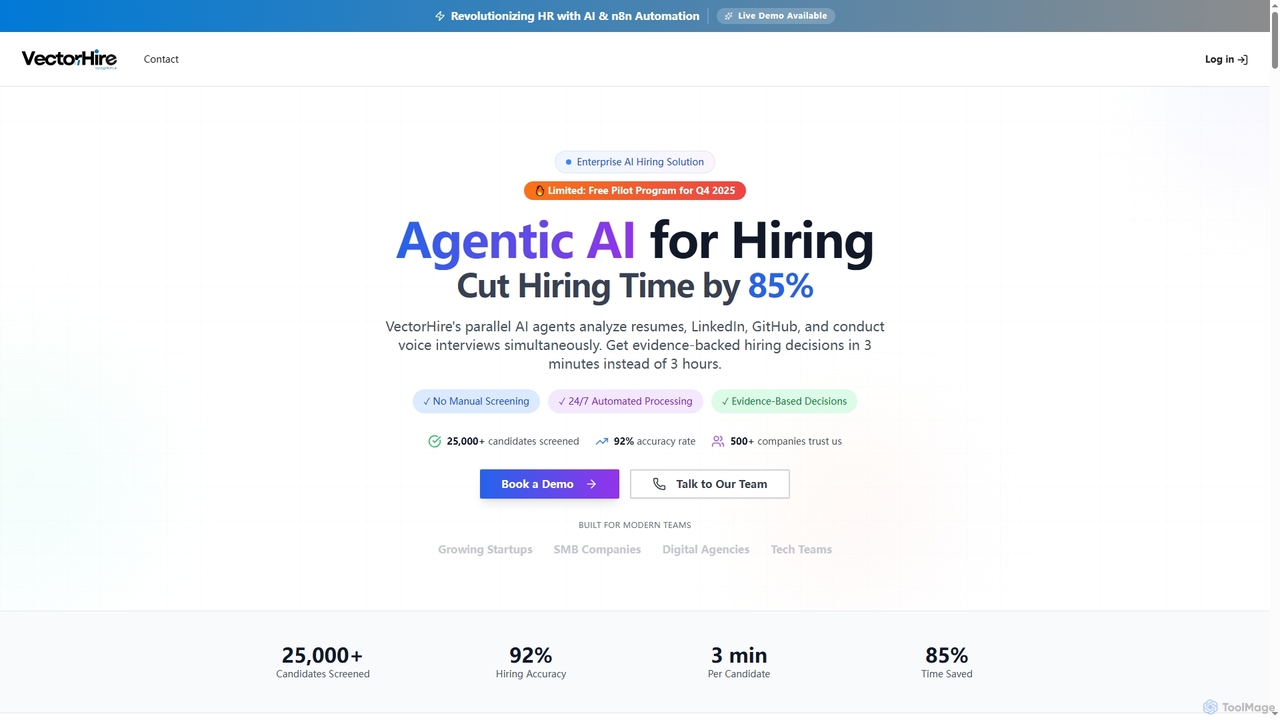
VectorHire is an agentic AI hiring solution that revolutionizes HR by cutting hiring time by 85%. It uses parallel AI agents to simultaneously analyze resumes, LinkedIn, GitHub, and conduct voice interviews, delivering evidence-backed hiring decisions in just 3 minutes.

Hiring Automation
Visits 5.3KFavorites 147Likes 140

About Hiring Automation

Hiring Automation tools are AI-powered solutions designed to streamline and optimize various stages of the recruitment process. These tools leverage machine learning, natural language processing, and data analytics to automate repetitive tasks, from initial candidate sourcing and screening to interviewing and onboarding. By reducing manual effort and enhancing objectivity, Hiring Automation aims to accelerate time-to-hire, improve candidate experience, and ultimately secure higher quality talent for organizations.

Core Features

  • AI Resume Screening: Automatically parses resumes, extracts key information, and ranks candidates based on job requirements.
  • Automated Interview Scheduling: Coordinates interview times between candidates and hiring managers, sending invites and reminders.
  • AI Candidate Assessment: Utilizes AI to analyze video interviews, conduct skills tests, and evaluate soft skills objectively.
  • Proactive Candidate Sourcing: Scans databases and networks to identify and engage passive candidates matching specific criteria.
  • Onboarding Workflow Automation: Automates the distribution of pre-boarding documents and initial training for new hires.

Use Cases

Hiring Automation is particularly beneficial for large enterprises with high recruitment volumes, enabling them to efficiently process thousands of applications. Recruitment agencies leverage these tools to manage diverse client needs and accelerate candidate placement. HR departments in growing companies utilize automation to reduce administrative burdens and focus on strategic talent acquisition initiatives.

How to Choose

When selecting a Hiring Automation tool, evaluate its integration capabilities with your existing Applicant Tracking System (ATS) or HRIS. Consider the specific recruitment stages it automates and its customization options for different roles or industries. Prioritize tools with robust bias detection features, strong data security, and a scalable pricing model that aligns with your organization's hiring needs.

Hiring Automation use cases

1

Automate Initial Candidate Screening

For talent acquisition specialists receiving hundreds of applications, AI-powered screening tools automatically parse resumes, extract relevant skills, and rank candidates against predefined job criteria. This significantly reduces the manual review workload, ensures consistent evaluation, and allows recruiters to focus on the most qualified applicants from the outset.

2

Streamline Interview Scheduling

HR administrators can utilize hiring automation platforms to automatically coordinate interview slots between candidates and multiple hiring managers. The system sends personalized invitations, manages calendar conflicts, and issues reminders, eliminating the time-consuming back-and-forth communication and accelerating the overall interview process.

3

Conduct Objective Candidate Assessments

Hiring managers can deploy AI-driven assessment tools, such as video interview analysis for communication skills or gamified cognitive tests, to evaluate candidates consistently and objectively. This approach helps to minimize unconscious bias, provides data-backed insights into candidate suitability, and improves the fairness and accuracy of hiring decisions.

4

Proactively Source Passive Candidates

Recruitment teams leverage AI to actively search professional networks, public profiles, and internal databases for passive candidates who possess specific skills and experience. The automation can then initiate personalized outreach campaigns, expanding the talent pool beyond active job seekers and identifying hidden gems for critical roles.

5

Automate Pre-boarding Documentation

HR departments can automate the distribution and collection of pre-boarding documents, welcome kits, and initial compliance forms for new hires. This ensures that all necessary paperwork is completed efficiently before the start date, providing a smooth onboarding experience for employees and reducing administrative tasks for HR staff.

6

Generate Data-Driven Hiring Insights

HR analysts use hiring automation platforms to gather and analyze comprehensive data on recruitment metrics, including time-to-hire, cost-per-hire, candidate source effectiveness, and diversity statistics. These insights enable organizations to identify bottlenecks, optimize their recruitment strategies, and make more informed decisions to improve overall talent acquisition performance.

Hiring Automation FAQ

What is Hiring Automation?

Hiring Automation refers to the application of artificial intelligence and software to automate repetitive and data-intensive tasks within the recruitment lifecycle. These tools utilize machine learning, natural language processing, and predictive analytics to streamline processes such as candidate sourcing, resume screening, interview scheduling, and initial candidate communication. The core objective is to enhance efficiency, reduce human bias, and improve the overall quality and speed of hiring decisions.

How do I choose the right Hiring Automation tool for my organization?

When selecting a Hiring Automation tool, it is crucial to consider several factors. Evaluate its compatibility and integration capabilities with your existing Applicant Tracking System (ATS) and HRIS. Assess the specific recruitment stages it automates and whether these align with your organization's pain points. Look for customization options, robust data security, and features designed to mitigate bias. Finally, consider scalability, user experience for both candidates and recruiters, and the pricing model to ensure it meets your long-term needs.

What are the main benefits of using Hiring Automation?

The primary benefits of implementing Hiring Automation include significant time and cost savings by automating manual tasks, allowing recruiters to focus on strategic activities. It improves the candidate experience through faster responses and personalized interactions. Furthermore, automation enhances hiring quality by reducing unconscious bias in screening and assessment, leading to more objective evaluations and better-fit hires. It also provides valuable data for continuous optimization of recruitment strategies.

What are the common features found in Hiring Automation tools?

Common features in Hiring Automation tools typically include AI-powered resume parsing and screening, which automatically extracts and ranks candidate information. Automated interview scheduling systems manage calendars and send invites. Virtual assistant chatbots handle initial candidate queries and engagement. AI-driven assessment platforms evaluate skills and behavioral traits. Proactive sourcing capabilities identify passive talent, and comprehensive analytics dashboards provide insights into recruitment performance. Some tools also offer automated onboarding workflows.

How does Hiring Automation differ from traditional Applicant Tracking Systems (ATS)?

While both are crucial for recruitment, traditional Applicant Tracking Systems (ATS) primarily serve as a database and workflow management system for candidate applications. They store resumes, track application statuses, and manage communication. Hiring Automation, on the other hand, actively *performs* tasks using AI, such as automatically screening resumes, scheduling interviews, or even conducting initial AI-powered assessments. Hiring Automation tools often integrate with an ATS to add intelligent, automated capabilities, transforming a passive record-keeping system into a proactive, efficiency-driven recruitment engine.