Kaipsul
Kaipsul is an innovative macOS application that leverages Apple Intelligence to pre-process large text datasets, compressing them by …
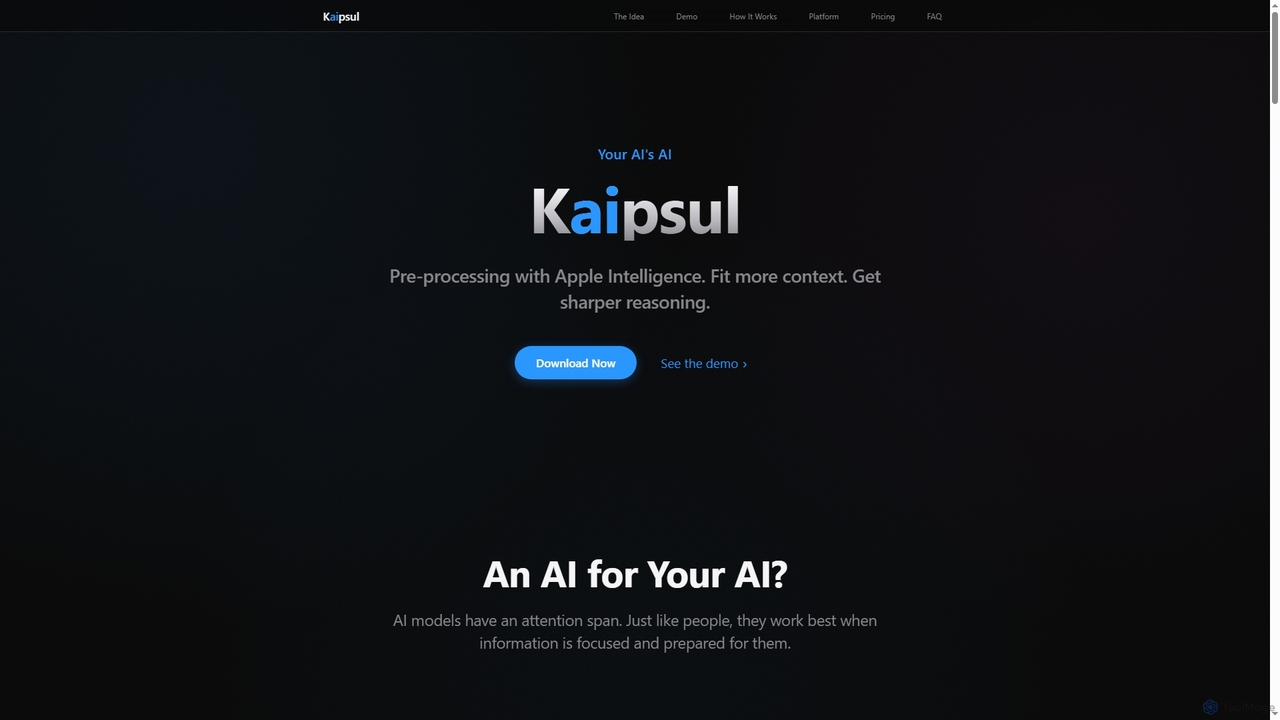
Kaipsul is an innovative macOS application that leverages Apple Intelligence to pre-process large text datasets, compressing them by up to 90% while preserving semantic meaning. It enables AI models to handle more context, overcome "context window exceeded" errors, and achieve sharper reasoning, all through 100% local, on-device processing.
About Llm Optimization
LLM Optimization tools are designed to enhance the performance, efficiency, and cost-effectiveness of Large Language Models (LLMs). These tools leverage advanced techniques like prompt engineering, fine-tuning, and model compression to tailor LLMs for specific tasks and domains. They enable businesses and developers to achieve higher accuracy, faster inference, and reduced operational costs, making LLMs more practical and reliable for real-world applications.
Core Features
- Prompt Engineering & Management: Tools to design, test, and optimize prompts for better LLM output and consistency.
- Fine-tuning & Customization: Capabilities to adapt pre-trained LLMs to specific datasets and tasks, improving domain-specific accuracy.
- Model Compression & Quantization: Techniques to reduce LLM size and computational requirements, leading to faster inference and lower costs.
- Retrieval Augmented Generation (RAG) Integration: Features to connect LLMs with external knowledge bases for more accurate and up-to-date responses.
- Performance Monitoring & Evaluation: Dashboards and metrics to track LLM performance, latency, cost, and output quality.
Applicable Scenarios
LLM Optimization is crucial for organizations deploying custom AI assistants, developing industry-specific content generation tools, or integrating LLMs into high-volume customer service operations. It helps data scientists refine models for niche applications and product managers ensure their AI features are both powerful and cost-efficient.
How to Choose
When selecting LLM Optimization tools, consider your specific goals (e.g., cost reduction, accuracy improvement, speed), the LLM models you use, and integration capabilities with your existing infrastructure. Evaluate the range of optimization techniques offered, ease of use, scalability, and the level of support for custom datasets and deployment environments.

Llm OptimizationUse Cases
Optimizing Customer Service Chatbots for Specific Industries
A financial services company uses LLM Optimization tools to fine-tune a general LLM with their proprietary knowledge base and customer interaction data. This process enhances the chatbot's ability to provide accurate, compliant, and contextually relevant answers to complex financial queries, significantly reducing the need for human agent intervention and improving customer satisfaction by 25%.
Reducing Inference Costs for Large-Scale Content Generation
A digital marketing agency needs to generate thousands of unique product descriptions daily. By employing LLM Optimization techniques like model quantization and distillation, they can run a smaller, more efficient LLM on cheaper hardware or cloud instances. This reduces their inference costs by 40% while maintaining the required quality and speed for their high-volume content creation workflows.
Enhancing Enterprise Search and Internal Knowledge Retrieval
A large corporation implements a RAG-based LLM Optimization solution to improve its internal search engine. Employees can now ask natural language questions and receive precise answers drawn from vast internal documentation, including PDFs, wikis, and databases. This significantly reduces time spent searching for information, boosting employee productivity and decision-making speed across departments.
Implementing Guardrails for Responsible AI Deployment
A healthcare provider uses LLM Optimization tools to implement safety guardrails and content moderation filters on their patient-facing AI assistant. This ensures that the LLM avoids generating harmful, biased, or medically inaccurate information, adhering to strict regulatory compliance and ethical guidelines. The optimization prevents potential risks and builds trust with patients, crucial for sensitive applications.
Accelerating Development of Custom AI Agents and Workflows
AI developers leverage LLM Optimization platforms to rapidly iterate on prompt designs and evaluate model responses for new AI agents. Features like version control for prompts, A/B testing of different optimization strategies, and automated evaluation metrics significantly accelerate the development cycle. This allows teams to deploy new AI-powered features 30% faster, bringing innovative solutions to market more quickly.
Fine-tuning LLMs for Niche Scientific Research
Researchers in a specialized scientific field use LLM Optimization to fine-tune a base LLM with a vast corpus of academic papers, experimental data, and domain-specific terminology. This tailored LLM can then accurately summarize complex research, generate hypotheses, and assist in data analysis, significantly accelerating discovery processes and enabling breakthroughs that would be difficult with general-purpose models.