ToolMage
Sign in

Best 1 Machine Learning Training AI tools for Artificial Intelligence

Popular Machine Learning Training AI tools in Artificial Intelligence include Google Skills, helping you work more efficiently.

Google Skills
Freemium

Google Skills

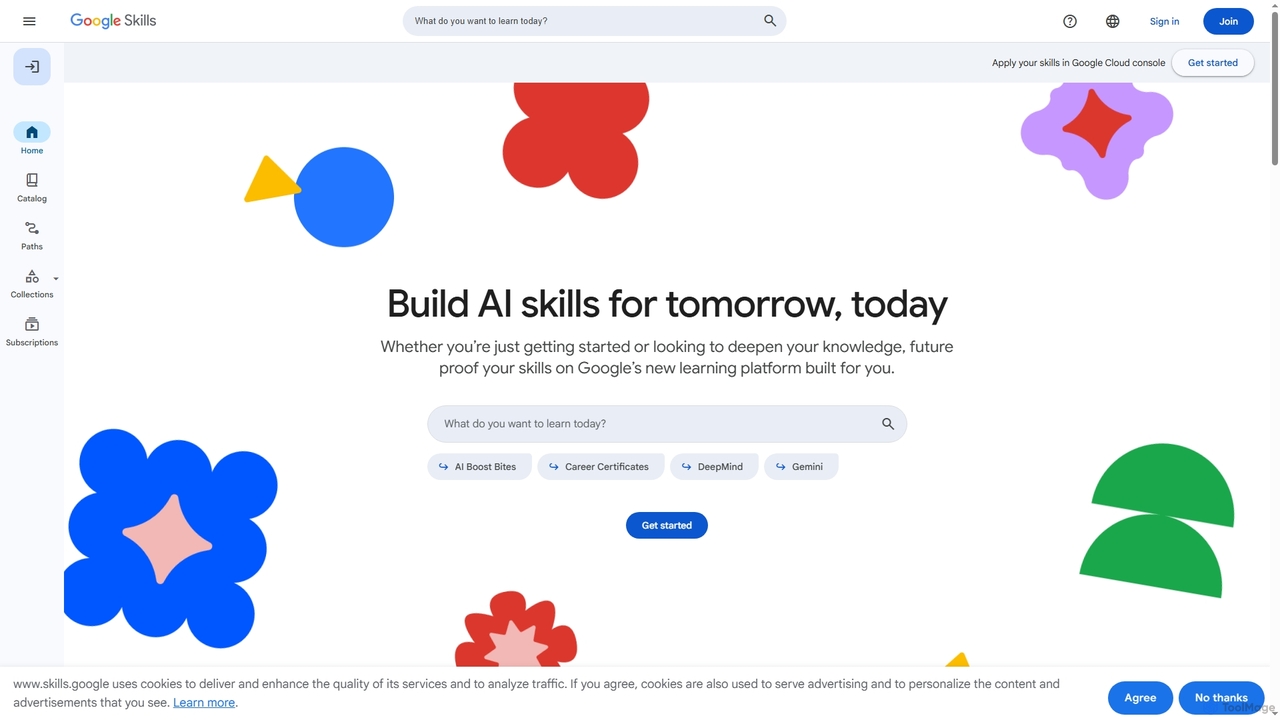
Google Skills is an online learning platform designed to help individuals and teams build and validate in-demand technical skills, particularly in AI and cloud technologies. It offers a range of learning paths, including hands-on labs, courses, skill badges, and industry-recognized certifications from Google experts, enabling users to future-proof their careers and enhance workforce capabilities.

Machine Learning Training
Visits 6.9MFavorites 119Likes 118

About Machine Learning Training

Machine Learning Training platforms are specialized environments designed to build, train, and deploy machine learning models. These tools provide the necessary infrastructure, such as GPUs and distributed computing, to process large datasets and run complex algorithms efficiently. They streamline the entire MLOps lifecycle, from data preparation and experiment tracking to model versioning and deployment. This focus on the end-to-end workflow enables data scientists and developers to create production-ready AI systems, distinguishing these platforms from general-purpose coding environments.

Core Features

  • Managed Infrastructure: Provides on-demand access to scalable compute resources like GPUs and TPUs without manual server management.
  • Experiment Tracking: Automatically logs and compares model parameters, metrics, and outputs for analysis and reproducibility.
  • Data & Model Versioning: Tracks changes to datasets and models, enabling rollback and auditing similar to version control for code.
  • Collaborative Workspaces: Offers shared environments where teams can co-develop models, share data, and manage projects.
  • Automated Deployment: Simplifies the process of packaging a trained model and deploying it as a scalable API endpoint.

Use Cases

These platforms are essential for data science teams, ML engineers, and researchers in sectors like technology, finance, healthcare, and e-commerce. They are used to develop custom solutions such as fraud detection systems, medical image analysis models, personalized recommendation engines, and natural language processing applications.

How to Choose

When selecting a tool, consider its support for your preferred frameworks (e.g., TensorFlow, PyTorch), integration with your existing data stack, the scalability of its compute resources, and the comprehensiveness of its MLOps features. Also, evaluate the platform's collaboration capabilities and pricing model based on your team's size and project complexity.

Featured tool rankings

Machine Learning Training use cases

1

Building a Custom Image Recognition Model

A retail company's data science team needs to create a model that identifies their products from user-uploaded images. Using a Machine Learning Training platform, they upload and version their labeled image dataset. The team collaborates in a shared notebook environment to develop a convolutional neural network (CNN). They then launch multiple training jobs with different hyperparameters, using the platform's experiment tracking to monitor accuracy and find the best-performing model, which is then deployed as an API for their app.

2

Training a Natural Language Processing (NLP) Model

A marketing analytics firm wants to analyze customer sentiment from thousands of online reviews. They use an ML Training platform to preprocess the text data and train a BERT-based model. The platform's managed infrastructure provides the necessary GPU power for this large model. Researchers track each training run, comparing results to optimize the model for classifying reviews as positive, negative, or neutral, ultimately providing actionable insights for their clients.

3

Developing a Predictive Customer Churn Model

A subscription-based service provider aims to reduce customer churn. Their analysts use an ML Training platform to build a predictive model using historical user activity data. The platform's features allow them to easily preprocess data, train various models like Gradient Boosting, and evaluate their performance. The final model predicts which customers are likely to cancel, enabling the marketing team to launch targeted retention campaigns proactively.

4

Optimizing an E-commerce Recommendation Engine

An e-commerce platform seeks to improve its product recommendation system. ML engineers use a training platform to experiment with collaborative filtering and deep learning models. They leverage the platform's distributed training capabilities to process massive user interaction logs. By versioning datasets and models, they can safely test new algorithms and deploy improved versions without service disruption, leading to higher user engagement and sales.

5

Accelerating Scientific Research with ML

A bioinformatics research lab is analyzing genomic data to identify patterns related to a specific disease. Researchers use a Machine Learning Training platform to manage large datasets and train complex deep learning models. The collaborative environment allows experts from different domains to contribute. The platform's ability to scale computational resources on-demand significantly shortens the time required for experiments, accelerating the pace of scientific discovery.

6

Training Reinforcement Learning Agents for Robotics

A robotics startup is developing an autonomous warehouse robot. Engineers use an ML Training platform with simulation integrations to train a reinforcement learning (RL) agent. The platform manages thousands of parallel simulation runs, allowing the agent to learn optimal navigation and picking strategies through trial and error in a virtual environment. Experiment tracking is crucial for analyzing learning curves and reward functions before deploying the policy to the physical robot.

Machine Learning Training FAQ

What is Machine Learning Training?

Machine Learning Training is the process of feeding data to an AI algorithm (a model) to help it learn patterns and make accurate predictions. Tools in this category provide a complete environment for this process, including data management, computational resources (like GPUs), experiment tracking, and model deployment. They are essentially the digital workshops where AI models are built, refined, and prepared for real-world use.

How do I choose a Machine Learning Training platform?

When choosing a platform, evaluate these four key aspects:

  • Framework Support: Ensure it supports your preferred libraries like TensorFlow, PyTorch, or Scikit-learn.
  • Scalability: Check if it provides easy access to scalable resources like GPUs and distributed training for large models.
  • MLOps Features: Look for integrated tools for experiment tracking, model versioning, and deployment automation.
  • Collaboration: If you work in a team, assess its features for shared workspaces, code repositories, and project management.
What's the difference between an ML Training platform and a local Jupyter Notebook?

A local Jupyter Notebook is an interactive coding environment, excellent for initial exploration and small-scale experiments. An ML Training platform is a complete, production-oriented system. It builds upon the notebook concept by adding managed infrastructure (scalable GPUs), robust experiment tracking, data/model versioning, collaboration tools, and streamlined deployment pipelines. These additions are essential for building reliable, large-scale ML systems that go beyond a single developer's machine.

What are the key stages in a typical machine learning training workflow?

A typical workflow involves several stages, all managed by ML training platforms. It starts with Data Preparation (cleaning, labeling, and transforming data), followed by Model Development (writing code and defining the model architecture). Next is Experimentation, which involves training the model with different parameters and tracking results to find the best version. Finally, after validation, comes Deployment, where the model is packaged and made available as an application or API for real-world use.

Who are the primary users of Machine Learning Training tools?

The primary users are technical professionals involved in building AI systems. This includes Data Scientists who design and experiment with models, Machine Learning Engineers who focus on productionizing and scaling these models for real-world applications, and AI Researchers who use these platforms to develop and test new algorithms. These tools are designed to support the entire lifecycle of model development, from an initial idea to a deployed product.