ToolMage
Sign in

Best 6 Machine Learning AI tools for Artificial Intelligence

Popular Machine Learning AI tools in Artificial Intelligence include Imbue, Synctron, Proception, Spaculus, BrainPredict, and Code88, helping you work more efficiently.

BrainPredict
Paid

BrainPredict

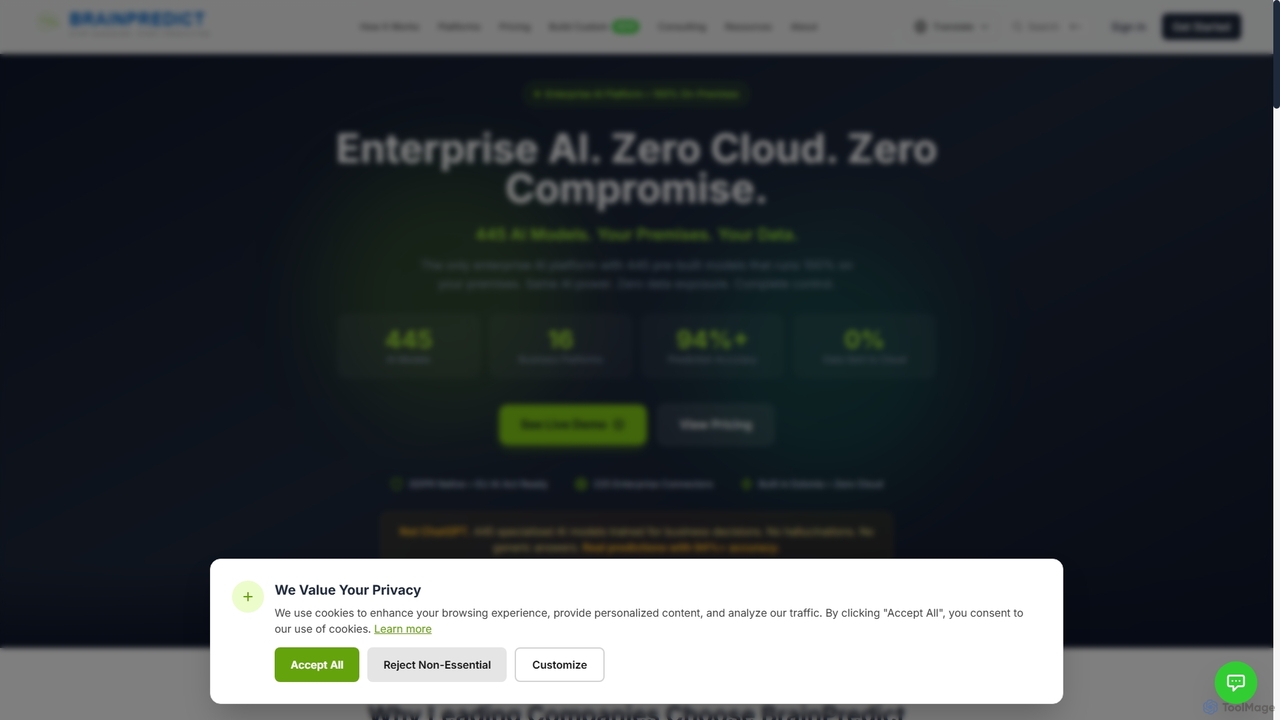
BrainPredict is an enterprise AI platform offering 445 specialized AI models that run 100% on-premises. It ensures zero cloud exposure and complete data sovereignty, delivering 94%+ prediction accuracy for critical business decisions across 16 functions.

3D
Visits 7.5KFavorites 91Likes 75
Synctron

Synctron

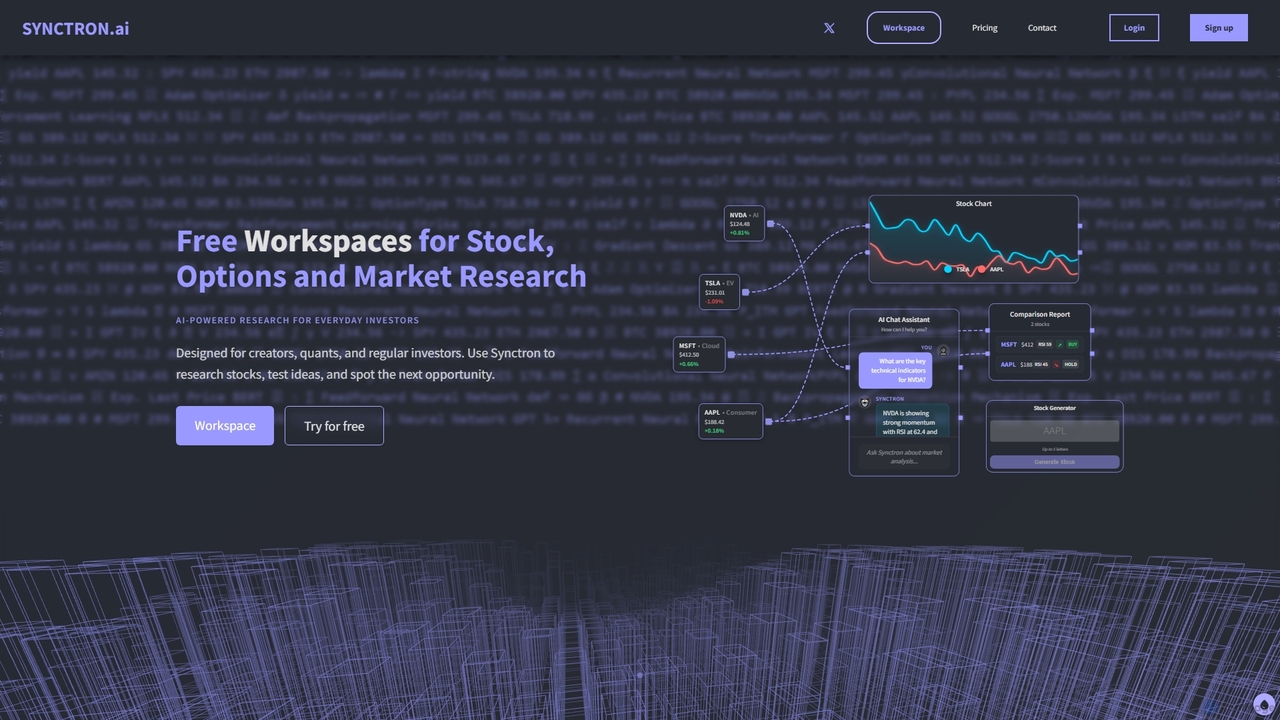
Synctron appears to be an advanced AI platform leveraging sophisticated machine learning models like Recurrent Neural Networks, Transformers, and GPT for complex data analysis, potentially in quantitative finance. It integrates concepts such as Gradient Descent, Attention Mechanisms, and Adam Optimizer, suggesting a focus on high-performance analytical capabilities for financial markets and data-driven decision-making.

Machine Learning
Visits 10.3KFavorites 102Likes 99
Code88
Paid

Code88

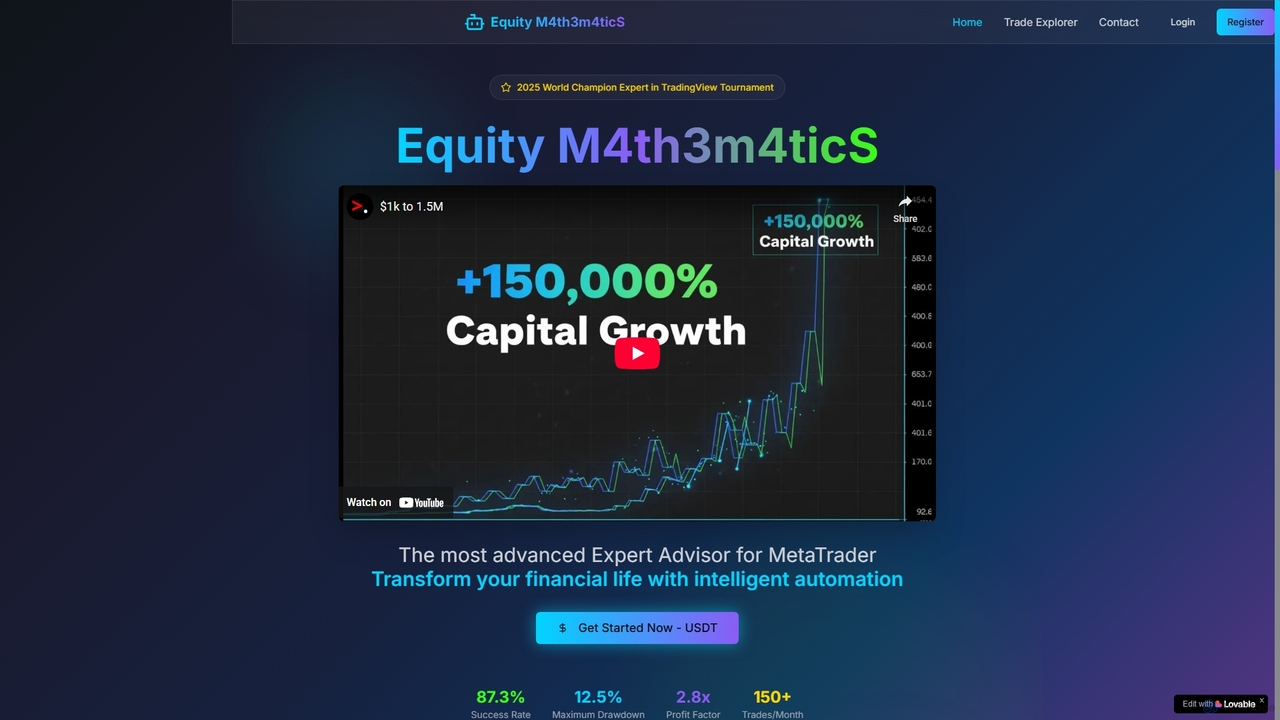
Code88 offers Equity M4th3m4ticS, an advanced AI-powered Expert Advisor for MetaTrader, designed to automate forex trading with high precision and intelligent risk management. It leverages machine learning and deep neural networks to transform financial life through intelligent automation and consistent capital growth.

Machine Learning
Visits 6.5KFavorites 160Likes 181
Spaculus
Paid

Spaculus

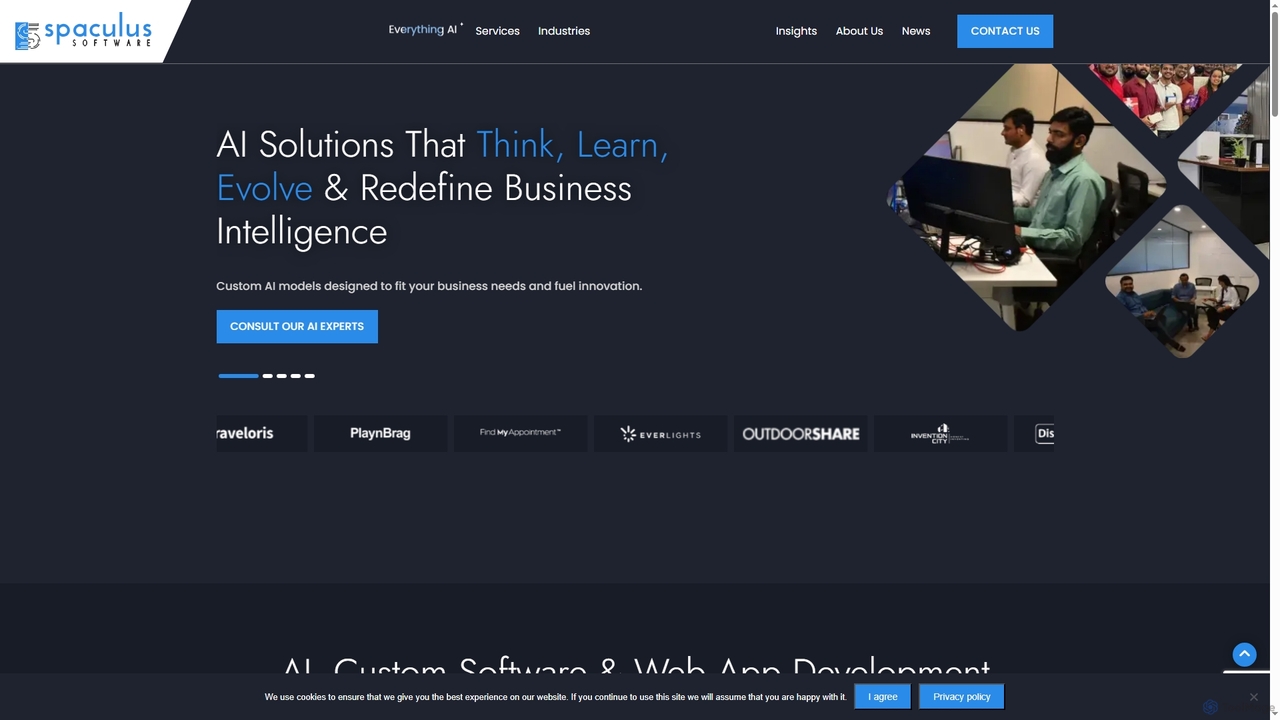
Spaculus is a leading technology company specializing in AI, custom software, and web app development. They provide tailored solutions including advanced AI models, machine learning, generative AI, and intelligent chatbots to help businesses automate processes, enhance decision-making, and drive innovation. They also offer mobile app development and expert AI engineering talent.

Generative Models
Visits 8.7KFavorites 145Likes 143
Imbue

Imbue

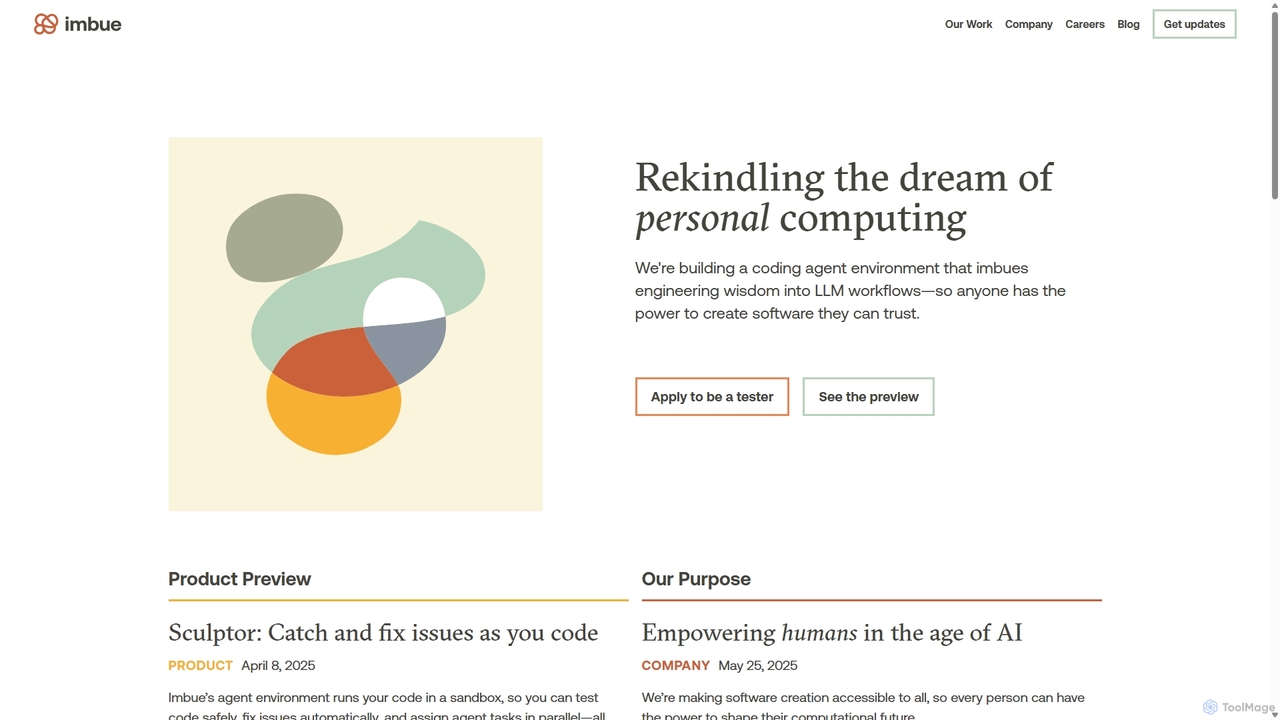
Imbue is an AI research and product company building AI agents that can reason and code. Its flagship product, Sculptor, is a coding agent environment that helps developers write high-quality, reliable software by automatically detecting issues, generating tests, and fixing bugs in a safe, sandboxed environment.

Machine Learning
Visits 56.6KFavorites 155Likes 156
Proception

Proception

Proception develops advanced humanoid hands, merging robotics and AI to achieve unprecedented dexterity. Their flagship product, ProHand, features human-like precision, adaptive grip, and tactile sensing. Backed by Y Combinator, Proception aims to revolutionize industries like manufacturing, healthcare, and research by enabling robots to perform complex, delicate tasks previously exclusive to humans.

Machine Learning
Visits 10KFavorites 140Likes 142

About Machine Learning

Machine Learning (ML) tools are a specialized category of AI software for building, training, and deploying models that learn from data. These tools use statistical algorithms to identify patterns, make predictions, and improve their performance over time without explicit programming. They are fundamental for creating predictive analytics, automating complex decision-making, and uncovering insights from large datasets. Many platforms now offer Automated Machine Learning (AutoML) capabilities, making advanced data science accessible to a wider range of users.

Core Features

  • Model Development & Training: Provides environments and libraries (like TensorFlow, PyTorch) to build, train, and validate various models such as regression, classification, and clustering.
  • Data Preprocessing & Feature Engineering: Includes functions for cleaning, transforming, normalizing, and selecting the most relevant data features to improve model accuracy.
  • Model Deployment & MLOps: Offers infrastructure to deploy trained models as APIs, manage their lifecycle, monitor performance, and automate retraining.
  • Automated Machine Learning (AutoML): Automates the end-to-end process of applying machine learning, from data preparation to model selection and hyperparameter tuning.

Use Cases

Machine Learning tools are primarily used by data scientists, ML engineers, and researchers. Industries like finance leverage them for fraud detection and algorithmic trading. In healthcare, they assist in disease diagnosis from medical images. E-commerce platforms use ML to power recommendation engines and forecast demand.

How to Choose

When selecting a Machine Learning tool, consider the required technical expertise (code-based vs. low-code/no-code GUI). Evaluate the range of supported algorithms and model types. Assess its scalability for handling large datasets and its integration capabilities with your existing data sources and IT infrastructure. Finally, consider the MLOps features for managing the model lifecycle in production.

Machine Learning use cases

1

Predictive Customer Churn Analysis

A data analyst at a telecommunications company uses a machine learning platform to analyze historical customer data, including usage patterns, contract details, and support interactions. They build a binary classification model (e.g., Logistic Regression or Gradient Boosting) to predict the likelihood of each customer churning in the next quarter. The platform's data preprocessing tools help clean and prepare the data, and its model validation features ensure accuracy. The resulting insights allow the marketing team to launch targeted retention campaigns for at-risk customers, reducing churn by a projected 15%.

2

Automated Medical Image Diagnosis Assistance

A medical researcher in a hospital uses a machine learning framework with computer vision capabilities to develop a model for detecting signs of pneumonia in chest X-rays. They upload a large, labeled dataset of thousands of X-ray images. The ML tool helps them train a Convolutional Neural Network (CNN) model. After training and validation, the model is deployed as a diagnostic aid. It automatically flags suspicious areas on new X-rays for radiologists to review, improving diagnostic speed and helping to catch subtle cases that might be missed by the human eye alone.

3

Building an E-commerce Recommendation Engine

An ML engineer at an online retail company is tasked with creating a personalized product recommendation system. Using a machine learning platform, they access user interaction data, such as clicks, purchases, and ratings. They implement a collaborative filtering algorithm to find similar users and items. The platform allows them to experiment with different algorithms and hyperparameters to optimize recommendation relevance. Once deployed via the platform's MLOps tools, the model provides real-time recommendations on the website, leading to a 10% increase in average order value.

4

Real-Time Financial Fraud Detection

A fintech company integrates a machine learning service to prevent fraudulent transactions. Their data science team trains an anomaly detection model on a massive dataset of historical transaction data, labeling known fraudulent activities. The model learns the patterns of normal transaction behavior. Using the ML platform's deployment tools, the model is integrated into their payment processing pipeline. It now analyzes new transactions in real-time, assigning a fraud risk score. Transactions exceeding a certain threshold are automatically blocked or flagged for manual review, significantly reducing financial losses due to fraud.

5

Sentiment Analysis of Customer Feedback

A product manager wants to understand customer sentiment towards a new feature. They use an ML tool with Natural Language Processing (NLP) capabilities to analyze thousands of app reviews and social media comments. They train a text classification model to categorize feedback as 'Positive', 'Negative', or 'Neutral'. The platform provides pre-trained models that can be fine-tuned on their specific product-related vocabulary. The resulting dashboard shows a real-time sentiment score and highlights common themes in negative feedback, allowing the product team to quickly identify and prioritize issues for the next development cycle.

6

Optimizing Supply Chain Demand Forecasting

A logistics manager for a large retail chain needs to accurately predict product demand to optimize inventory levels. Using an AutoML platform, they upload historical sales data, along with external factors like holidays and promotional events. The platform automatically tests various time-series forecasting models (like ARIMA or Prophet) and selects the best-performing one. The resulting forecast model predicts weekly demand for thousands of products across different locations. This allows the company to reduce overstocking of unpopular items and prevent stockouts of popular ones, leading to lower storage costs and increased sales.

Machine Learning FAQ

What are Machine Learning (ML) tools?

Machine Learning tools are software applications, platforms, or libraries that enable data scientists and developers to build, train, and deploy ML models. Unlike traditional software that follows explicit instructions, these tools help create systems that learn patterns and make predictions from data. Key functionalities include data preprocessing, model training with various algorithms (e.g., regression, classification), model evaluation, and deployment into production environments (MLOps).

How to choose the right Machine Learning tool?

Choosing the right ML tool depends on several factors. Consider the following:

  • User Skill Level: Are you a coder comfortable with Python/R (e.g., TensorFlow, Scikit-learn), or do you need a low-code/no-code GUI platform (e.g., AutoML tools)?
  • Project Scale: Does the tool need to handle massive datasets and scale across distributed computing clusters (e.g., Apache Spark)?
  • Integration: How well does it integrate with your existing data sources, cloud services, and applications?
  • MLOps Capabilities: Does it support the full lifecycle, including model versioning, monitoring, and automated retraining?
  • Cost: Evaluate the pricing model, whether it's open-source, pay-per-use, or a subscription-based platform.
What's the difference between Machine Learning and traditional Data Analytics tools?

The primary difference lies in their goal. Traditional Data Analytics tools (like BI software) focus on descriptive and diagnostic analysis, answering 'what happened' and 'why it happened' by analyzing historical data. They are primarily for human interpretation. Machine Learning tools focus on predictive and prescriptive analysis, using historical data to train models that can predict future outcomes ('what will happen') or suggest actions ('what should be done'). ML aims to automate decision-making, whereas data analytics aims to inform human decision-making.

What are the main types of Machine Learning?

Machine learning is broadly categorized into three main types based on the nature of the data and the learning process:

  • Supervised Learning: The model learns from labeled data, meaning each data point is tagged with a correct output. It's used for tasks like classification (e.g., spam detection) and regression (e.g., predicting house prices).
  • Unsupervised Learning: The model works with unlabeled data to find hidden patterns or intrinsic structures. Common tasks include clustering (e.g., customer segmentation) and dimensionality reduction.
  • Reinforcement Learning: The model learns by interacting with an environment. It receives rewards or penalties for its actions, aiming to maximize the cumulative reward. This is used in robotics, gaming, and navigation systems.
Who typically uses Machine Learning tools?

The user base for Machine Learning tools is expanding. Traditionally, the primary users were:

  • Data Scientists: They use these tools for exploratory data analysis, feature engineering, and building complex predictive models.
  • Machine Learning Engineers: They focus on productionizing models, building scalable ML pipelines, and managing the model lifecycle (MLOps).
  • Researchers: Academics and R&D professionals use ML tools to experiment with new algorithms and push the boundaries of AI.

More recently, with the rise of AutoML and low-code platforms, other roles like Business Analysts, Data Analysts, and Software Developers are also using ML tools to build and integrate predictive capabilities into their applications without deep statistical knowledge.