
OCR Arena
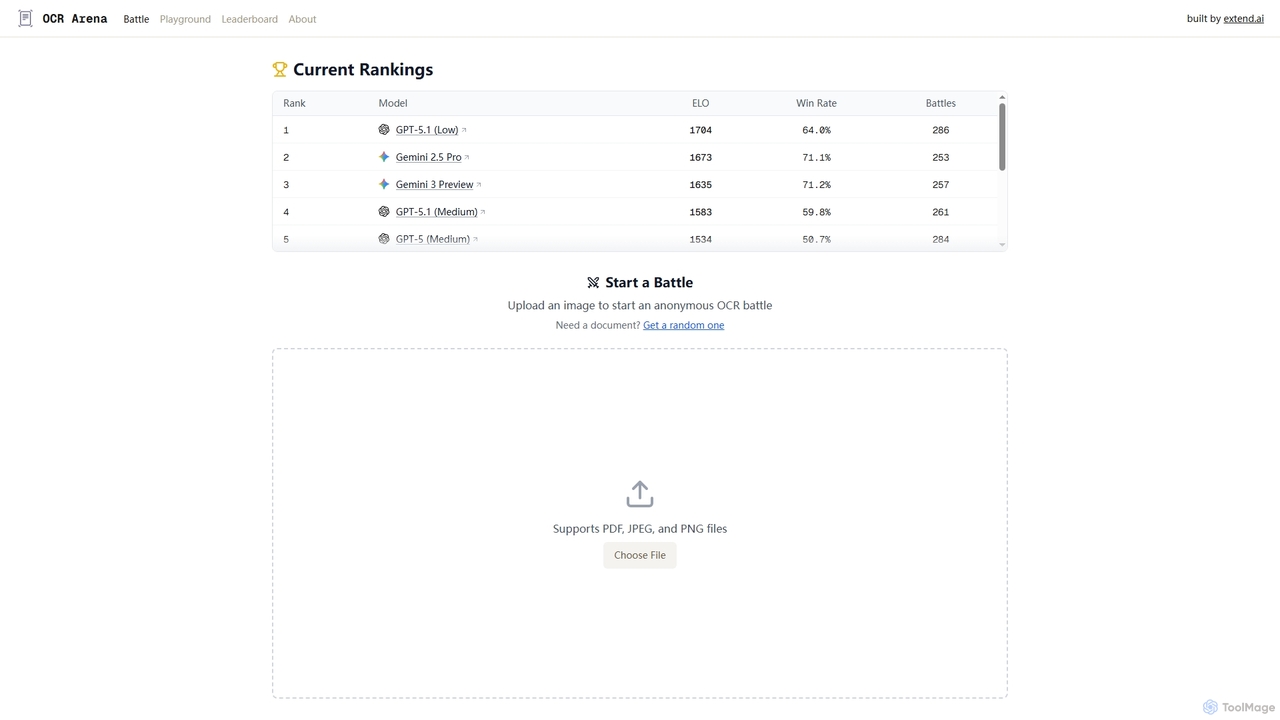
OCR Arena is a free online platform designed for testing and evaluating leading foundation Vision-Language Models (VLMs) and …
OCR Arena is a free online platform designed for testing and evaluating leading foundation Vision-Language Models (VLMs) and open-source Optical Character Recognition (OCR) models. It allows users to upload documents, measure accuracy, and compare model performance on a public leaderboard.
About Model Evaluation
Model Evaluation tools are AI-powered platforms designed to rigorously assess the performance, quality, and reliability of machine learning models. These tools leverage statistical analysis, performance metrics, and diagnostic techniques to quantify how effectively a model generalizes to unseen data. Their primary value lies in ensuring that AI systems are accurate, fair, robust, and ready for real-world deployment, thereby minimizing risks and maximizing operational efficiency.
Core Features
- Performance Metric Calculation: Automatically computes key metrics like accuracy, precision, recall, F1-score, MSE, and AUC-ROC for various model types.
- Bias Detection & Fairness Analysis: Identifies and quantifies potential biases within models, ensuring equitable outcomes across different demographic groups.
- Error Analysis & Debugging: Pinpoints specific data points or scenarios where a model performs poorly, aiding in targeted model improvement.
- Model Comparison & Selection: Facilitates side-by-side comparison of multiple model versions or algorithms to identify the best performer.
- Data Drift & Anomaly Detection: Monitors deployed models for shifts in data distribution or performance degradation over time.
Use Cases
Data scientists and machine learning engineers utilize these tools to validate new model iterations before production, ensuring they meet predefined performance benchmarks. AI product managers leverage them to compare different model candidates for new features, making data-driven decisions on model selection. Researchers also employ model evaluation platforms to rigorously assess the robustness and generalizability of novel AI algorithms.
How to Choose
When selecting a Model Evaluation tool, consider its compatibility with your existing machine learning frameworks and supported model types. Evaluate the breadth of evaluation metrics offered, especially for specific tasks like NLP or computer vision. Prioritize tools with strong interpretability and explainability features, and assess their integration capabilities with your MLOps pipelines for seamless workflow. Scalability for handling large datasets is also a crucial factor.
Model EvaluationUse Cases
Validating New Machine Learning Models
Data scientists utilize Model Evaluation tools to rigorously test newly developed machine learning models before deployment. This involves calculating performance metrics like accuracy, precision, and recall on unseen data, identifying potential overfitting or underfitting, and ensuring the model meets predefined performance benchmarks. This process minimizes risks associated with deploying unreliable models, ensuring robust performance in production environments.
Validating New Machine Learning Models
Data scientists rigorously test and validate newly developed machine learning models before they are deployed to production. By using model evaluation tools, they can run comprehensive tests, calculate performance metrics like accuracy and F1-score on unseen data, and ensure the model meets all performance benchmarks and quality standards, preventing costly errors in live systems.
Monitoring Deployed AI Systems for Drift
MLOps engineers employ Model Evaluation tools to continuously monitor the performance of AI models deployed in production. These tools detect data drift (changes in input data distribution) and concept drift (changes in the relationship between input and target variables) that can degrade model accuracy over time. By setting up alerts for significant drift, teams can proactively retrain or update models, maintaining optimal performance and preventing costly errors in real-world applications.
Detecting Model Bias in AI Systems
AI ethicists and data scientists employ these tools to identify and quantify potential biases within AI models, particularly those used in sensitive applications like credit scoring or hiring. The tools help analyze model behavior across different demographic groups, ensuring fairness and preventing discriminatory outcomes, which is crucial for ethical AI deployment and regulatory compliance.
Ensuring Fairness and Mitigating Bias in AI
Organizations use Model Evaluation tools to identify and mitigate biases in AI models, particularly in sensitive applications like hiring, lending, or healthcare. These tools analyze model predictions across different demographic groups (e.g., age, gender, ethnicity) to detect unfair outcomes. By quantifying fairness metrics and visualizing disparities, data ethicists and developers can refine models to promote equitable decision-making and comply with ethical AI guidelines, building public trust.
Optimizing Hyperparameters for Deep Learning
Machine learning engineers utilize model evaluation platforms to systematically assess the impact of various hyperparameter configurations on deep learning model performance. By running experiments and comparing metrics like validation loss and accuracy, they can identify the optimal set of hyperparameters that lead to the best-performing and most robust models, significantly improving development efficiency.
Debugging and Improving Model Performance
AI developers leverage Model Evaluation tools to debug and iteratively improve their models. Interpretability features (XAI) help them understand which features contribute most to a model's predictions or why a model made a specific error. By pinpointing weaknesses and areas for improvement, developers can refine model architectures, adjust hyperparameters, or augment training data, leading to more accurate and efficient AI solutions.
Monitoring Deployed Model Performance Drift
MLOps teams integrate model evaluation tools into their production pipelines to continuously monitor the performance of deployed AI models. These tools track key metrics over time, detect data drift or concept drift, and alert teams to any degradation in model accuracy or reliability. This proactive monitoring ensures models remain effective and relevant in dynamic real-world environments.
Benchmarking and Comparing AI Algorithms
Researchers and data science teams use Model Evaluation tools to benchmark different AI algorithms or model versions against each other. By applying consistent evaluation metrics and datasets, they can objectively compare the strengths and weaknesses of various approaches. This is crucial for selecting the best-performing model for a specific task, optimizing resource allocation, and advancing the state-of-the-art in AI research and development.
Comparing Multiple AI Algorithm Candidates
Researchers and development teams use model evaluation tools to objectively compare the strengths and weaknesses of different AI algorithms or model architectures for a specific problem. By standardizing evaluation metrics and datasets, they can make informed decisions about which approach yields superior results, accelerating research and development cycles.
Ensuring Regulatory Compliance for AI Models
Industries with strict regulations, such as finance and healthcare, rely on Model Evaluation tools to ensure their AI models comply with legal and ethical standards. These tools provide auditable reports on model performance, fairness, and transparency, which are often required by regulatory bodies. By systematically documenting evaluation results, organizations can demonstrate due diligence, avoid penalties, and build trust with stakeholders and customers.
Ensuring Regulatory Compliance for AI Models
Compliance officers and legal teams leverage model evaluation tools to verify that AI models adhere to industry-specific regulations, fairness guidelines, and transparency requirements. These tools provide auditable reports on model performance, bias analysis, and explainability, helping organizations demonstrate compliance and build trust with stakeholders and regulators.