Locally AI
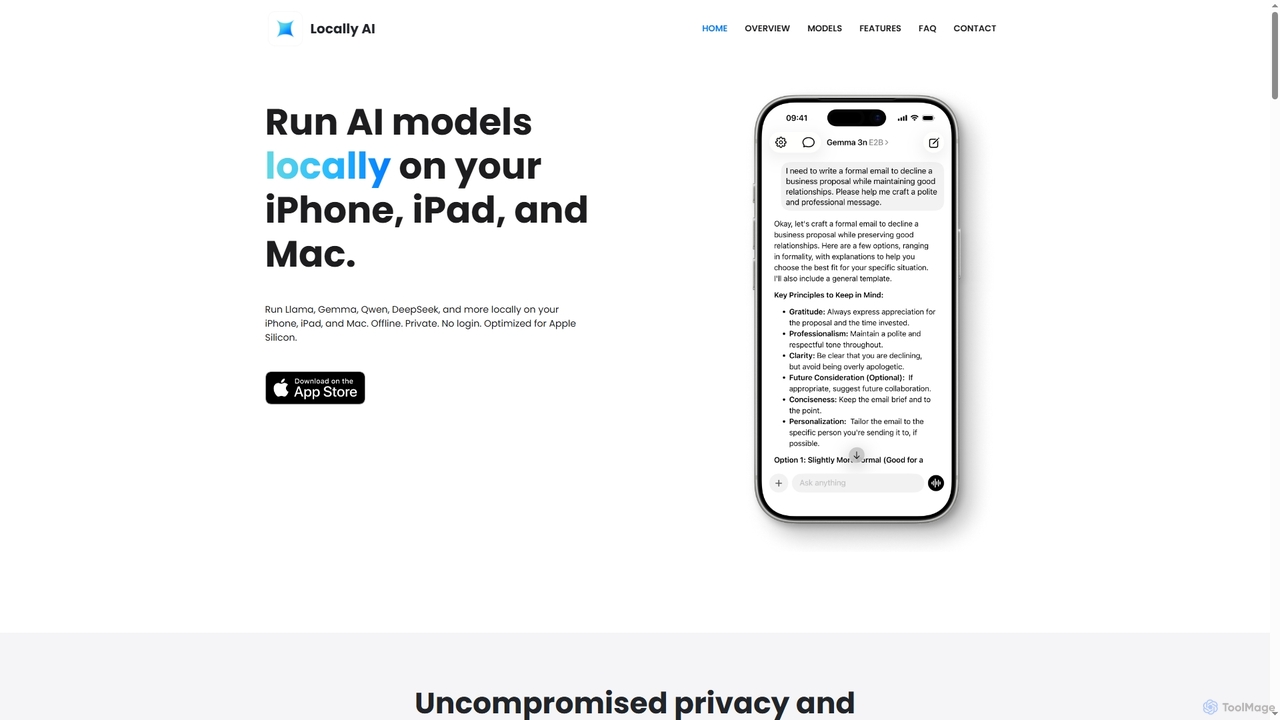
Locally AI enables users to run powerful AI models directly on their iPhone, iPad, and Mac devices. It …
Locally AI enables users to run powerful AI models directly on their iPhone, iPad, and Mac devices. It prioritizes privacy and offers features like offline voice mode, Siri integration, and customizable prompts for text and image processing, all seamlessly integrated within the Apple ecosystem.
About On Device Ai
On Device AI refers to artificial intelligence models designed to run directly on edge devices, such as smartphones, IoT sensors, and embedded systems, rather than relying on cloud servers. These tools leverage optimized algorithms and hardware acceleration to perform inference locally, enabling real-time processing and enhanced data privacy. The primary value lies in delivering immediate AI capabilities, reducing latency, and operating independently of internet connectivity, making AI more accessible and secure in diverse environments.
Core Features
- Local Inference: AI models execute computations directly on the device, eliminating the need to send data to the cloud.
- Low Latency: Processing occurs instantly on the device, resulting in faster response times for critical applications.
- Enhanced Privacy: User data remains on the device, significantly reducing privacy risks associated with cloud data transfer.
- Offline Capability: AI functionalities can operate without an active internet connection, ensuring continuous service availability.
- Energy Efficiency: Optimized models and hardware allow for AI processing with minimal power consumption, extending device battery life.
Use Cases
On Device AI is crucial in scenarios where real-time responsiveness, data privacy, or offline operation are paramount. This includes consumer electronics for personalized experiences, industrial IoT for predictive maintenance at the edge, and automotive systems for immediate safety decisions. It empowers applications to deliver intelligent features directly to users without the overhead or security concerns of constant cloud communication.
How to Choose
Selecting an On Device AI solution requires evaluating several factors: the target device's computational resources and memory, the complexity and size of the AI model, and the specific performance and latency requirements. Consider the availability of optimized SDKs and frameworks (e.g., TensorFlow Lite, Core ML), the ease of model deployment and updates, and the level of data privacy needed for your application. Compatibility with existing hardware and development ecosystems is also key.

On Device AiUse Cases
Real-time Smartphone Features
Smartphone manufacturers integrate On Device AI for features like instant facial recognition for unlocking, real-time language translation during calls, or advanced camera processing for portrait mode and scene detection. This allows users to experience seamless, private, and low-latency AI functionalities directly on their device, enhancing user experience without sending personal data to the cloud.
Real-time Voice Assistant on Smartphones
Smartphone users benefit from instant responses from voice assistants like Siri or Google Assistant, even offline. On Device AI processes voice commands locally, enabling quick execution of tasks such as setting alarms, making calls, or controlling device settings without sending audio data to cloud servers, ensuring privacy and responsiveness.
Offline Voice Assistants
Users in areas with unreliable internet or those prioritizing privacy can benefit from offline voice assistants powered by On Device AI. These assistants can perform basic commands, set alarms, play music, or control smart home devices without needing a cloud connection, ensuring functionality and data privacy even when off-grid.
Facial Recognition for Device Unlocking
Users can securely unlock their smartphones or access restricted areas using facial recognition. On Device AI performs the biometric matching directly on the device, comparing the live camera feed with stored facial data. This ensures that sensitive biometric information never leaves the device, enhancing security and privacy while providing immediate access.
Predictive Maintenance in Industrial IoT
In manufacturing or remote industrial sites, On Device AI on edge devices monitors machinery vibrations, temperature, and sound patterns. It analyzes this data locally to detect anomalies and predict potential equipment failures in real-time. This enables proactive maintenance, reduces downtime, and avoids costly cloud data transfer for continuous monitoring.
Predictive Maintenance in Industrial IoT
In manufacturing plants, IoT sensors equipped with On Device AI monitor machinery for anomalies. The AI models analyze vibration, temperature, and sound data locally to detect potential equipment failures in real-time. This allows for immediate alerts and proactive maintenance, preventing costly downtime without constant data streaming to a central server.
Personalized Health Monitoring on Wearables
Wearable devices like smartwatches use On Device AI to continuously analyze biometric data, such as heart rate, sleep patterns, and activity levels. This local processing enables immediate alerts for health anomalies, provides personalized fitness insights, and maintains the privacy of sensitive health data, all without constant synchronization with cloud servers.
Personalized Recommendations in Offline Retail Apps
Retail applications can offer personalized product recommendations to shoppers even when internet connectivity is poor or unavailable. On Device AI analyzes a user's browsing history and preferences stored locally to suggest relevant items, improving the shopping experience and driving sales without relying on cloud-based recommendation engines.
Enhanced Security for Smart Home Devices
Smart home cameras and doorbells leverage On Device AI for local object detection and facial recognition. Instead of sending all video feeds to the cloud for analysis, the device can identify known individuals or differentiate between pets and intruders locally, sending alerts only for relevant events. This significantly improves privacy and reduces bandwidth usage.
Advanced Driver-Assistance Systems (ADAS)
Modern vehicles utilize On Device AI for critical safety features like lane keeping assist, automatic emergency braking, and pedestrian detection. AI models process sensor data (cameras, radar, lidar) in real-time on the vehicle's embedded systems. This immediate processing is vital for making split-second decisions to prevent accidents, where cloud latency would be unacceptable.
Augmented Reality (AR) Applications
Mobile AR applications utilize On Device AI for real-time environment understanding, object tracking, and pose estimation. By processing camera feeds locally, AR apps can overlay virtual content onto the real world with minimal latency, creating immersive and responsive experiences for gaming, navigation, or interactive learning without relying on cloud processing for visual analysis.
Smart Home Device Automation
Smart home devices, such as security cameras or smart speakers, use On Device AI for local processing of events. A security camera might detect human presence or a pet locally, triggering an alert or recording only relevant footage, reducing false alarms and bandwidth usage. This ensures faster responses and greater privacy for home monitoring and automation tasks.