
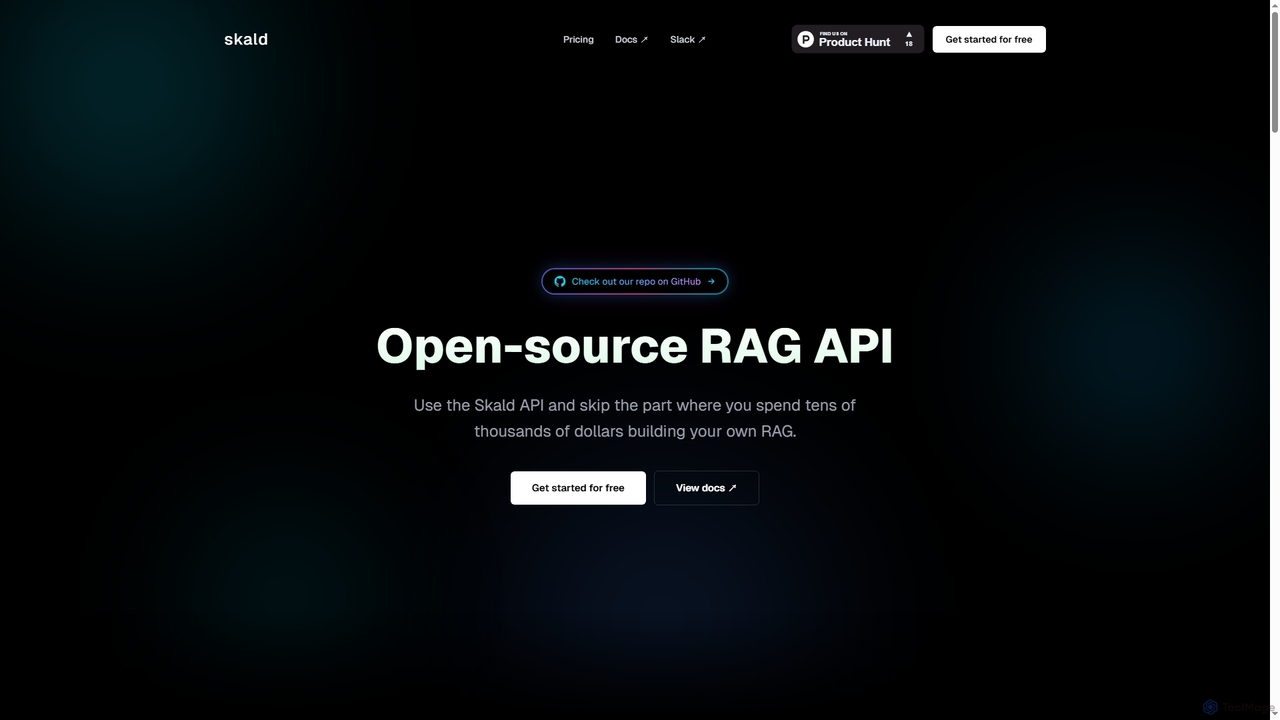
Skald
Skald is an open-source RAG API designed for developers to quickly build AI agents without the complexity of …
Skald is an open-source RAG API designed for developers to quickly build AI agents without the complexity of managing RAG infrastructure. It simplifies knowledge storage, context management, and semantic search, offering a powerful solution for integrating long-term memory into AI applications.
About Rag
RAG (Retrieval-Augmented Generation) tools are AI-powered systems that enhance large language models (LLMs) by integrating external knowledge. These tools retrieve relevant information from vast datasets or documents and then use it to inform the LLM's response generation. This process significantly improves the accuracy, relevance, and factual grounding of AI-generated content, minimizing hallucinations and providing up-to-date information.
Core Features
- Information Retrieval: Automatically searches and extracts relevant data from specified knowledge bases.
- Contextual Integration: Seamlessly feeds retrieved information into the LLM's prompt for enhanced generation.
- Fact-Checking & Grounding: Reduces factual errors by grounding responses in verified external data sources.
- Dynamic Knowledge Update: Allows LLMs to access and utilize the latest information without retraining.
- Source Citation: Often provides references to the original documents or data used for generation.
Use Cases
RAG tools are vital for applications requiring precise, data-driven AI responses across various sectors. They are particularly valuable in fields like customer support, research, legal analysis, and content creation where accuracy and up-to-dateness are paramount.
How to Choose
When selecting RAG tools, consider the compatibility with your existing LLMs and data sources, the efficiency and accuracy of its retrieval mechanism, the scalability for large knowledge bases, and the ease of integration and customization. Evaluate its ability to handle diverse data formats and provide clear source attribution.
RagUse Cases
Enhanced Customer Support Chatbots
Customer service teams deploy RAG-powered chatbots to provide accurate and up-to-date answers to customer queries. By retrieving information from product manuals, FAQs, and internal knowledge bases, the chatbot can offer precise solutions, troubleshoot issues, and guide users effectively, significantly reducing resolution times and improving customer satisfaction.
Legal Document Analysis and Q&A
Legal professionals utilize RAG tools to quickly extract and synthesize information from vast libraries of legal documents, case law, and regulations. This enables them to ask complex questions about specific cases or legal precedents and receive grounded, cited answers, streamlining research, due diligence, and contract analysis processes.
Scientific Research and Literature Review
Researchers and academics leverage RAG systems to navigate extensive scientific literature, journal articles, and experimental data. The tools help in summarizing findings, identifying relevant studies, and answering specific research questions by retrieving and integrating information from diverse academic databases, accelerating discovery and hypothesis generation.
Personalized Educational Content Generation
Educators and e-learning platforms use RAG to create highly personalized learning materials and answer student questions based on specific curricula and textbooks. The system retrieves relevant sections from course materials to generate explanations, examples, and quizzes tailored to individual student needs, enhancing comprehension and engagement.
Internal Knowledge Management and Employee Onboarding
Enterprises implement RAG solutions to build intelligent internal knowledge bases for employees. New hires can quickly find answers to HR policies, IT support, or project-specific information by querying the RAG system, which retrieves accurate details from company documents, accelerating onboarding and reducing reliance on human experts.
Real-time Market Intelligence and Trend Analysis
Business analysts and strategists employ RAG tools to gather and synthesize real-time market data, news articles, and competitor reports. By retrieving the latest information, the system can generate summaries, identify emerging trends, and answer specific business questions, supporting informed decision-making and strategic planning.