Artificial Intelligence Best in category 1 results Research Assistance AI Tool

Popular AI tools in the Research Assistance field of Artificial Intelligence include GraceLitRev, etc., helping you quickly improve efficiency.

GraceLitRev

GraceLitRev

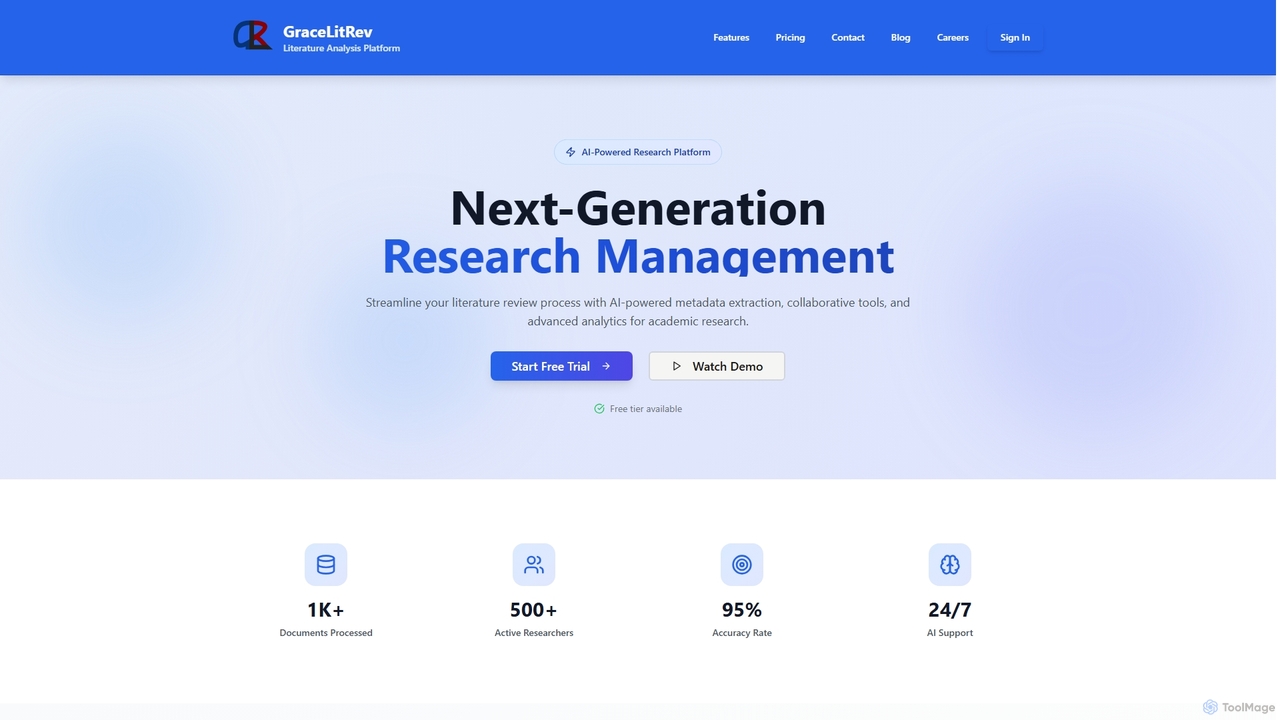
GraceLitRev is an AI-powered platform designed to revolutionize academic literature review. It streamlines research management through intelligent metadata …

2.8K

About Research Assistance

Research Assistance tools are a specialized category of AI designed to automate and accelerate the process of gathering, analyzing, and synthesizing information. Leveraging advanced Natural Language Processing (NLP), these platforms can comprehend vast amounts of text from academic papers, reports, and datasets to extract key insights and identify connections. They significantly reduce the time spent on manual tasks like literature reviews and data collection, enabling users to focus on critical analysis and discovery. Unlike standard search engines, these tools offer deeper contextual understanding, providing cited summaries and helping to uncover research gaps.

Core Features

  • Automated Literature Review: Scans vast databases to find, summarize, and thematically group relevant scholarly articles.
  • Semantic Search: Understands the conceptual meaning behind a query to deliver more relevant and nuanced results beyond keyword matching.
  • Data Extraction: Automatically identifies and pulls specific data points, figures, or findings from documents and tables.
  • Insight Synthesis: Analyzes multiple sources simultaneously to identify overarching themes, conflicting arguments, and knowledge gaps.
  • Citation Management: Generates accurate citations in various academic formats (APA, MLA, Chicago) and often integrates with reference managers.

Applicable Scenarios

These tools are invaluable for academics, PhD candidates, and university students conducting literature reviews. They are also widely used by market analysts for competitive intelligence, legal professionals for case precedent research, and R&D teams in corporations for tracking scientific advancements and patents.

Selection Criteria

When choosing a Research Assistance tool, evaluate the breadth and quality of its source database (e.g., access to specific journals). Consider the depth of its analytical features—does it only summarize, or can it perform thematic analysis? Also, assess its integration capabilities with tools like Zotero or Word and the accuracy of its citation generation.

Research AssistanceUse Cases

1

Accelerating Academic Literature Reviews

A PhD candidate in social sciences is tasked with writing a comprehensive literature review for their dissertation, a process that could take months. By using an AI Research Assistance tool, they input their core research questions and keywords. The AI scans millions of academic papers from databases like JSTOR and PubMed, returning a curated list of the most relevant articles within minutes. It then generates concise summaries for each paper, groups them by theme, and highlights key arguments and methodologies. This reduces the initial reading time by over 80%, allowing the student to focus on synthesizing the information and identifying their unique contribution to the field.

2

Conducting Market and Competitor Analysis

A market analyst for a technology firm needs to produce a quarterly report on industry trends and competitor activities. Instead of manually sifting through hundreds of news articles, press releases, and financial reports, they use an AI assistant. The tool is configured to monitor specific companies and topics. It automatically extracts key information such as product launches, financial performance, and strategic partnerships, presenting it in a synthesized dashboard. The analyst can ask direct questions like "What are the main R&D trends in Q3?" and receive a summarized answer with direct links to the source documents, enabling faster and more accurate reporting.

3

Streamlining Legal Precedent Research

A paralegal at a law firm is preparing for a complex intellectual property case. They need to find all relevant case law precedents. Using an AI research tool specialized for legal documents, they upload the case brief. The AI uses semantic search to understand the legal concepts involved and scours legal databases for matching precedents. It not only lists relevant cases but also summarizes the court's reasoning and highlights passages that are most pertinent to their current case. This process, which traditionally takes days of manual work, is completed in a few hours, improving case preparation efficiency and accuracy.

4

Validating Hypotheses in Scientific Research

A biomedical researcher has a new hypothesis but needs to ensure it hasn't been previously disproven or explored. They use an AI research tool to perform an exhaustive search of existing scientific literature. The tool can identify not just papers that support their idea but, more importantly, those that present conflicting evidence. It visualizes connections between different studies, helping the researcher understand the current state of knowledge and refine their experimental design. This prevents redundant research and strengthens the foundation of their new study by addressing potential counterarguments from the outset.

5

Enhancing Journalistic Investigations

An investigative journalist receives a leak of thousands of documents related to a corporate scandal. Manually reading through them is impractical. They upload the entire dataset to a secure AI Research Assistance platform. The tool indexes all the documents and allows the journalist to ask natural language questions, such as "Find all communications about Project X in March." The AI extracts relevant names, dates, and conversations, creating a timeline of events and identifying key individuals. This capability transforms unstructured data into actionable evidence, enabling the journalist to uncover the story's core facts efficiently and accurately.

6

Optimizing Corporate R&D Strategy

An R&D manager at a pharmaceutical company is responsible for identifying promising new areas for drug development. They use an AI research tool to continuously monitor new clinical trial results, patents, and scientific publications in their field. The AI synthesizes this information to identify emerging therapeutic targets and novel research methodologies. It can also analyze the patent landscape to flag areas with high competition or opportunities for innovation. This data-driven approach helps the company allocate its R&D budget more effectively and stay ahead of scientific breakthroughs.

Research AssistanceFrequently Asked Questions