TickerSight
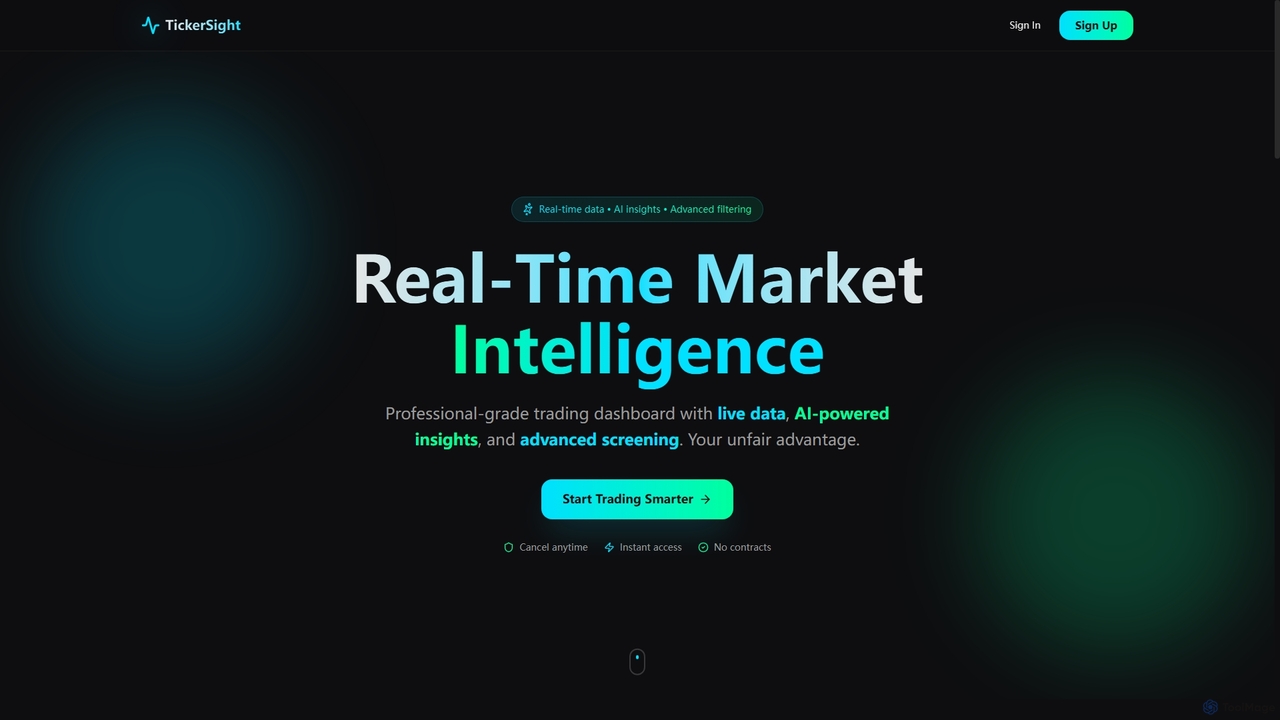
TickerSight is an AI-powered real-time trading intelligence platform designed for active traders. It provides live market data from …
TickerSight is an AI-powered real-time trading intelligence platform designed for active traders. It provides live market data from major exchanges, advanced AI sentiment analysis of news, and comprehensive screening tools. Traders can track pre-market and after-hours activity, visualize sector rotation, and utilize real-time technical indicators to make smarter, faster decisions, gaining a professional edge without the high cost.
About Sentiment Analysis
Sentiment Analysis is an AI-powered technology that automatically identifies and extracts subjective information from text, determining the emotional tone or sentiment expressed. Leveraging natural language processing (NLP) and machine learning, these tools classify text as positive, negative, or neutral, and can often detect specific emotions like joy, anger, or sadness. This capability provides invaluable insights into public opinion, customer satisfaction, and brand perception, enabling data-driven decision-making across various industries.
Core Features
- Polarity Detection: Classifies text into positive, negative, or neutral sentiment.
- Emotion Classification: Identifies specific emotions such as joy, anger, sadness, or surprise within text.
- Aspect-Based Sentiment Analysis: Pinpoints sentiment towards particular entities or features mentioned in text.
- Sarcasm and Irony Detection: Advanced models can identify complex linguistic nuances that alter sentiment.
- Multi-language Support: Analyzes sentiment across various languages and dialects.
Use Cases
Sentiment Analysis tools are crucial for businesses and organizations seeking to understand public and customer perception. They are widely used in marketing to gauge campaign effectiveness, in customer service to identify dissatisfied customers, and in product development to prioritize features based on user feedback. These tools transform unstructured text data into actionable insights, revealing underlying attitudes and opinions.
How to Choose
When selecting a Sentiment Analysis tool, consider its accuracy and robustness in handling diverse text types and languages. Evaluate its ability to perform aspect-based analysis and detect nuanced emotions or sarcasm. Look for integration capabilities with existing platforms, scalability to process large volumes of data, and customization options to adapt to specific industry jargon or context. Pricing models and real-time processing capabilities are also important factors.

Sentiment AnalysisUse Cases
Analyzing Customer Reviews for Product Improvement
Product managers use sentiment analysis to process thousands of customer reviews and feedback from app stores, e-commerce sites, and social media. This helps identify common pain points, highly praised features, and emerging trends, enabling data-driven decisions for product updates and new feature development.
Monitoring Brand Reputation on Social Media
Marketing teams deploy sentiment analysis tools to track mentions of their brand, products, and competitors across social media platforms, news sites, and forums. They can quickly detect negative sentiment spikes, identify potential PR crises, and understand public perception in real-time, allowing for timely responses and strategic communication adjustments.
Evaluating Customer Service Interactions
Call center supervisors and customer support managers utilize sentiment analysis on transcribed calls, chat logs, and email exchanges. This helps assess agent performance, identify customer frustration points, and pinpoint areas for service improvement, leading to enhanced customer satisfaction and reduced churn.
Gauging Public Opinion for Political Campaigns
Political strategists and researchers apply sentiment analysis to news articles, public forums, and social media discussions related to candidates, policies, and current events. This provides insights into voter sentiment, identifies key issues resonating with the public, and helps tailor campaign messaging for maximum impact.
Market Research and Competitor Analysis
Business intelligence analysts use sentiment analysis to understand market trends and competitor standing. By analyzing public discussions, product reviews, and news about rival companies, they can identify competitive advantages, market gaps, and areas where competitors are excelling or failing, informing strategic business decisions.
Processing Employee Feedback for HR Insights
Human Resources departments can use sentiment analysis on anonymous employee surveys, internal communication platforms, and exit interviews. This helps gauge overall employee morale, identify specific concerns or areas of dissatisfaction within the workforce, and proactively address issues to improve employee engagement and retention.