ToolMage
Sign in

Best 1 Business Process Management AI tools for Business

Popular Business Process Management AI tools in Business include Mazaal AI, helping you work more efficiently.

Mazaal AI
Freemium

Mazaal AI

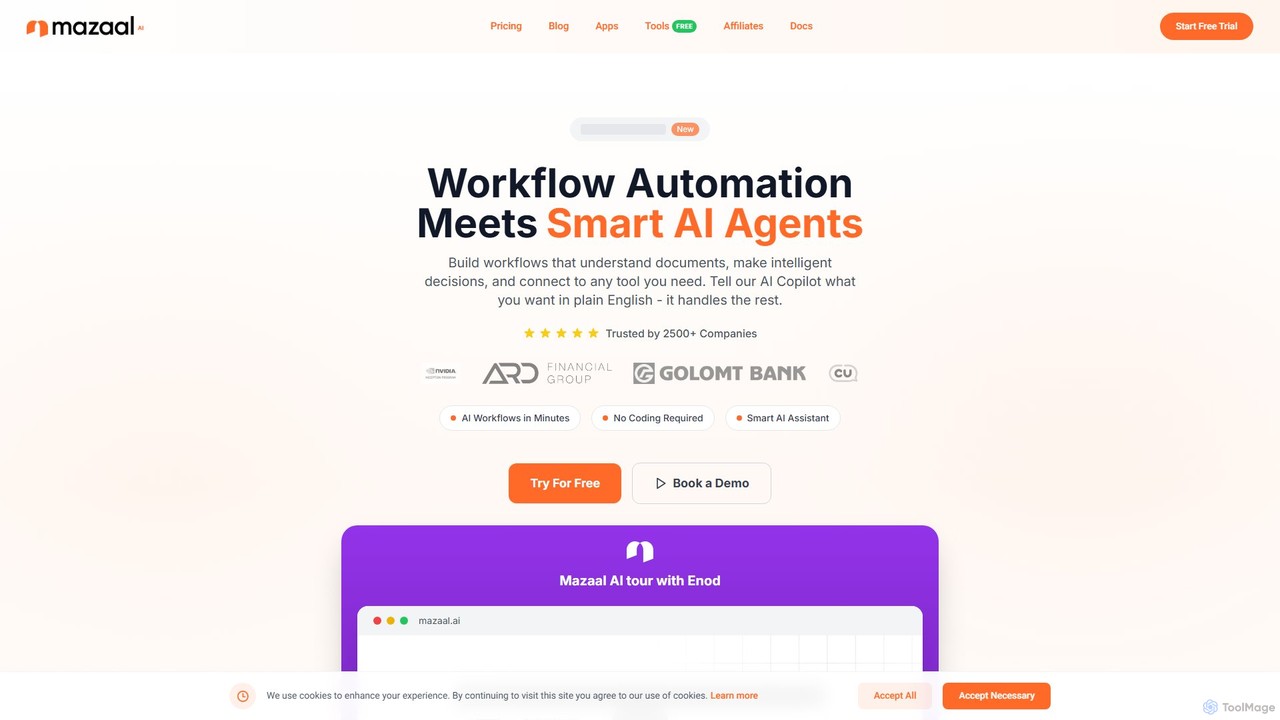
Mazaal AI is a no-code, AI-powered platform for building intelligent business process and workflow automations. Using a natural language Copilot, users can describe their needs in plain English to create complex workflows that understand documents, make decisions, and connect to virtually any tool. It's designed to make sophisticated automation accessible to everyone, from small businesses to large enterprises, without needing to write a single line of code.

Business Process Management
Visits 39.7KFavorites 135Likes 124

About Business Process Management

Business Process Management (BPM) AI tools are designed to automate, optimize, and monitor an organization's operational workflows using artificial intelligence. These tools leverage AI to analyze complex processes, identify inefficiencies, and suggest improvements, enabling businesses to achieve greater operational efficiency and agility. By streamlining repetitive tasks and providing data-driven insights, BPM AI solutions empower companies to enhance decision-making and adapt quickly to market changes, contributing significantly to overall business transformation.

Core Features

  • Intelligent Process Mapping: Automatically discover, map, and visualize existing business processes for clarity and analysis.
  • AI-Powered Automation: Automate repetitive tasks and entire workflows using machine learning, reducing manual effort and errors.
  • Performance Monitoring & Analytics: Track process KPIs, identify bottlenecks, and predict future performance with AI-driven insights.
  • Compliance & Governance: Ensure processes adhere to regulatory standards and internal policies through automated checks and audit trails.
  • Decision Support: Provide AI-driven recommendations for process optimization, resource allocation, and strategic adjustments.

Use Cases

Organizations across various sectors, from finance to manufacturing, utilize BPM AI tools to transform their operations. For instance, a financial institution might use these tools to automate loan application processing, reducing manual review time and improving accuracy. Similarly, a manufacturing company could optimize its supply chain logistics by predicting demand fluctuations and automating inventory management workflows, leading to more resilient and cost-effective operations.

How to Choose

When selecting a BPM AI tool, consider its integration capabilities with existing enterprise systems (ERP, CRM), the breadth of its automation features, and its analytical depth for process insights. Evaluate the user-friendliness of its interface for process modeling and monitoring, as well as the vendor's support for AI model customization and scalability to meet future business growth and evolving operational needs.

Business Process Management use cases

1

Automating Customer Onboarding Workflows

For financial services or SaaS companies, AI-powered BPM tools can automate the entire customer onboarding process, from document verification and background checks to account setup. This reduces manual effort, accelerates service delivery, and ensures compliance, significantly improving the customer experience and operational speed by streamlining complex initial interactions.

2

Optimizing Supply Chain Logistics

Manufacturing and retail businesses can use BPM AI to analyze supply chain data, predict demand, and automate inventory reordering and logistics scheduling. This minimizes stockouts, reduces carrying costs, and optimizes delivery routes, leading to more resilient and cost-effective operations that respond dynamically to market changes.

3

Streamlining HR Recruitment Processes

HR departments can leverage BPM AI to automate candidate screening, interview scheduling, and offer letter generation. The AI can analyze resumes for best fit, manage communication flows, and ensure a consistent, fair, and efficient recruitment experience, freeing up HR staff for more strategic tasks like talent development and retention.

4

Enhancing IT Service Management (ITSM)

IT teams can deploy BPM AI to automate incident resolution, service request fulfillment, and change management workflows. AI can categorize tickets, route them to the correct teams, and even suggest solutions based on past data, leading to faster resolution times, improved IT service quality, and reduced operational costs for the IT department.

5

Automating Invoice Processing and Approval

Finance departments in any industry can use BPM AI to automate the entire accounts payable process, from invoice capture and data extraction to matching and approval workflows. This reduces errors, speeds up payment cycles, and provides real-time visibility into financial obligations, enhancing cash flow management and ensuring timely vendor payments.

6

Improving Regulatory Compliance and Audit Trails

Organizations in highly regulated industries (e.g., healthcare, finance) can use BPM AI to ensure all processes adhere to strict compliance requirements. The tools can automatically log every step, flag potential deviations, and generate comprehensive audit trails, simplifying regulatory reporting and reducing compliance risks by maintaining transparent and auditable operations.

Business Process Management FAQ

What are Business Process Management (BPM) AI tools?

BPM AI tools are software solutions that use artificial intelligence to automate, analyze, and optimize an organization's operational workflows. They go beyond traditional BPM by leveraging machine learning to identify patterns, predict outcomes, and make intelligent recommendations for process improvements, enhancing efficiency and agility across various business functions.

How do BPM AI tools differ from traditional BPM software?

Traditional BPM software focuses on defining, modeling, and executing processes based on predefined rules. BPM AI tools, however, integrate AI capabilities like machine learning and natural language processing to dynamically analyze process data, learn from past performance, and intelligently adapt workflows, offering predictive insights and autonomous optimization that traditional systems lack.

What are the key benefits of implementing BPM AI in a business?

Implementing BPM AI can lead to significant benefits, including increased operational efficiency through automation, reduced costs by eliminating manual errors and bottlenecks, and improved decision-making with data-driven insights. It also enhances agility, allowing businesses to quickly adapt to market changes, and ensures better compliance with automated monitoring and comprehensive audit trails.

Which industries can benefit most from Business Process Management AI?

Virtually any industry with complex, repetitive processes can benefit. High-impact sectors include financial services (loan processing, fraud detection), healthcare (patient onboarding, claims processing), manufacturing (supply chain optimization, quality control), retail (inventory management, customer service), and IT (service management, infrastructure automation), where process efficiency is critical.

What should I consider when integrating BPM AI with existing systems?

When integrating BPM AI, prioritize tools with robust API capabilities and connectors for your existing ERP, CRM, and other core business applications. Assess the ease of data exchange, security protocols, and the vendor's support for custom integrations. A seamless integration ensures data consistency and maximizes the value of your automated workflows across the enterprise.