llmware
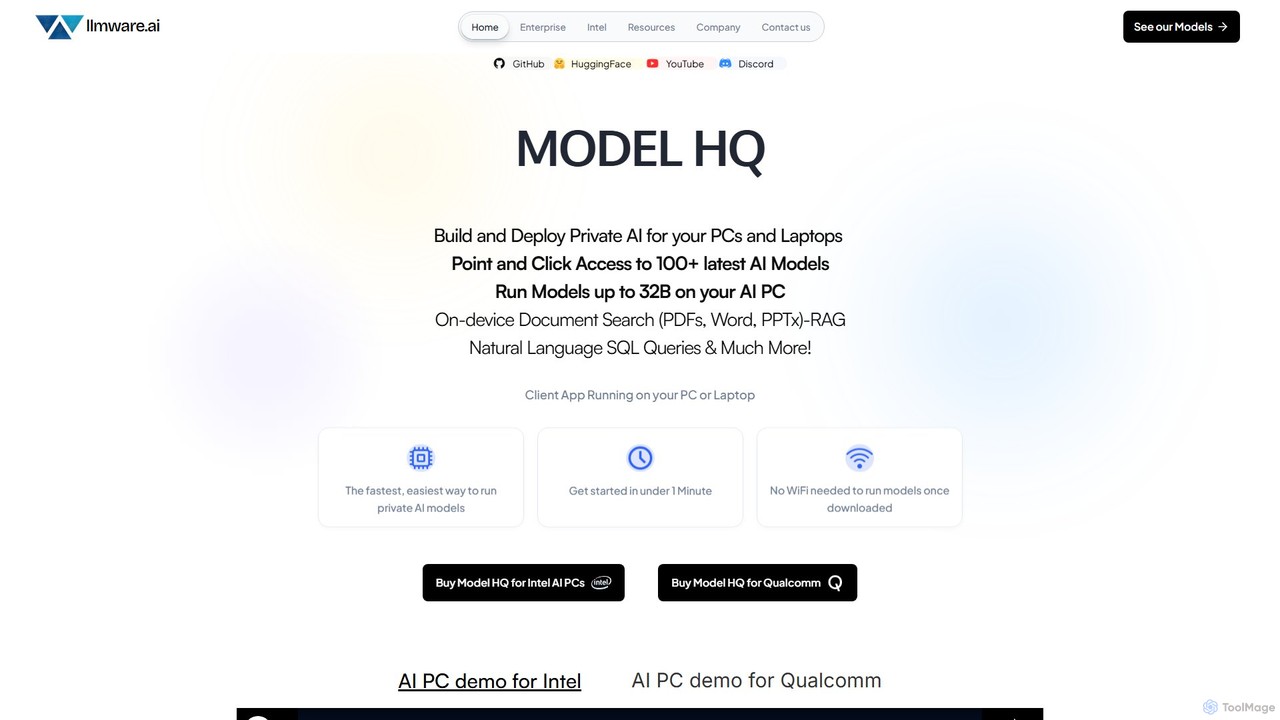
llmware is an enterprise-focused AI platform for building and deploying private AI workflows. Its flagship product, Model HQ, …
llmware is an enterprise-focused AI platform for building and deploying private AI workflows. Its flagship product, Model HQ, enables users to run over 100 small language models (up to 32B parameters) securely and locally on AI PCs without an internet connection. It offers on-device RAG, SQL queries, and other automated tasks, emphasizing data privacy, hardware optimization, and zero per-token inference costs.
About Data Analysis
AI Data Analysis tools are a class of software that uses machine learning and artificial intelligence to automate the discovery of insights from complex datasets. These tools leverage algorithms for predictive modeling, pattern recognition, and natural language processing to interpret data without manual intervention. They empower businesses to move beyond descriptive reporting and uncover future trends, identify anomalies, and make data-driven decisions with greater speed and accuracy. This capability makes advanced analytics accessible even to users without deep statistical expertise.
Core Features
- Automated Insights: Automatically surfaces significant patterns, correlations, and outliers in data that human analysts might miss.
- Predictive Modeling: Builds and deploys models to forecast future outcomes, such as sales trends, customer churn, or inventory demand.
- Natural Language Querying (NLQ): Allows users to ask questions about their data in plain language and receive answers, charts, and reports instantly.
- Data Preparation Automation: Streamlines the process of cleaning, transforming, and structuring raw data to make it ready for analysis.
- Sentiment Analysis: Utilizes NLP to analyze text data from reviews or social media to gauge customer opinions and emotions.
Use Cases
These tools are widely used across various industries. In e-commerce, they help analyze customer behavior to personalize recommendations and reduce churn. Financial institutions use them for fraud detection and credit risk assessment. Marketers rely on them to optimize campaign performance and forecast market trends. Essentially, any role from business analyst to C-level executive can use these tools to extract actionable intelligence from their data.
How to Choose
When selecting an AI Data Analysis tool, first consider its integration capabilities with your existing data sources (e.g., databases, CRM, cloud storage). Evaluate the user interface: is it a no-code platform for business users or a more technical environment for data scientists? Assess the scope of its analytical models and ensure it supports the types of analysis you need. Finally, consider its scalability to handle growing data volumes and the quality of its data visualization and reporting features.
Data AnalysisUse Cases
Predicting Customer Churn for Subscription Services
A marketing manager at a SaaS company needs to proactively reduce customer churn. Using an AI data analysis tool, they connect user activity data, support ticket history, and subscription information. The tool's machine learning model analyzes these combined datasets to identify patterns that precede cancellations. It then automatically assigns a 'churn risk score' to each customer. This allows the marketing team to target high-risk customers with personalized retention offers, such as discounts or feature training, ultimately reducing monthly churn by a measurable percentage.
Optimizing E-commerce Sales with Market Basket Analysis
An e-commerce manager wants to increase the average order value by promoting related products. They upload transaction history data into an AI analysis tool. The tool applies association rule mining algorithms to discover which products are frequently purchased together (e.g., 'customers who buy coffee beans also buy filters'). Based on these automated insights, the manager creates targeted product bundles, implements 'Frequently Bought Together' sections on product pages, and designs cross-sell email campaigns, leading to a direct increase in sales per transaction.
Automating Sentiment Analysis of Customer Feedback
A product manager is overwhelmed by thousands of customer reviews from app stores, surveys, and social media. To quickly gauge overall sentiment, they feed this unstructured text data into an AI analysis platform. The tool's Natural Language Processing (NLP) capabilities automatically classify each piece of feedback as positive, negative, or neutral. It also identifies and groups recurring themes, such as 'feature requests' or 'login issues'. This provides the product team with a real-time, high-level overview of customer satisfaction and pinpoints specific areas for improvement without manual reading.
Forecasting Sales Demand for Retail Inventory Management
A supply chain analyst for a retail chain needs to accurately forecast demand to optimize inventory levels. They use an AI data analysis tool to analyze historical sales data, seasonality, promotional calendars, and external factors like public holidays. The tool's predictive models generate granular demand forecasts for each product at each store location. This allows the analyst to automate reordering processes, reduce instances of stockouts on popular items, and minimize overstocking of slow-moving products, thereby improving cash flow and profitability.
Detecting Financial Anomalies in Real-Time
A financial controller at a large corporation is responsible for monitoring thousands of daily transactions for fraud or errors. Instead of manual spot-checks, they implement an AI analysis tool that connects to their accounting system. The tool learns the normal patterns of financial activity and uses anomaly detection algorithms to flag any transaction that deviates significantly from the norm, such as unusually large payments or transactions at odd hours. This provides an immediate alert system, enabling the finance team to investigate suspicious activities promptly and prevent potential financial losses.
Optimizing Marketing Campaigns with Natural Language Queries
A digital marketing specialist needs to quickly understand campaign performance without building complex reports. Using an AI analysis tool with Natural Language Querying (NLQ), they can simply type questions like, 'Which ad campaign had the highest ROI last month?' or 'Compare conversion rates for Facebook vs. Google ads in Q2.' The tool instantly processes the request, analyzes the connected marketing data, and presents the answer as a clear chart or summary. This empowers the marketer to get immediate insights, make faster decisions, and adjust campaign strategies on the fly.