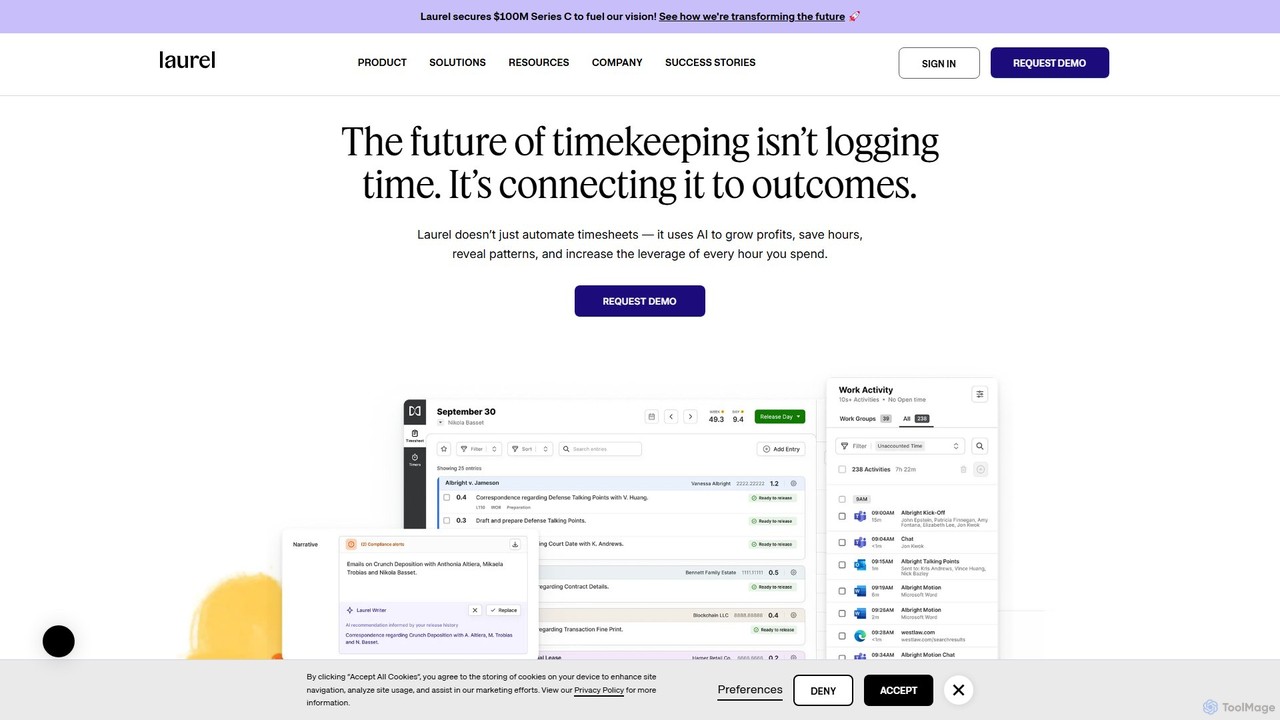
Laurel
Laurel is an AI-powered time intelligence platform that automates timekeeping for professional services firms like law and accounting. …
Laurel is an AI-powered time intelligence platform that automates timekeeping for professional services firms like law and accounting. It goes beyond simple time tracking by connecting time to business outcomes, helping firms recover lost billable hours, increase profitability, and gain deep operational insights to optimize pricing and resource allocation.
About Legal Tech
Legal Tech tools are specialized AI applications designed to automate and enhance legal processes for lawyers, law firms, and corporate legal departments. These platforms leverage technologies like Natural Language Processing (NLP) to analyze complex contracts and machine learning to conduct predictive legal research. They significantly improve efficiency in document review, case management, and compliance monitoring, allowing legal professionals to focus on strategic analysis and client advisory. By providing data-driven insights, these tools help mitigate risks and inform legal strategy with greater accuracy.
Core Features
- Contract Analysis: Automatically reviews legal documents to identify key clauses, risks, and deviations from standard templates.
- AI-Powered Legal Research: Rapidly searches vast databases of case law and statutes to find relevant precedents and legal arguments.
- E-Discovery Automation: Intelligently sorts and analyzes large volumes of electronic data to identify relevant evidence for litigation.
- Case Management Automation: Organizes case files, tracks critical deadlines, and automates routine client communications and reporting.
- Compliance Monitoring: Tracks regulatory changes in real-time and assesses their impact on organizational policies to ensure adherence.
Use Cases
Legal Tech is widely adopted by law firms of all sizes, in-house corporate legal teams, and government agencies. It is crucial for tasks such as due diligence in mergers and acquisitions, managing intellectual property portfolios, and supporting complex litigation. Compliance officers also use these tools to navigate intricate regulatory landscapes in sectors like finance and healthcare.
How to Choose
When selecting a Legal Tech tool, consider its jurisdictional coverage to ensure relevance to your legal system. Evaluate its specialization for your specific practice area, such as corporate law or litigation. Prioritize platforms with robust data security protocols and certifications to protect client confidentiality. Finally, assess its ability to integrate with your existing case management, document storage, and communication software.
Legal TechUse Cases
Automate Contract Review for Due Diligence
A corporate lawyer handling a merger and acquisition (M&A) deal uses a Legal Tech tool to analyze hundreds of contracts from the target company. Instead of manually reading each document, which could take weeks, the AI scans and flags non-standard clauses, potential liabilities, and missing signatures within hours. The lawyer receives a summarized risk report, allowing them to focus their attention on critical issues, accelerate the due diligence process, and provide more accurate advice to their client, significantly reducing manual effort and potential for human error.
Accelerate Legal Research for Litigation
A paralegal at a busy law firm is tasked with finding case law to support a complex motion. Using an AI-powered legal research tool, they input a natural language query describing the legal issue. The system instantly analyzes thousands of judicial opinions and statutes, returning a ranked list of the most relevant cases, including those that might be missed by traditional keyword searches. It also visualizes the relationships between cases, showing how precedents have been treated over time. This reduces research time from days to hours and strengthens the firm's legal arguments with more comprehensive and on-point citations.
Streamline E-Discovery Document Review
In a large-scale corporate litigation case, a legal team faces the challenge of reviewing millions of emails and electronic documents. They deploy an e-discovery platform that uses AI to perform predictive coding. After lawyers review a small sample of documents, the AI learns the criteria for relevance and privilege. It then automatically categorizes the entire dataset, prioritizing the most critical documents for human review. This process drastically reduces the volume of documents requiring manual inspection, saving thousands of billable hours and cutting e-discovery costs by more than 50% while increasing the accuracy of the review.
Manage Intellectual Property Portfolios
An in-house counsel at a global technology company uses a Legal Tech platform to manage its extensive portfolio of trademarks and patents. The system automates the tracking of all registration and renewal deadlines across different jurisdictions, sending timely alerts to prevent lapses. It also employs AI to monitor online marketplaces and social media for potential trademark infringements, automatically generating cease-and-desist letter drafts. This proactive approach protects the company's valuable IP assets, reduces administrative overhead, and allows the legal team to focus on strategic IP enforcement rather than manual tracking.
Ensure Continuous Regulatory Compliance
A compliance officer at a financial services firm is responsible for keeping the company's policies up-to-date with constantly changing regulations. They use an AI-powered compliance management tool that continuously scans for updates from regulatory bodies worldwide. When a new regulation is issued, the tool automatically analyzes its text, identifies the impact on existing internal policies, and suggests necessary amendments. This automates a highly complex and time-consuming task, reduces the risk of non-compliance penalties, and provides a clear, auditable trail of all policy changes made in response to regulatory updates.
Draft Standard Legal Documents Efficiently
A solo practitioner or small law firm needs to generate routine legal documents like Non-Disclosure Agreements (NDAs), employment contracts, or lease agreements quickly and accurately. They use an AI document drafting tool where they can input key variables (e.g., names, dates, specific clauses). The tool then generates a complete, well-formatted document based on pre-approved, jurisdiction-specific templates. Some advanced tools can even suggest alternative clauses based on the context provided. This allows the firm to produce high-quality, consistent documents in minutes, freeing up valuable time to focus on more complex legal work and client relationships.