ToolMage
Sign in

Best 1 Micro Enterprise Management AI tools for Business

Popular Micro Enterprise Management AI tools in Business include Comptalyze, helping you work more efficiently.

Comptalyze
Freemium

Comptalyze

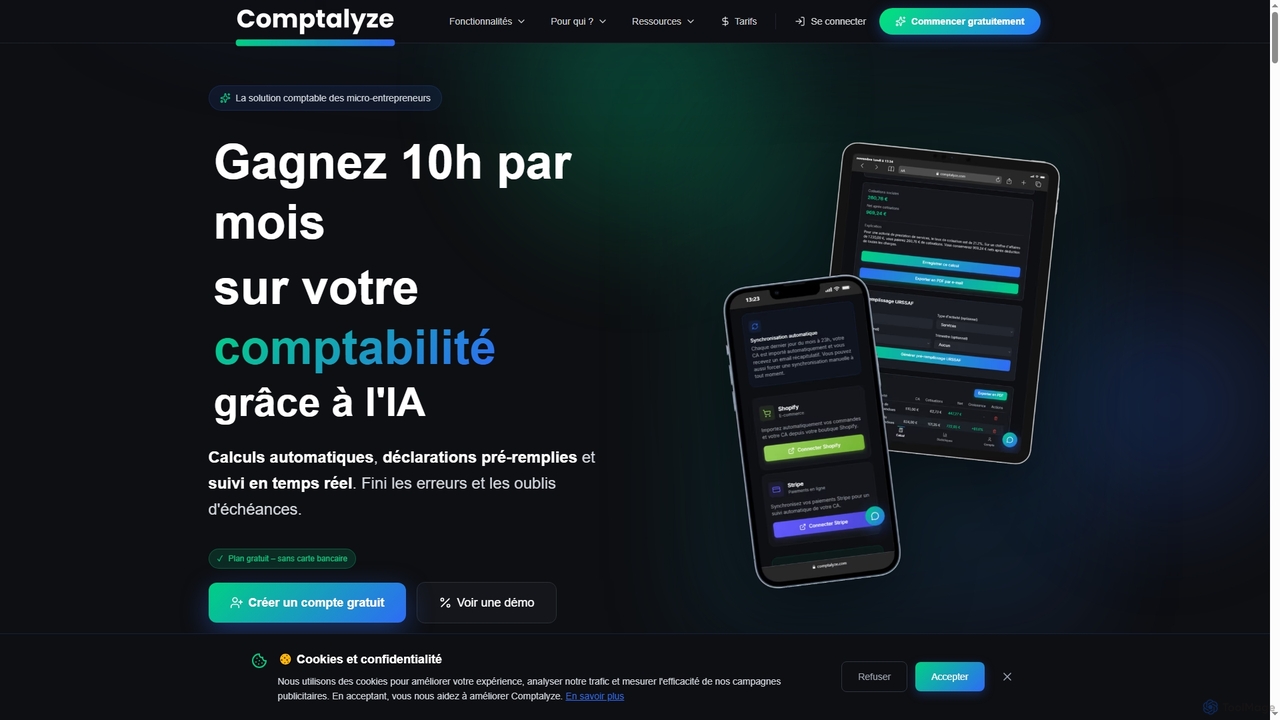
Comptalyze is an AI-powered accounting solution designed specifically for micro-entrepreneurs in France. It automates URSSAF calculations, pre-fills declarations, generates professional invoices, and provides real-time financial tracking, helping users save significant time and ensure compliance with French fiscal regulations.

Tax Advisor
Visits 5.7KFavorites 115Likes 110

About Micro Enterprise Management

Micro Enterprise Management AI tools are specialized solutions designed to empower small businesses, freelancers, and solopreneurs by automating and optimizing various operational tasks. These tools leverage artificial intelligence to streamline processes like financial tracking, customer engagement, and marketing, enabling micro-enterprises to operate efficiently with limited resources. They provide actionable insights and reduce manual workload, fostering growth and competitiveness in a dynamic market.

Core Features

  • Automated Financial Tracking: Simplifies expense logging, invoicing, and basic bookkeeping with AI-driven categorization and reconciliation.
  • AI-Powered Customer Engagement: Automates customer support, lead nurturing, and personalized communication through chatbots and smart email responses.
  • Smart Marketing & Content Generation: Assists in creating marketing copy, social media posts, and ad campaigns, optimizing reach and engagement.
  • Streamlined Operations & Task Management: Organizes projects, schedules tasks, and automates routine administrative duties to boost productivity.
  • Predictive Analytics for Growth: Offers insights into sales trends, customer behavior, and market opportunities to inform strategic decisions.

Applicable Scenarios

These tools are ideal for freelancers managing multiple clients, solopreneurs running online stores, small local service providers needing efficient booking and customer communication, and micro-agencies aiming to optimize project delivery with minimal overhead. They help manage daily operations, from client acquisition to financial reporting, without requiring a large team.

How to Choose

When selecting a Micro Enterprise Management AI tool, prioritize ease of use and a user-friendly interface, as micro-enterprises often lack dedicated IT support. Look for robust integration capabilities with existing platforms (e.g., accounting software, e-commerce platforms). Consider the specific feature set that addresses your most pressing needs, such as financial management or marketing automation, and evaluate the pricing model for cost-effectiveness and scalability as your business grows.

Micro Enterprise Management use cases

1

Automating Freelance Invoicing & Expense Tracking

A freelance graphic designer uses an AI-powered Micro Enterprise Management tool to automatically generate invoices based on project completion, track billable hours, and categorize business expenses. The AI learns from past transactions, ensuring accurate financial records and simplifying tax preparation, allowing the designer to focus more on creative work and less on administrative tasks.

2

Automated Expense Tracking and Invoicing for Freelancers

A freelance graphic designer uses an AI-powered tool to automatically categorize business expenses from bank statements and generate professional invoices for clients. The tool learns from past transactions, reducing manual data entry by 90% and ensuring accurate financial records for tax season, allowing the designer to focus more on creative work rather than administrative tasks.

3

Streamlining E-commerce Order & Inventory Management

An owner of a small online boutique leverages AI Micro Enterprise Management software to synchronize product inventory across multiple sales channels, process orders automatically, and manage shipping logistics. The system predicts demand based on sales trends, suggests reorder points, and automates customer notifications, ensuring smooth operations and reducing manual errors.

4

AI-Driven Social Media Content Creation for E-commerce

An owner of a small online boutique leverages an AI tool to generate engaging social media captions, product descriptions, and ad copy for new arrivals. By inputting product details and target audience, the AI produces multiple content variations, saving hours of brainstorming and writing, and helping maintain a consistent online presence across platforms to attract more customers.

5

Personalized Customer Support for Local Service Businesses

A local plumbing service implements an AI chatbot on its website to handle common customer inquiries, such as booking appointments, service pricing, and emergency requests. The chatbot provides instant, personalized responses 24/7, freeing up staff to focus on complex issues and improving customer satisfaction by offering immediate assistance outside of business hours.

6

Enhancing Local Service Business Customer Engagement

A small salon owner utilizes an AI tool for Micro Enterprise Management to manage appointment scheduling, send automated reminders, and handle initial customer inquiries via a chatbot. The AI personalizes communication based on client history, collects feedback, and identifies peak booking times, improving customer satisfaction and optimizing staff schedules.

7

Simplifying Project Management for Small Consulting Firms

A micro-consulting firm employs an AI-driven platform to manage client projects, assign tasks to a small team, and track progress against deadlines. The tool provides real-time analytics on project profitability and resource utilization, helping the firm optimize workflows, identify potential bottlenecks, and ensure projects are delivered on time and within budget.

8

Optimizing Marketing Campaigns for Solopreneurs

A solopreneur launching a new online course uses an AI marketing platform to analyze audience data and suggest optimal ad placements, budget allocation, and campaign messaging across different channels. The AI continuously monitors performance, making real-time adjustments to maximize return on ad spend and reach the most relevant potential students, significantly boosting enrollment rates.

9

Personalizing Marketing for Solo Content Creators

A solo content creator uses Micro Enterprise Management AI to analyze audience engagement, generate personalized content ideas, and automate social media posting across platforms. The AI helps segment audiences, schedule campaigns for optimal reach, and track performance metrics, enabling the creator to grow their brand effectively without hiring a marketing team.

10

Streamlining Project and Task Management for Micro-Agencies

A micro-marketing agency with three employees utilizes an AI-enhanced project management tool to automatically assign tasks, track progress, and identify potential bottlenecks across client projects. The AI predicts task completion times and suggests resource reallocations, ensuring projects stay on schedule and within budget, improving team collaboration and client delivery efficiency.

11

Generating Business Reports and Insights for Startups

A startup founder uses an AI business intelligence tool to consolidate data from sales, marketing, and operations into easy-to-understand reports. The AI identifies key performance indicators, highlights growth opportunities, and flags potential risks, providing the founder with critical insights for strategic planning and investor presentations without needing a dedicated data analyst.

12

Optimizing Financial Planning & Reporting for Startups

A lean startup team uses an AI-powered Micro Enterprise Management solution to forecast cash flow, create detailed budget plans, and generate compliance-ready financial reports. The AI integrates with banking and payment systems, providing real-time financial health insights and automating reconciliation, crucial for securing funding and making informed strategic decisions.

Micro Enterprise Management FAQ

What are Micro Enterprise Management AI tools?

Micro Enterprise Management AI tools are software solutions specifically designed to help small businesses, freelancers, and solopreneurs automate and optimize their daily operations. They leverage artificial intelligence to handle tasks like financial tracking, customer communication, and marketing, enabling efficient management with limited staff and resources. These tools aim to simplify complex business processes, reduce manual effort, and provide data-driven insights for growth.

What are Micro Enterprise Management tools?

Micro Enterprise Management tools are AI-powered software solutions specifically designed to help very small businesses and solo entrepreneurs manage their operations efficiently. They automate and integrate various business functions like finance, customer relations, marketing, and project management, providing comprehensive support to optimize limited resources and streamline daily tasks.

How do Micro Enterprise Management AI tools differ from general Business AI solutions?

The primary difference lies in scale and focus. General Business AI solutions cater to larger enterprises with complex needs, often requiring significant customization and IT infrastructure. Micro Enterprise Management AI tools, conversely, are built for simplicity, affordability, and ease of use, targeting the specific challenges of small operations. They offer streamlined features, often cloud-based, that provide immediate value without extensive setup, focusing on core tasks vital for micro-business survival and growth.

How do AI tools benefit micro-enterprises specifically?

AI tools offer micro-enterprises significant benefits by automating time-consuming administrative tasks, providing data-driven insights for better decision-making, and enabling personalized customer interactions without the need for extensive staff. This allows owners to focus on core business growth, reduce operational costs, and compete more effectively with larger entities by leveraging advanced technology.

What are the key benefits of using AI for micro-enterprise management?

Using AI for micro-enterprise management offers several key benefits. Firstly, it significantly boosts efficiency by automating repetitive tasks, freeing up valuable time for core business activities. Secondly, it provides cost savings by reducing the need for extensive manual labor or specialized hires. Thirdly, AI offers data-driven insights for better decision-making in areas like marketing and sales. Finally, it enhances customer experience through personalized and instant support, helping micro-enterprises compete more effectively.

What key features should I look for in a Micro Enterprise Management tool?

When choosing a Micro Enterprise Management tool, prioritize features such as automated bookkeeping and expense tracking, integrated CRM for customer management, personalized marketing automation, and efficient project or task management. Look for solutions that offer intuitive interfaces, strong integration capabilities with other essential business apps, and scalable pricing plans to grow with your enterprise.

Can Micro Enterprise Management tools help with marketing and sales?

Yes, many Micro Enterprise Management tools include robust AI-driven marketing and sales features. They can help automate email campaigns, schedule social media posts, analyze customer behavior to personalize offers, and manage lead generation. By leveraging AI, these tools enable micro-enterprises to execute sophisticated marketing strategies and nurture sales leads effectively, even with limited resources.

What features should I look for when choosing a Micro Enterprise Management AI tool?

When selecting a Micro Enterprise Management AI tool, prioritize features that directly address your business's most critical needs. Look for intuitive user interfaces that require minimal training. Essential features often include automated invoicing and expense tracking, AI-powered customer support (e.g., chatbots), smart marketing content generation, and efficient task management. Ensure the tool offers seamless integration with your existing software ecosystem and provides scalable pricing plans that fit your budget as your business evolves.

Can AI tools help with financial management for micro-enterprises?

Absolutely. AI tools are highly effective for financial management in micro-enterprises. They can automate expense categorization by analyzing bank transactions, generate professional invoices and send payment reminders, and even provide basic cash flow forecasts based on historical data. Some tools offer simple bookkeeping functionalities, reconciling accounts and generating financial reports, which significantly reduces the administrative burden and helps maintain accurate financial health without needing a dedicated accountant for daily tasks.

What's the difference between general business management software and Micro Enterprise Management tools?

General business management software often caters to a broader range of businesses, from small to large, and may have more complex features or require significant customization. Micro Enterprise Management tools, however, are specifically tailored for the unique needs of very small businesses, focusing on simplicity, cost-effectiveness, and integrated automation for common tasks, making them more accessible and immediately beneficial for solo entrepreneurs and small teams.