Humaans
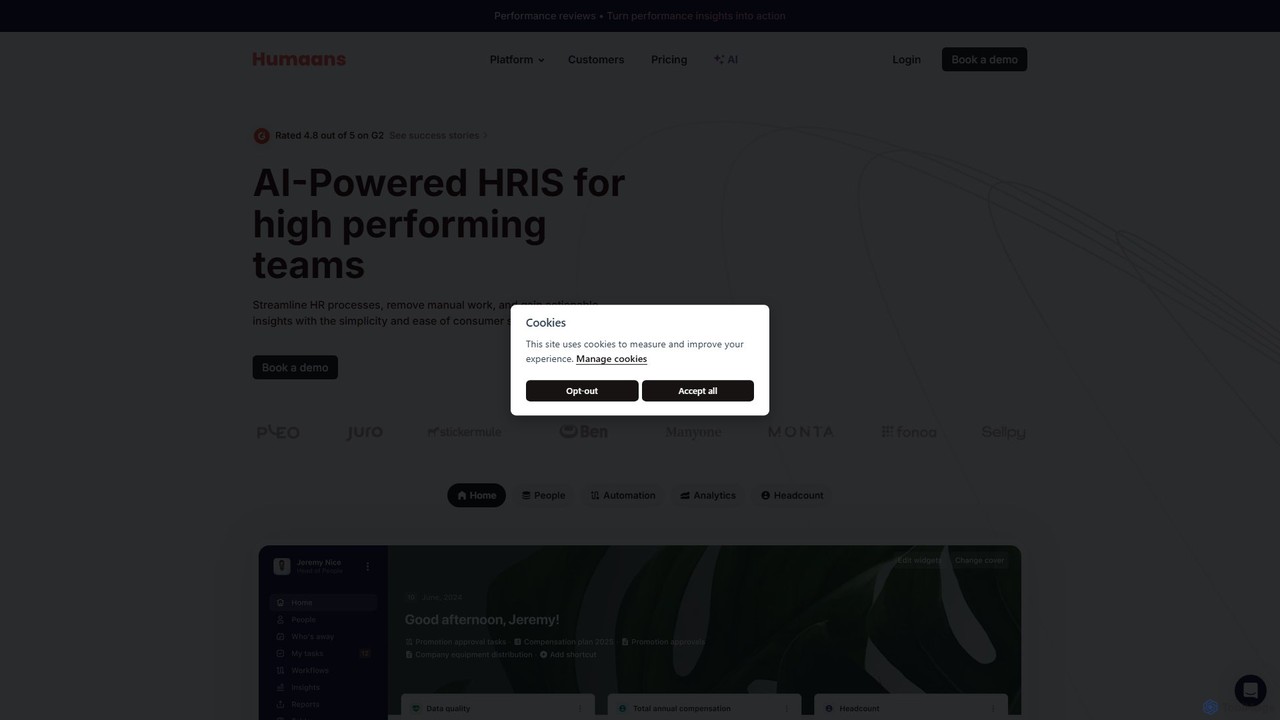
Humaans is an AI-powered Human Resource Information System (HRIS) designed for high-performing, growing teams. It centralizes all employee …
Humaans is an AI-powered Human Resource Information System (HRIS) designed for high-performing, growing teams. It centralizes all employee data, automates HR processes like onboarding and offboarding, and provides actionable insights through powerful analytics. Featuring an AI companion, it streamlines workflows and enhances employee experience.
About People Operations
AI People Operations tools are a class of software that leverages artificial intelligence to optimize the entire employee lifecycle, from recruitment to retention. These platforms utilize machine learning and natural language processing to automate administrative tasks, analyze workforce data, and provide predictive insights. The primary value lies in transforming traditional HR functions into a more strategic, data-driven operation, improving both efficiency and employee experience. They enable HR teams to focus on high-impact initiatives rather than routine processes.
Core Features
- Intelligent Recruiting: Automates resume screening, candidate matching, and interview scheduling based on skills and cultural fit.
- Employee Engagement Analytics: Analyzes feedback and communication data to measure morale, identify trends, and predict attrition risks.
- AI-Powered Performance Management: Facilitates unbiased performance reviews, tracks goal progress, and identifies skill gaps.
- Automated Onboarding & Support: Creates personalized onboarding journeys and provides instant answers to HR queries via chatbots.
- Predictive Workforce Analytics: Forecasts future hiring needs, models organizational changes, and tracks diversity metrics.
Use Cases
These tools are widely used by HR departments in fast-growing startups to manage high-volume hiring, and by large enterprises to analyze employee engagement and reduce turnover. They are also valuable for remote companies seeking to standardize onboarding and support processes for a distributed workforce.
How to Choose
When selecting a tool, consider its integration capabilities with your existing HRIS/ATS, the specific modules you need (e.g., recruiting vs. engagement), data security and compliance standards like GDPR, and the platform's analytical and reporting depth. Also, evaluate the user experience for both administrators and employees.
People OperationsUse Cases
Automate High-Volume Candidate Screening
An HR manager at a rapidly expanding tech company is tasked with screening over 1,000 applications for a single software engineer role. Using an AI People Operations tool, they set criteria for required skills, experience, and qualifications. The AI instantly parses all resumes, shortlisting the top 50 candidates who best match the profile. This reduces the initial screening time from several days to a few hours, allowing the recruitment team to focus on interviewing qualified applicants and improving the quality of hire.
Predict and Reduce Employee Turnover
A People Analytics team in a large corporation wants to proactively address employee attrition. They use an AI platform to analyze anonymized data points like tenure, promotion history, and employee survey feedback. The model identifies patterns and flags employees who are at a high risk of leaving. This allows HR business partners to initiate confidential check-ins, address potential issues, and implement targeted retention strategies, ultimately lowering costly turnover rates.
Create Personalized Onboarding for Remote Teams
A fully remote company needs to ensure a consistent and engaging onboarding experience. They use an AI People Operations tool to create automated, role-specific onboarding workflows. The system assigns tasks, schedules introductory meetings, and delivers training content. It also uses a chatbot to answer new hires' common questions 24/7, ensuring every employee receives the necessary support for faster integration and higher initial satisfaction.
Eliminate Bias in Job Descriptions
A Diversity and Inclusion (D&I) specialist aims to attract a more diverse pool of candidates. Before posting a new job opening, they run the description through an AI tool. The AI scans the text for gender-coded language, exclusionary phrases, and overly aggressive terminology. The tool suggests neutral alternatives, helping the company craft more inclusive job posts that appeal to a wider range of qualified talent and support D&I goals.
Provide 24/7 Automated HR Support
To free up HR staff for more strategic work, a company implements an AI-powered HR chatbot. Integrated with the company's knowledge base, the chatbot provides instant, accurate answers to hundreds of common queries about leave policies, benefits, and payroll via Slack or Microsoft Teams. This improves employee self-service and ensures they get the information they need anytime, without waiting for an HR representative, thus enhancing overall employee experience.
Conduct Skills Gap Analysis for Workforce Planning
A Learning & Development (L&D) manager needs to prepare the workforce for future business needs. They use an AI tool to map the existing skills of all employees based on performance reviews and project history. The platform then compares this internal skills inventory against the skills required for upcoming strategic initiatives. This reveals critical gaps, allowing the L&D team to design targeted training programs and upskilling pathways to build a future-ready workforce.