
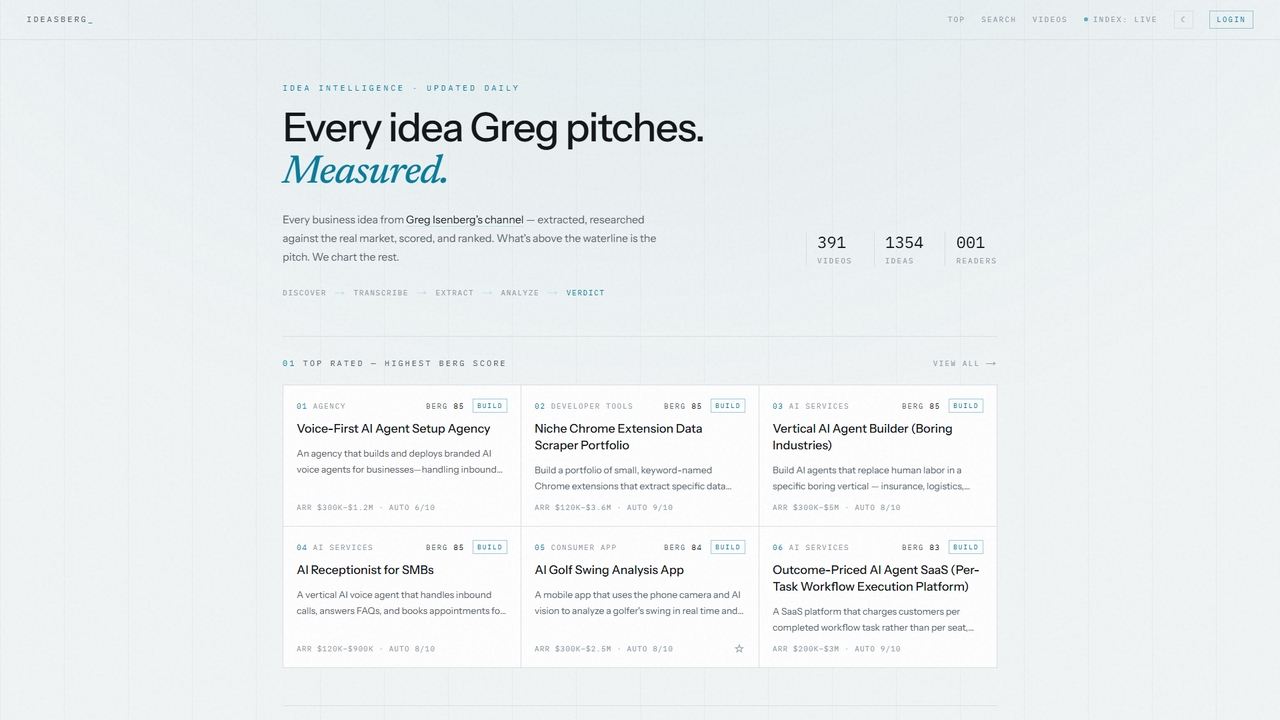
IdeasBerg
A curated database and research tool that extracts, scores, and ranks business ideas from Greg Isenberg's channel, providing market analysis and actionable insights for entrepreneurs.
Startup IdeasVisits 6.1KFavorites 17Likes 19
Popular Startup Ideas AI tools in Business include IdeasAI, IdeasBerg, SaaS Library, Demand Tap, and Hustle Hunter, helping you work more efficiently.
A curated database and research tool that extracts, scores, and ranks business ideas from Greg Isenberg's channel, providing market analysis and actionable insights for entrepreneurs.
Startup Ideas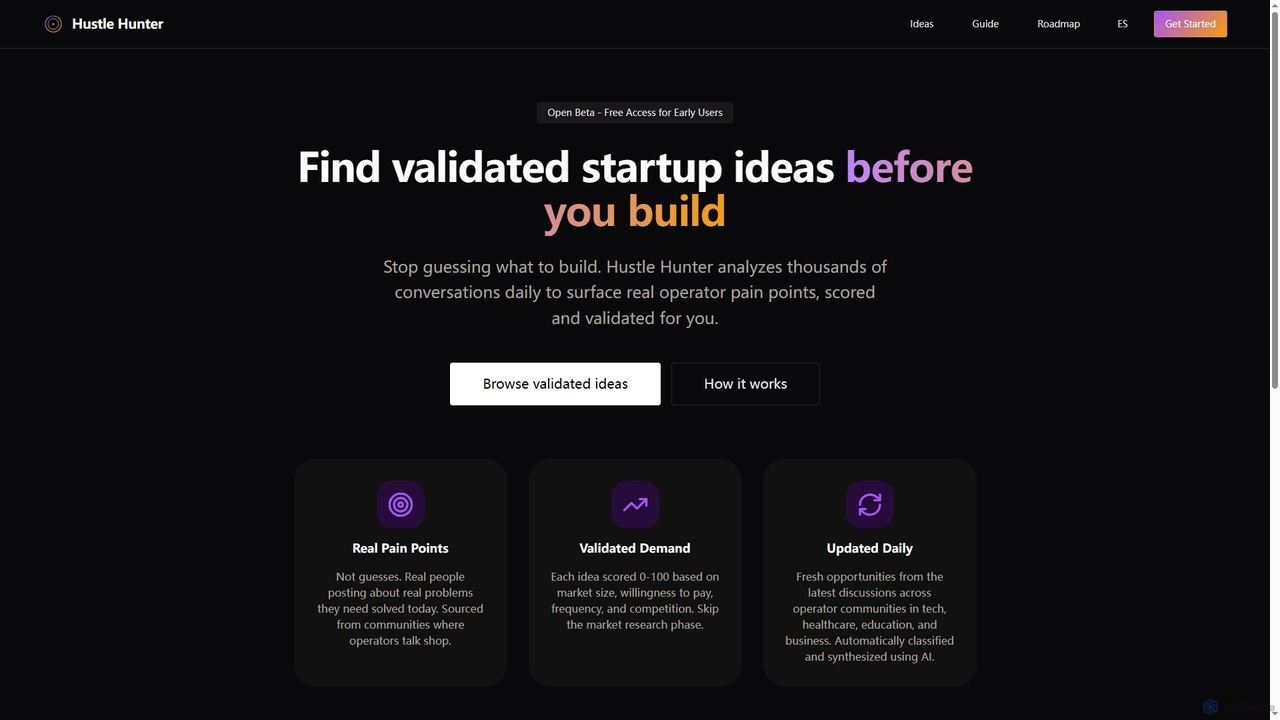
Hustle Hunter is an AI-powered platform designed for solo founders to discover validated startup ideas. It analyzes thousands of online conversations daily to identify real operator pain points, scoring them based on market size, willingness to pay, frequency, and competition, helping entrepreneurs build solutions with confirmed demand.
Startup Ideas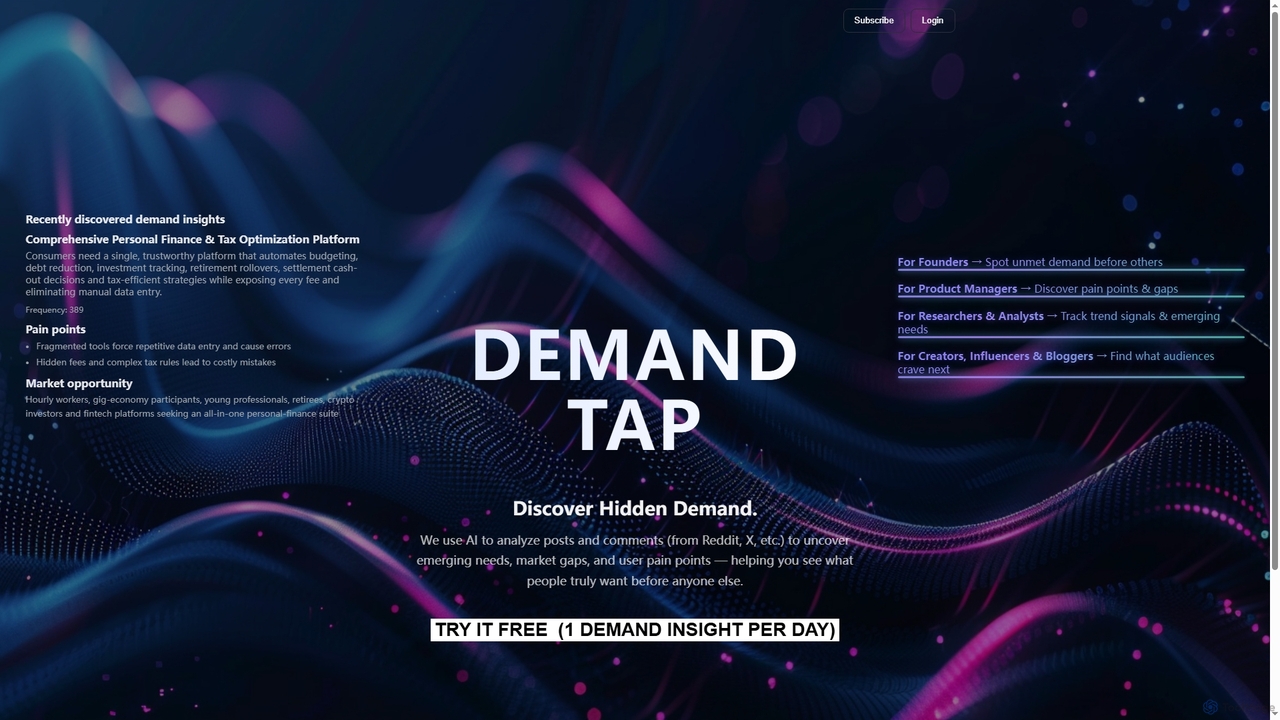
Demand Tap is an AI-powered market research tool that analyzes social media conversations from platforms like Reddit and X to uncover emerging consumer needs, market gaps, and user pain points, helping users discover what people truly want.
Startup Ideas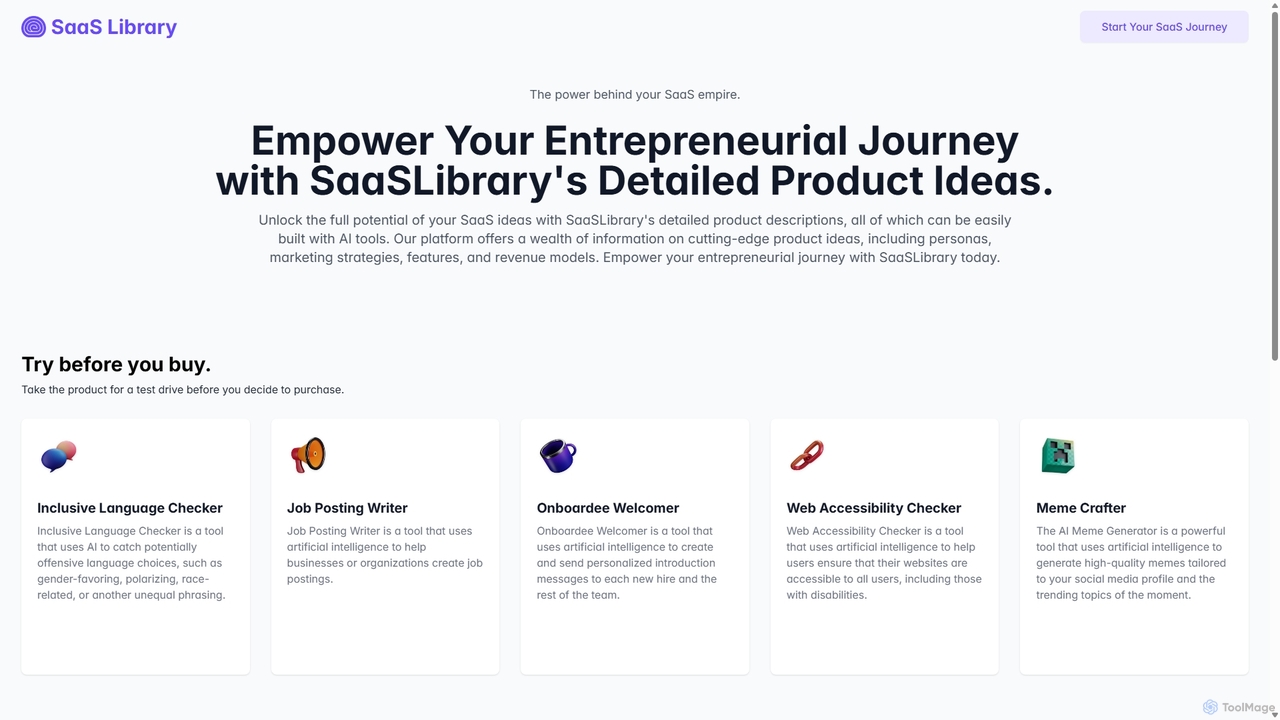
SaaS Library is a comprehensive database for entrepreneurs and product managers, offering over 100 detailed SaaS product ideas. Each idea includes target personas, feature recommendations, market analysis, and revenue models. It also features a suite of AI-powered micro-tools to accelerate your SaaS journey from concept to launch.
Startup Ideas
IdeasAI is a database of startup ideas generated by AI and curated by human votes. It's designed for entrepreneurs, indie hackers, and creators looking for their next big project, offering a massive, ever-growing list of concepts to spark innovation.
Startup IdeasAI Startup Ideas tools are a class of platforms designed to generate, analyze, and refine business concepts using artificial intelligence. They leverage large language models and market data analysis to identify potential niches, user pain points, and innovative business models. These tools are valuable for aspiring entrepreneurs, product managers, and innovators looking to overcome creative blocks and discover data-driven market opportunities. Unlike traditional brainstorming, they provide structured suggestions, initial competitive analysis, and frameworks for early-stage validation.
These tools are primarily used by individuals at the very beginning of the entrepreneurial journey, including aspiring founders, students in business programs, and freelancers seeking new ventures. Corporate innovation teams also use them to brainstorm new product lines or services within the broader Business context, accelerating the ideation phase before committing resources.
When selecting an AI Startup Ideas tool, consider the quality and recency of its underlying data sources. Evaluate the level of customization available for inputs, such as industry, budget, and personal skills. Assess the depth of the analysis provided—does it only offer an idea, or does it include competitive insights and a basic business canvas? Finally, consider the output format and whether it can be easily exported or integrated with other business planning tools.
An individual with a background in marketing but no specific business idea wants to start their own venture. They use an AI Startup Ideas tool, inputting their skills ('digital marketing', 'content creation'), interests ('sustainability', 'pet care'), and a modest initial budget. The tool generates a list of 20 potential business concepts, including 'a subscription box for eco-friendly pet toys' and 'a niche marketing agency for sustainable brands'. Each idea comes with a brief analysis of the target audience, potential competition, and suggested revenue models, providing a concrete starting point for further research.
A software developer has a hunch for a new SaaS tool for independent authors to manage their book launch promotions. Before investing months in development, she uses an AI idea tool to validate the concept. She inputs the core problem: 'authors struggle to coordinate marketing across multiple platforms'. The AI analyzes market trends, existing competitors, and online discussions. It confirms the pain point is significant and suggests key features like a social media scheduler, an email campaign template builder, and a review request tracker. This data-driven validation gives her the confidence to proceed and helps prioritize the feature roadmap.
A product innovation team at a large retail company is tasked with exploring new digital services. Instead of traditional workshops, they use an AI Startup Ideas tool to accelerate brainstorming. They input their company's core assets ('large customer database', 'physical store network') and strategic goals ('increase customer engagement'). The AI generates ideas like 'a personalized shopping assistant app that integrates with in-store beacons' and 'a local delivery subscription service leveraging existing logistics'. This approach helps the team quickly move from broad goals to specific, actionable concepts, saving weeks of ideation time.
A content creator specializing in entrepreneurship needs fresh topics for their blog and YouTube channel. They use an AI Startup Ideas tool not to start a business, but for content inspiration. By querying for 'startup ideas in the creator economy' or 'AI-powered business ideas for 2025', they generate dozens of unique angles. They can then create content like 'Top 5 AI Tools to Find Your Next Business Idea' or 'We Analyzed 100 AI-Generated Startups: Here's What We Learned'. This provides valuable, engaging content for their audience while showcasing their expertise in emerging business trends.
In an entrepreneurship course, a professor assigns students to develop a business concept. To foster creativity and data-driven thinking, the professor has the class use an AI Startup Ideas tool. Students can input their passions and academic backgrounds to generate initial concepts. They then use the tool's analysis features to evaluate market size and competition, learning key business validation principles in a hands-on, interactive way. This modern approach to business education makes the process of ideation less intimidating and more grounded in real-world data.
A full-time employee wants to build a source of passive income but lacks the time for extensive market research. They turn to an AI Startup Ideas tool, specifically filtering for 'low-code', 'automated', and 'micro-SaaS' concepts. The tool suggests ideas like 'an AI-powered tool to generate alt text for images for bloggers' or 'a simple subscription tracker for personal finance'. These ideas are scoped to be manageable as a side project, require minimal ongoing maintenance, and target a clear, niche audience, making them ideal for someone looking to start small.
AI Startup Ideas tools are specialized software platforms that use artificial intelligence, particularly large language models and data analysis, to generate and evaluate new business concepts. They help users overcome creative blocks by providing a structured list of potential ventures based on inputs like industry, user skills, and market trends. Beyond simple ideation, many of these tools also offer initial market analysis, competitive insights, and potential business models to help validate the feasibility of an idea.
Choosing the right tool depends on your specific needs. Consider these factors:
AI Startup Ideas tools generate concepts by combining and re-contextualizing vast amounts of data from existing businesses, market trends, and user needs. While they may not produce an idea that is absolutely unprecedented in human history, their strength lies in identifying unique intersections and underserved niches that a human might overlook. They can connect a problem in one industry with a solution from another, or identify a new target audience for an existing business model. The value is often in the novelty of the combination and the data-driven validation, rather than pure, abstract invention.
They serve different stages of the entrepreneurial process. An AI Startup Idea tool focuses on the very beginning: the 'what' and 'why'. Its purpose is to generate and validate the core concept of the business. A business plan generator, on the other hand, focuses on the 'how'. It takes an already-formed idea and helps structure it into a formal document covering financials, marketing strategy, operations, and team structure. You would typically use an idea tool first, and once you've settled on a promising concept, you would then use a business plan generator to detail your execution strategy.
A wide range of individuals and teams can benefit from these tools. This includes: