ToolMage
Sign in

Best 1 Voice Of Customer (Voc) AI tools for Business

Popular Voice Of Customer (Voc) AI tools in Business include Enterpret, helping you work more efficiently.

Enterpret
Paid

Enterpret

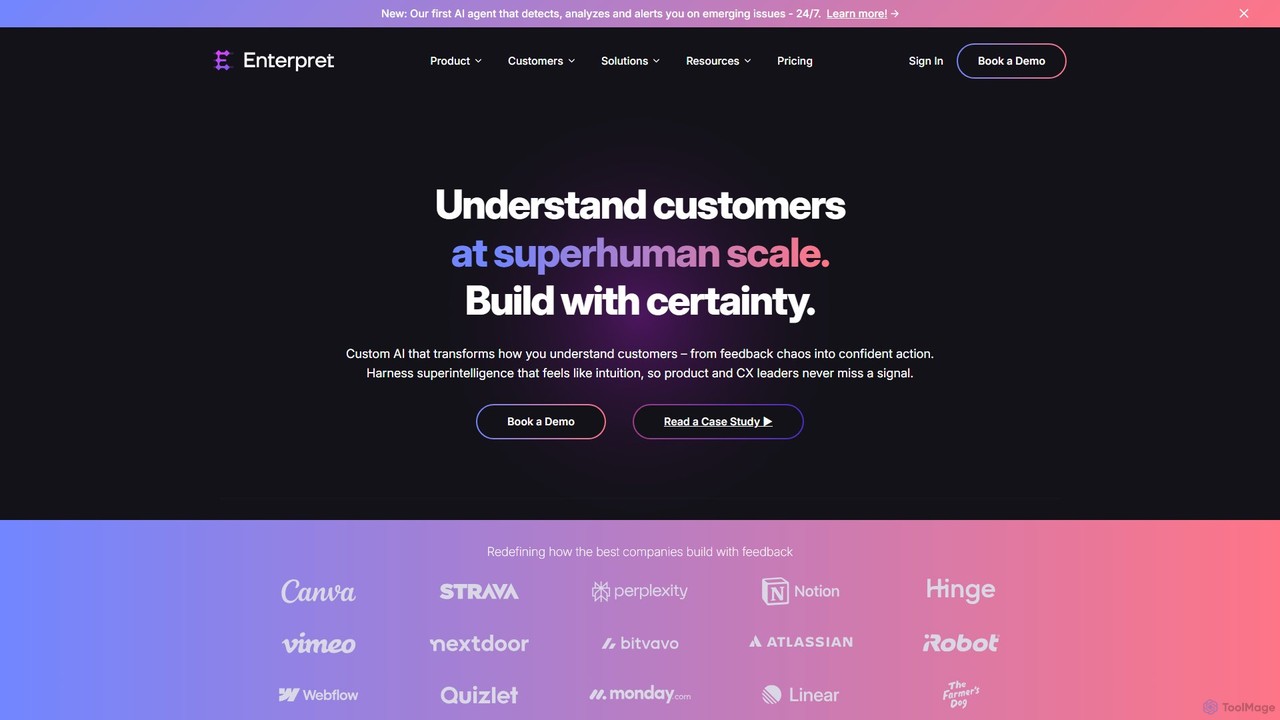
Enterpret is an AI-powered customer feedback intelligence platform that unifies feedback from all channels. It helps product and CX teams analyze qualitative data at scale, uncover actionable insights, and build products with certainty by understanding the true voice of the customer.

Customer Support
Visits 37.7KFavorites 156Likes 139

About Voice Of Customer (Voc)

Voice of Customer (VoC) tools are AI-powered platforms designed to systematically collect, analyze, and report on customer feedback from multiple channels. These tools use Natural Language Processing (NLP) to perform sentiment analysis, topic extraction, and trend identification on unstructured data like reviews, surveys, and social media posts. By centralizing and interpreting customer feedback, businesses gain deep insights to improve products, enhance customer experiences, and make data-driven strategic decisions. They effectively transform raw customer opinions into actionable business intelligence.

Core Features

  • Multi-Channel Data Aggregation: Gathers feedback from diverse sources like reviews, social media, surveys, and support tickets.
  • AI-Powered Sentiment Analysis: Automatically classifies customer feedback as positive, negative, or neutral.
  • Topic & Theme Extraction: Identifies recurring topics, keywords, and key issues mentioned by customers.
  • Insight Dashboards & Reporting: Visualizes feedback trends, sentiment scores, and key metrics in real-time.
  • Automated Alerts & Routing: Notifies relevant teams about critical feedback or emerging negative trends for prompt action.

Use Cases

VoC tools are crucial for product managers prioritizing feature development, customer experience (CX) teams identifying service pain points, and marketing teams understanding brand perception. For instance, an e-commerce company can analyze product reviews to discover common complaints about shipping or product quality, enabling targeted improvements.

How to Choose

When selecting a VoC tool, consider the range of data sources it supports and its integration capabilities with your existing systems (e.g., CRM, helpdesk). Evaluate the sophistication of its AI analysis, including the accuracy of its sentiment and topic modeling. Also, assess the customizability of its dashboards and reporting features to ensure they align with your business KPIs and provide clear, actionable insights.

Voice Of Customer (Voc) use cases

1

Prioritizing Product Feature Development

Product managers use VoC tools to aggregate feature requests and complaints from support tickets, app store reviews, and community forums. The AI categorizes and quantifies this feedback, revealing the most requested features or pressing issues. This data-driven approach allows the product team to prioritize their roadmap based on real user needs, moving beyond guesswork and ensuring development efforts align with customer value, ultimately leading to higher user satisfaction and retention.

2

Improving the Customer Support Experience

Customer support leaders leverage VoC platforms to analyze thousands of support chat transcripts and post-interaction surveys. By applying sentiment and topic analysis, they can pinpoint common friction points in the support process, identify knowledge gaps in their agent training, and track customer satisfaction trends over time. This enables them to proactively address systemic issues, optimize support workflows, and reduce average resolution times, boosting overall customer satisfaction.

3

Monitoring Brand Reputation on Social Media

Marketing and PR teams connect VoC tools to social media platforms like Twitter, Reddit, and Facebook. The system continuously monitors brand mentions, analyzing public sentiment in real-time. This allows teams to quickly detect and respond to potential PR crises, identify brand advocates, and understand public perception of marketing campaigns. Automated alerts for sharp negative sentiment spikes enable rapid intervention and reputation management.

4

Enhancing the E-commerce Customer Journey

An e-commerce manager uses a VoC tool to analyze on-site survey responses, post-purchase feedback, and product reviews. The tool might reveal that customers frequently complain about a confusing checkout process or unclear product descriptions. Armed with these specific insights, the manager can make targeted website improvements, A/B test solutions, and measure the impact on conversion rates and customer satisfaction, directly linking customer feedback to revenue growth.

5

Validating New Market Entry Strategies

A strategy team considering expansion into a new region uses a VoC tool to analyze public reviews and social media conversations about competitors in that market. The analysis reveals unmet customer needs, common complaints about existing products, and local preferences. This intelligence helps the team validate their market-fit assumptions, tailor their product offering, and craft a more effective market entry strategy, reducing risk and accelerating growth.

6

Reducing Customer Churn with Proactive Insights

A customer success team in a SaaS company uses a VoC platform to analyze feedback from low-NPS survey responses, cancellation reason forms, and support tickets from at-risk accounts. The AI identifies leading indicators of churn, such as complaints about specific features or pricing concerns. This allows the team to proactively engage these customers with targeted solutions, offer training, or adjust their plans, thereby reducing churn rates and improving long-term customer value.

Voice Of Customer (Voc) FAQ

What is a Voice of Customer (VoC) tool?

A Voice of Customer (VoC) tool is a software platform that automates the process of collecting, analyzing, and acting on customer feedback. It aggregates data from various sources like surveys, reviews, social media, and support tickets. Using AI technologies like Natural Language Processing (NLP), it analyzes this data for sentiment, topics, and trends, transforming unstructured customer comments into structured, actionable insights for business improvement.

How do I choose the right VoC tool?

To choose the right VoC tool, evaluate these key factors:

  • Data Sources: Ensure it integrates with all the channels where your customers provide feedback (e.g., email, social media, review sites, CRM).
  • Analysis Capabilities: Assess the depth of its AI analysis, including sentiment accuracy, topic modeling, and predictive insights.
  • Integration: Check its ability to connect with your existing tech stack, such as Slack, Jira, or Salesforce, for seamless workflows.
  • Reporting & Visualization: The tool should offer customizable dashboards that make it easy to understand trends and share insights across teams.
What's the difference between VoC tools and survey tools?

The primary difference is scope and analysis. Traditional survey tools are primarily for collecting structured feedback (e.g., ratings, multiple-choice questions). Voice of Customer (VoC) tools go much further: they aggregate feedback from many sources (including surveys) and specialize in analyzing unstructured, open-ended text using AI to uncover sentiment, themes, and root causes that simple survey tools cannot.

Who in a company typically uses VoC tools?

VoC tools are used by various teams across an organization. Product managers use them to guide roadmaps, customer experience (CX) teams to identify and fix service gaps, marketing teams to monitor brand health and campaign feedback, and support teams to improve agent performance and processes. Executive leadership also uses the high-level insights for strategic planning.

What are the main benefits of using a VoC program?

The main benefits include making data-driven decisions instead of relying on assumptions, improving customer retention by proactively addressing issues, and enhancing product development by aligning it with user needs. A successful VoC program also helps increase customer loyalty and provides a clear competitive advantage by fostering a customer-centric culture throughout the organization.