ToolMage
Sign in

Best 2 Certification AI tools for Career

Popular Certification AI tools in Career include PMI and dropoutdeveloper, helping you work more efficiently.

PMI
Freemium

PMI

The Project Management Institute (PMI) is the world's leading authority for project management professionals. It offers globally recognized certifications like PMP®, professional development resources, and a vast community network. PMI empowers individuals and organizations to excel by providing standards, research, education, and networking opportunities, with a growing focus on modern practices like Agile and AI project management.

Certification
Visits 4.6MFavorites 109Likes 127
dropoutdeveloper
Freemium

dropoutdeveloper

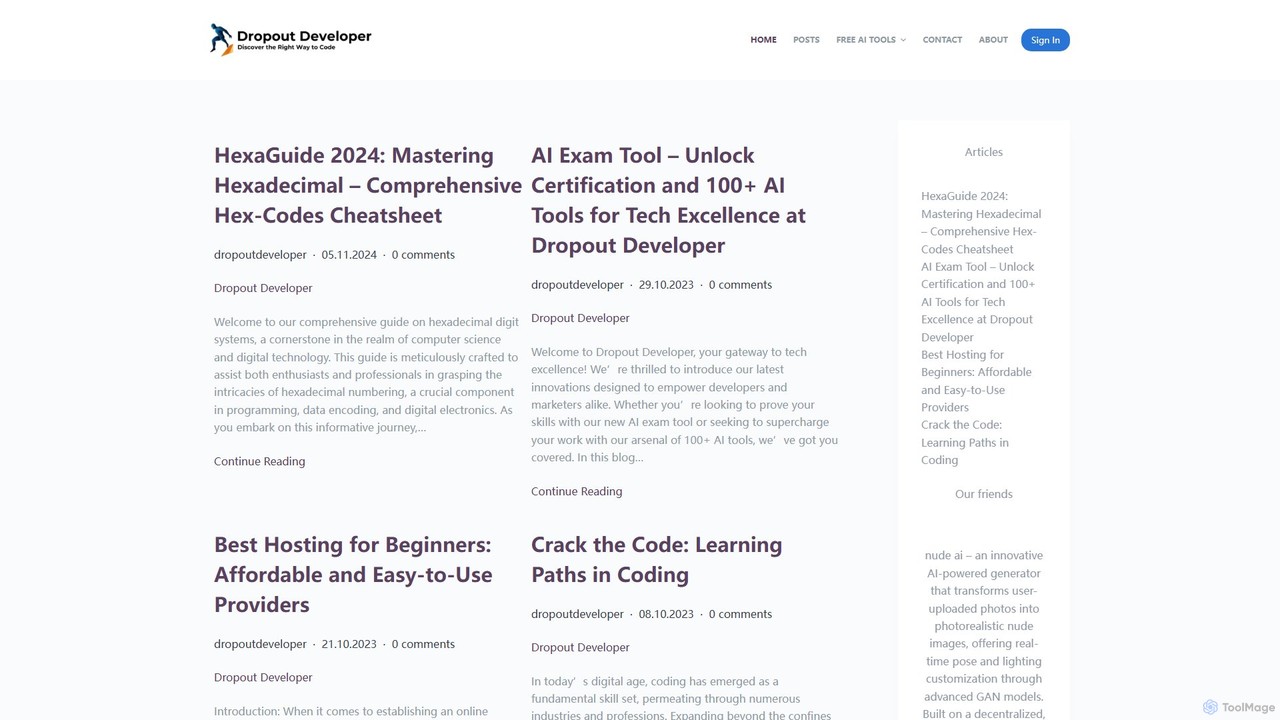
Dropout Developer is a comprehensive platform for developers and tech enthusiasts, offering a curated collection of over 100 AI-powered coding tools, an innovative AI Exam Tool for skill certification, and extensive educational resources. It's designed to accelerate learning, enhance productivity, and help users master new technologies and coding principles through practical tools and expert-led guides.

Certification
Visits 4.3KFavorites 119Likes 126

About Certification

AI Certification tools are platforms that leverage artificial intelligence to create, manage, and deliver professional certification programs. They utilize AI algorithms for generating adaptive assessments, creating personalized learning paths, and providing automated proctoring to ensure the integrity and effectiveness of the credentialing process. These tools help organizations and educational institutions validate skills, track professional development, and maintain industry standards at scale. Their primary advantage lies in offering secure, data-driven, and highly personalized certification experiences that go beyond traditional online learning.

Core Features

  • Adaptive Assessment Engine: Automatically adjusts the difficulty and content of exam questions based on a candidate's real-time performance.
  • AI-Powered Proctoring: Employs facial recognition, audio monitoring, and behavior analysis to detect and prevent cheating during remote exams.
  • Personalized Learning Paths: Analyzes a user's knowledge gaps and recommends specific modules or resources to prepare them for certification.
  • Automated Question Generation: Creates a large bank of unique, high-quality exam questions from existing content, reducing manual effort.
  • Secure Digital Credentialing: Issues verifiable digital badges and certificates that can be easily shared and authenticated online.

Applicable Scenarios

These tools are widely used by professional associations for member credentialing, technology companies for product expertise certification, and universities for offering specialized micro-credentials. They are also essential for corporate L&D departments to manage internal compliance training and employee upskilling programs.

Selection Criteria

When choosing an AI Certification tool, evaluate the sophistication of its AI features, particularly in assessment and proctoring. Consider its integration capabilities with your existing Learning Management System (LMS) or HRIS. Also, assess its security protocols, data privacy compliance (e.g., GDPR, CCPA), and the depth of its analytics and reporting features.

Featured tool rankings

Certification use cases

1

Automating Corporate Software Certification

A global software company needs to certify thousands of partners and developers on its new platform. Using an AI Certification tool, their training department uploads technical documentation. The AI automatically generates a comprehensive question bank covering various difficulty levels. Partners can take the exam remotely, with AI-powered proctoring monitoring the session for integrity. Upon passing, they instantly receive a verifiable digital badge, reducing the certification lifecycle from weeks to days and ensuring a consistent standard of expertise across their entire partner ecosystem.

2

Scaling Professional Association Credentialing

A national nursing association must provide continuing education and recertification for over 50,000 members. They implement an AI Certification platform that creates personalized learning paths for each nurse based on their specialty and past exam performance. The system identifies knowledge gaps and suggests relevant courses. This adaptive approach not only makes studying more efficient but also ensures members are up-to-date on the latest medical standards, ultimately improving patient care and upholding the association's professional credibility.

3

Issuing University Micro-Credentials

A university's business school wants to offer in-demand micro-credentials for skills like 'Digital Marketing Analytics'. They use an AI Certification platform to design and deliver the final assessment. The platform provides simulation-based questions that test practical skills, not just theoretical knowledge. After successful completion, students are awarded a secure digital badge they can add to their LinkedIn profiles, providing employers with verifiable proof of their specific competencies and enhancing their job market competitiveness.

4

Managing Employee Compliance Training

A financial services firm with a global workforce must ensure all employees complete mandatory annual compliance training. An AI Certification tool automates this process. It enrolls employees, tracks their progress, and administers the final test. The AI proctoring feature ensures that employees complete the assessment themselves, providing an auditable record for regulators. The platform's dashboard gives HR and compliance officers a real-time view of completion rates and identifies departments that may require additional follow-up.

5

Standardizing Franchise Operations Training

A fast-growing restaurant chain needs to ensure consistent quality and operational standards across hundreds of franchise locations. They deploy an AI Certification platform to train and certify new store managers. The curriculum includes interactive modules on food safety, customer service, and inventory management. The final certification exam uses AI to present scenario-based questions, testing a manager's decision-making skills in realistic situations. This ensures every manager meets the brand's high standards before opening a new store.

6

Validating Technical Skills for Recruitment

An IT recruitment agency needs a reliable way to assess the coding skills of job candidates before presenting them to clients. They integrate an AI Certification platform into their screening process. Candidates are sent a link to an adaptive coding test that adjusts in difficulty based on their answers. The platform automatically grades the code for efficiency and correctness, providing the agency with an objective, data-backed report on each candidate's technical proficiency. This saves clients' time in the interview process and increases the quality of hires.

Certification FAQ

What are AI Certification tools?

AI Certification tools are specialized software platforms designed to create, administer, and manage professional certification programs using artificial intelligence. Unlike simple quiz makers, they employ AI for advanced functions like generating adaptive exams that adjust to the user's skill level, providing automated remote proctoring to ensure exam integrity, and creating personalized study plans. They are primarily used by organizations to issue high-stakes, verifiable credentials that validate specific knowledge or skills.

How do AI Certification tools differ from a standard LMS?

The primary difference lies in their core purpose. A Learning Management System (LMS) is focused on delivering and managing educational content and courses. An AI Certification tool is focused on assessment and validation of knowledge with high integrity. Key differentiators include:

  • Assessment Focus: Certification tools have sophisticated engines for creating secure, high-stakes exams, often with AI-generated questions and adaptive testing.
  • Proctoring: They typically include AI-powered or live proctoring to prevent cheating, a feature rarely found in standard LMSs.
  • Verifiable Credentials: They specialize in issuing secure, shareable digital badges or certificates to prove accomplishment.
While an LMS manages the learning journey, an AI Certification tool validates the outcome.

What are the main benefits of using AI in the certification process?

Integrating AI into the certification process offers several significant benefits. First, it enhances security and credibility through automated proctoring, which can detect cheating behaviors more effectively and at a larger scale than human proctors alone. Second, it enables personalization through adaptive testing, making assessments more efficient and accurate by tailoring questions to each candidate's ability. Third, it improves operational efficiency by automating tasks like question generation and grading. Finally, it provides deep data analytics, offering insights into learner performance and identifying common knowledge gaps across an organization.

Who are the typical users of AI Certification tools?

AI Certification tools are used by a wide range of organizations that need to formally validate skills and knowledge. Key users include:

  • Professional Associations: To certify members and maintain industry standards (e.g., in medicine, finance, or engineering).
  • Corporations: For customer and partner product training, as well as internal employee upskilling and compliance certification.
  • IT and Software Companies: To issue technical certifications that validate expertise in their products and platforms.
  • Educational Institutions: To offer specialized certificates and micro-credentials that complement traditional degrees.

How should I choose an AI Certification tool for my organization?

When selecting an AI Certification tool, focus on four key areas. First, evaluate the assessment capabilities: does it support various question types, adaptive testing, and simulations? Second, scrutinize the proctoring technology: assess the reliability of its AI-powered monitoring and whether it offers options for human review. Third, check for integration options with your existing systems, such as your LMS or HR software. Finally, review its security and compliance standards to ensure it protects user data and meets industry regulations. Also consider the quality of its analytics and reporting to track learner progress effectively.