
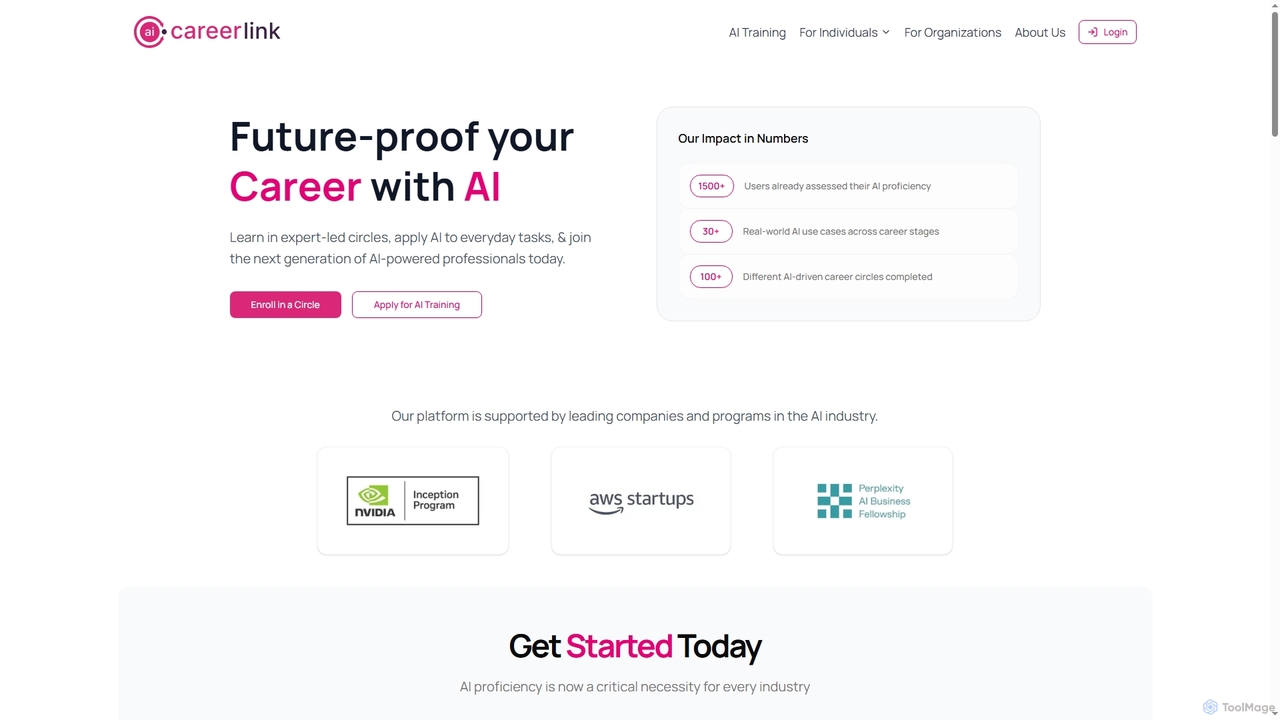
Careerlink
Careerlink is an AI-powered platform designed to future-proof careers by equipping professionals, students, and organizations with essential AI …
Careerlink is an AI-powered platform designed to future-proof careers by equipping professionals, students, and organizations with essential AI skills. It offers personalized career guidance, expert-led training circles for real-world AI applications, and curated AI tools to enhance productivity and innovation across various industries.
About Ai Training
AI Training tools are specialized online platforms and resources designed to teach artificial intelligence skills for career development. They provide structured learning experiences, from foundational concepts to advanced specializations like machine learning and data science. These tools are essential for individuals seeking to enter the AI field or professionals aiming to upskill in an increasingly automated world. They bridge the gap between theoretical knowledge and practical application through hands-on projects and interactive environments.
Core Features
- Interactive Coding Environments: Practice coding in languages like Python directly in the browser without complex setup.
- Structured Learning Paths: Follow guided curricula tailored for specific career goals, such as Machine Learning Engineer or Data Analyst.
- Real-World Projects: Build a professional portfolio by completing projects based on industry-relevant challenges.
- Expert-Led Instruction: Learn from video lectures and tutorials created by leading academics and industry practitioners.
- Skill Assessments & Certifications: Validate your knowledge through quizzes and exams to earn shareable certificates.
Use Cases
These tools are ideal for students, career changers, software developers transitioning into AI, and data analysts looking to deepen their machine learning knowledge. Companies also use these platforms for corporate training programs to upskill their workforce and stay competitive in the AI era.
How to Choose
When selecting an AI Training tool, evaluate the curriculum's depth and relevance to your career goals. Consider the quality of instructors, the availability of hands-on projects, the value of the certification in the job market, and the platform's community and support features for learners.
Ai TrainingUse Cases
Building Foundational Skills for a Data Science Career
A recent university graduate with a background in mathematics wants to become a Data Scientist. They use an AI Training platform to enroll in a 'Data Scientist Career Path'. The path starts with Python programming fundamentals, moves to data analysis with libraries like Pandas and NumPy, and then covers core machine learning algorithms. Through interactive exercises and guided projects, such as analyzing customer churn, they build practical skills and a portfolio to showcase to potential employers.
Upskilling from Software Engineer to MLOps Specialist
An experienced software engineer wants to specialize in Machine Learning Operations (MLOps). They already know how to code but need to understand the full lifecycle of deploying and maintaining ML models. They select an advanced course on an AI Training platform focusing on topics like CI/CD for machine learning, model monitoring, and containerization with Docker. The course's final project involves building a scalable deployment pipeline for a pre-trained model, giving them the hands-on experience needed for MLOps roles.
Corporate Training for a Data-Driven Marketing Team
A company's marketing department needs to leverage AI for better campaign performance. The marketing manager arranges a corporate training plan through an AI Training platform. The curriculum is customized to focus on practical applications like customer segmentation using clustering algorithms, sentiment analysis of social media feedback, and predictive analytics for sales forecasting. The team learns through a mix of video lectures and collaborative projects, enabling them to apply these new AI skills directly to their marketing strategies.
Learning AI Concepts for Product Management
A product manager working at a tech company needs to better understand AI to effectively lead the development of AI-powered features. They enroll in a non-technical 'AI for Product Managers' course. The course explains core concepts like machine learning, neural networks, and APIs in an accessible way, without requiring coding. They learn how to identify opportunities for AI, write product requirements for AI features, and understand the data needed to train models. This knowledge helps them communicate more effectively with the engineering team and make better strategic product decisions.
Preparing for AI Competitions and Hackathons
A computer science student wants to participate in online AI competitions like those on Kaggle. To prepare, they use an AI Training platform that offers advanced datasets and problem sets similar to real competitions. They focus on courses covering feature engineering, model ensembling, and hyperparameter tuning techniques. The platform's community forums allow them to discuss strategies with other aspiring competitors. By working through these challenging projects, they sharpen their modeling skills and improve their chances of ranking high in actual competitions.
Acquiring a Niche Skill in Natural Language Processing (NLP)
A freelance web developer wants to expand their services to include building custom chatbots. They need to learn Natural Language Processing (NLP). They find a specialization track on an AI Training platform dedicated to NLP. The courses cover text preprocessing, sentiment analysis, and building models with frameworks like TensorFlow or PyTorch. The final project requires them to build and train a functional chatbot for a specific use case, such as customer service. After completing the certification, they can confidently market this new, high-demand skill to clients.