ToolMage
Sign in

Best 1 Job Matching AI tools for Career Development

Popular Job Matching AI tools in Career Development include CareerScalar, helping you work more efficiently.

CareerScalar
Freemium

CareerScalar

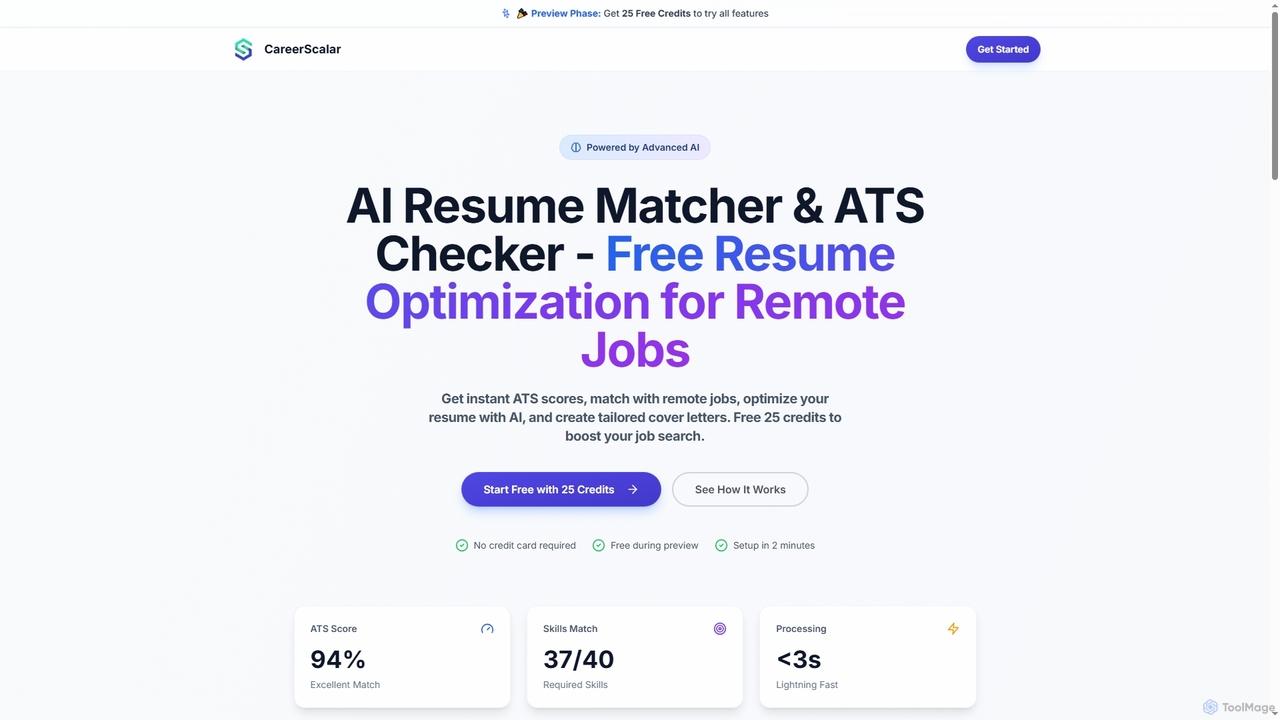
CareerScalar is an advanced AI-powered platform designed to revolutionize your job search. It offers an AI resume matcher, ATS checker, and optimization tools to help job seekers land remote positions faster. Users can get instant ATS scores, tailor resumes with AI, generate cover letters, and find perfectly matched remote jobs, starting with 25 free credits.

Job Matching
Visits 5.4KFavorites 125Likes 123

About Job Matching

AI-powered Job Matching tools are designed to connect job seekers with suitable employment opportunities by leveraging advanced algorithms. These tools utilize natural language processing (NLP) and machine learning to meticulously analyze resumes, job descriptions, and candidate profiles, going beyond simple keyword searches. This enables more precise and efficient recommendations, significantly reducing the time and effort for both recruiters and applicants within the broader career development landscape. By identifying key skills, experience, and even cultural fit, these platforms enhance the quality of matches, streamline the hiring process, and foster better long-term employment relationships.

Core Features

  • Automated Resume Analysis: Extracts and categorizes skills, experience, and qualifications from candidate resumes, converting unstructured data into actionable insights.
  • Intelligent Job Recommendation: Suggests highly relevant job postings based on individual candidate profiles, career history, and expressed preferences, often learning from user interactions.
  • Candidate Scoring & Ranking: Ranks applicants according to their alignment with specific job requirements, desired competencies, and organizational culture, providing objective evaluations.
  • Skill Gap Identification: Highlights missing skills required for desired roles or career progression, offering insights for targeted training and professional development paths.
  • Bias Reduction Mechanisms: Employs techniques to minimize human bias in the initial candidate screening and selection process, promoting fairer and more diverse hiring outcomes.

Applicable Scenarios

These tools are invaluable for corporate recruiters managing large applicant pools, enabling them to quickly identify top talent and reduce time-to-hire. Individual job seekers benefit from personalized job alerts that align precisely with their career goals and skill sets, cutting through the noise of generic job boards. Furthermore, HR departments can leverage these platforms to optimize internal talent mobility, matching existing employees with new opportunities for growth within the organization, thereby fostering retention and development.

How to Choose

When selecting an AI Job Matching tool, prioritize its matching accuracy and the precision of its underlying algorithms in connecting truly relevant profiles. Evaluate its integration capabilities with your existing HRIS or Applicant Tracking System (ATS) platforms to ensure seamless workflow and data synchronization. Consider the level of customization options available, allowing you to tailor matching criteria for specific roles, industry nuances, or unique company culture requirements. Finally, assess the overall user experience for both applicants and hiring teams, ensuring intuitive interfaces and efficient navigation.

Job Matching use cases

1

Streamlining Initial Candidate Screening

Corporate recruiters and HR managers often face hundreds of applications for a single job opening, making manual resume review time-consuming and prone to human error. AI Job Matching tools automatically scan and analyze resumes against detailed job descriptions, identifying and ranking top candidates based on skills, experience, and qualifications. This process significantly reduces initial screening time by up to 70%, allowing recruiters to focus their efforts on interviewing only the most qualified individuals.

2

Personalized Job Recommendations for Job Seekers

Individual job seekers are frequently overwhelmed by the sheer volume of job postings on various platforms, many of which are irrelevant to their specific skills or career aspirations. By uploading their resume and specifying preferences into an AI Job Matching platform, users receive highly tailored job suggestions that precisely align with their profile. This enhances the relevance of applications, improves the chances of securing interviews, and reduces the overall frustration associated with a broad job search.

3

Identifying Internal Mobility Opportunities

Large organizations often struggle to efficiently identify and promote internal talent for new roles or projects, leading to missed opportunities for employee growth and increased external hiring costs. Internal HR departments and employee development managers can utilize AI Job Matching tools to analyze employee skill profiles, performance data, and career interests against open internal positions. This fosters employee retention, optimizes talent utilization, and creates clear pathways for career advancement within the company.

4

Enhancing Diversity and Inclusion in Hiring

Traditional hiring processes can inadvertently introduce biases based on factors like names, gender, or educational institutions, limiting the diversity of candidate pools. AI Job Matching platforms can be configured to focus solely on objective skill and experience matching, often with features like resume anonymization during initial screening. This approach broadens the candidate pool, helps identify qualified individuals from underrepresented groups, and promotes fairer, more equitable hiring practices across the organization.

5

Skill-Based Talent Acquisition for Niche Roles

Recruiting for highly specialized or emerging technology roles requires precise skill matching that goes beyond generic job titles or industry experience. Specialized recruiters and tech hiring managers leverage AI tools to deeply analyze candidate portfolios, project contributions, and specific technical proficiencies against complex niche requirements. This accelerates the recruitment of hard-to-find talent by accurately identifying candidates with exact skill sets, even if their traditional job titles don't immediately reflect their capabilities.

6

Career Pathing and Skill Gap Analysis

Individuals seeking career advancement or a transition into a new field often lack clarity on the specific skills required for their desired roles. Career counselors and learning & development teams can use AI Job Matching tools to compare a user's current skill set against the requirements of target positions. The tool then highlights specific skill gaps, providing clear, actionable insights for professional development, guiding individuals towards relevant training, certifications, or educational programs to achieve their career goals.

Job Matching FAQ

What are AI Job Matching tools?

AI Job Matching tools are software applications that use artificial intelligence, primarily machine learning and natural language processing, to intelligently connect job seekers with suitable employment opportunities. They analyze vast amounts of data from resumes, job descriptions, and candidate preferences to provide highly relevant matches, streamlining the recruitment process for both employers and individuals.

How do I choose the best AI Job Matching tool for my needs?

To choose the best tool, consider its matching accuracy and the sophistication of its algorithms in identifying relevant candidates or jobs. Evaluate its integration capabilities with your existing HR systems (ATS, HRIS) for seamless data flow. Look for customization options to define specific matching criteria, and assess the user experience for ease of navigation and efficiency. Finally, consider the tool's ability to mitigate bias and ensure fair hiring practices.

What are the main benefits of using AI for job matching?

The main benefits include significantly increased efficiency in the hiring process, as AI can quickly screen and rank thousands of applications. It enhances matching accuracy by identifying subtle correlations between skills and job requirements, leading to better candidate quality. AI also helps reduce human bias, promotes diversity, and offers a more personalized and less frustrating experience for job seekers by presenting highly relevant opportunities.

How do AI Job Matching tools work?

AI Job Matching tools work by ingesting and processing large datasets, including resumes, job descriptions, and market trends. They use natural language processing (NLP) to understand the context and meaning of text, extracting key skills, experiences, and requirements. Machine learning algorithms then compare candidate profiles with job specifications, learning from successful matches over time to refine their recommendations and identify the best fit based on various parameters.

How do AI Job Matching tools differ from traditional job boards?

Traditional job boards primarily serve as passive platforms where users search by keywords and manually apply, while AI Job Matching tools offer active, intelligent matching. AI platforms use algorithms to proactively suggest highly relevant jobs to candidates and vice-versa, often learning from user behavior and preferences. This results in a more personalized experience, higher matching accuracy, and significantly greater efficiency compared to the manual, keyword-driven approach of traditional boards.