
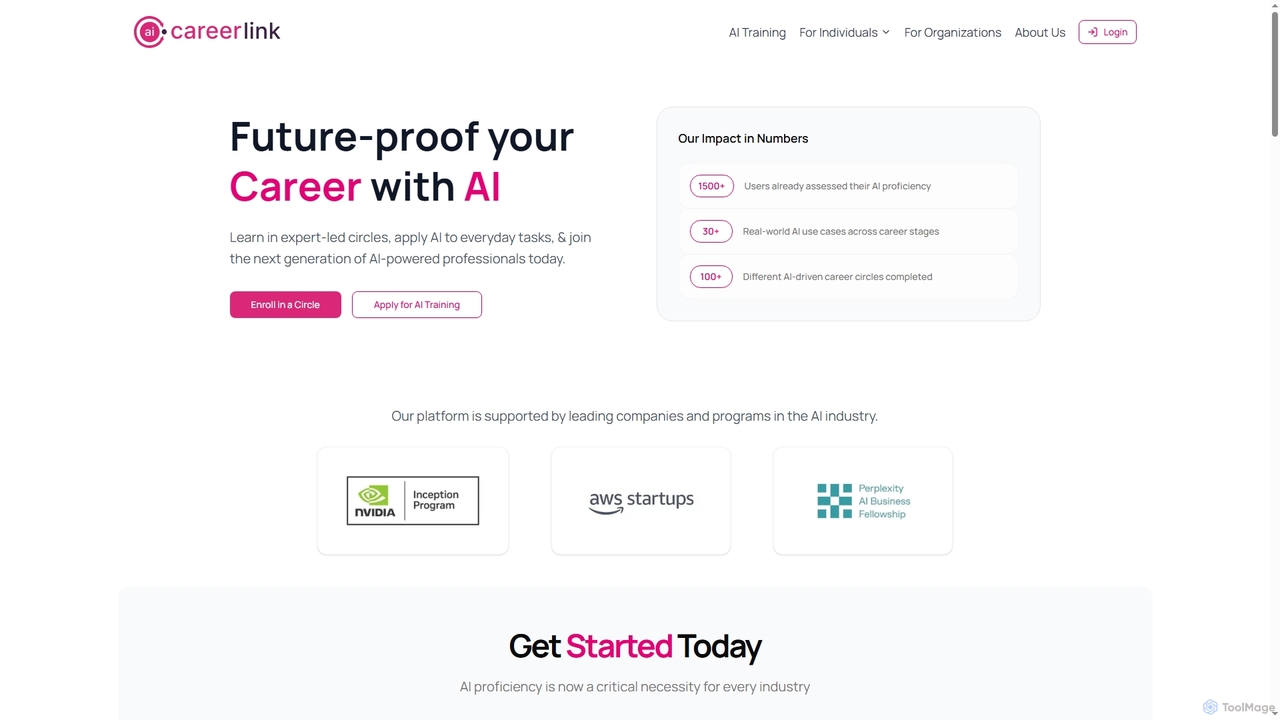
Careerlink
Careerlink is an AI-powered platform designed to future-proof careers by equipping professionals, students, and organizations with essential AI …
Careerlink is an AI-powered platform designed to future-proof careers by equipping professionals, students, and organizations with essential AI skills. It offers personalized career guidance, expert-led training circles for real-world AI applications, and curated AI tools to enhance productivity and innovation across various industries.
About Workforce Upskilling
Workforce Upskilling tools are AI-powered platforms designed to identify, develop, and track employee skills within an organization. They leverage machine learning to analyze individual competencies and business needs, creating personalized learning pathways for continuous professional growth. These tools help businesses close critical skill gaps, adapt to technological changes, and improve employee retention by investing in their workforce's capabilities. They often integrate with existing HR systems to provide a seamless and data-driven development experience.
Core Features
- Skill Gap Analysis: Uses AI to identify discrepancies between an organization's current skills and its future strategic needs.
- Personalized Learning Paths: Automatically generates customized training plans with relevant courses, content, and projects for each employee.
- AI-Powered Content Curation: Discovers and recommends high-quality learning materials from internal and external sources based on skill requirements.
- Performance Analytics: Provides dashboards to track learning progress, skill acquisition, and the overall impact of training initiatives on business goals.
- Career Pathing: Helps employees visualize potential career trajectories within the company and identifies the skills needed to advance.
Applicable Scenarios
These tools are primarily used by Human Resources (HR) and Learning & Development (L&D) departments in mid-to-large enterprises. For instance, a technology firm can use them to retrain engineers on new AI frameworks, or a healthcare organization can upskill clinical staff on new medical technologies and compliance procedures. They are crucial for industries undergoing rapid transformation.
Selection Criteria
When choosing a tool, evaluate its integration capabilities with your existing HRIS and LMS. Assess the quality and breadth of its content library, the sophistication of its skill assessment engine, and the clarity of its analytics and reporting. Also, consider the user experience for both administrators and employees to ensure high adoption rates.
Workforce UpskillingUse Cases
Closing a Tech Skill Gap for a Development Team
A Chief Technology Officer (CTO) needs to migrate their company's infrastructure to a new cloud platform. The Workforce Upskilling tool first assesses the entire development team's proficiency with the target platform, identifying specific knowledge gaps in areas like containerization and serverless functions. Based on this analysis, the AI automatically assigns personalized learning paths to each developer, combining video courses, hands-on labs, and certification prep materials. This targeted approach ensures developers only study what they need to, accelerating the team's readiness for the migration project.
Standardizing the Onboarding of New Sales Hires
A Sales Enablement Manager is tasked with reducing the ramp-up time for new sales representatives. They use an upskilling platform to create a standardized 30-day onboarding program. The AI curates content on product knowledge, sales methodology, and CRM usage. It delivers this content in bite-sized modules and includes interactive role-playing simulations to practice sales pitches. The platform tracks each new hire's progress, automatically flagging areas of weakness to their manager for personalized coaching, ensuring consistent performance across the team.
Developing Future Leaders from Within the Company
An HR Director wants to build a strong internal leadership pipeline. Using an upskilling tool, they launch a high-potential employee development program. The AI analyzes performance reviews and skill assessments to help identify suitable candidates. Once enrolled, these employees receive a personalized curriculum focused on leadership competencies like strategic thinking, financial acumen, and team motivation. The platform also uses AI to suggest optimal mentor-mentee pairings based on skills and career goals, fostering knowledge transfer and preparing the next generation of managers.
Automating and Tracking Mandatory Compliance Training
A Compliance Officer in a financial firm needs to ensure 100% completion of annual anti-money laundering (AML) training for all employees. The upskilling platform automates this entire process. It automatically enrolls all relevant staff, sends periodic reminders to those who haven't completed the course, and escalates to managers if deadlines are missed. The officer can access a real-time dashboard to monitor completion rates across departments and generate audit-ready reports with a single click, saving dozens of administrative hours and ensuring regulatory adherence.
Reskilling Manufacturing Workers for Industry 4.0
A Plant Manager is overseeing the introduction of robotic automation on the assembly line. To avoid layoffs, they use an upskilling platform to reskill the existing workforce. The platform identifies workers whose roles are most affected and delivers a blended learning program. This includes online modules on robotics theory and safety protocols, combined with VR/AR simulations that allow workers to practice operating and maintaining the new machinery in a safe, virtual environment. This proactive approach ensures a smooth transition to automation and empowers employees with valuable new skills.
Fostering a Culture of Self-Directed Learning
An L&D department wants to move from a top-down training model to one that empowers employees to own their development. They deploy an upskilling platform that acts as a 'learning marketplace'. The AI recommends content not only based on an employee's current role but also on their stated career aspirations and skills they've shown interest in. Employees can explore topics outside their immediate job function, from data science to creative writing. This fosters a culture of curiosity and continuous learning, helping the organization stay innovative and adaptable.